
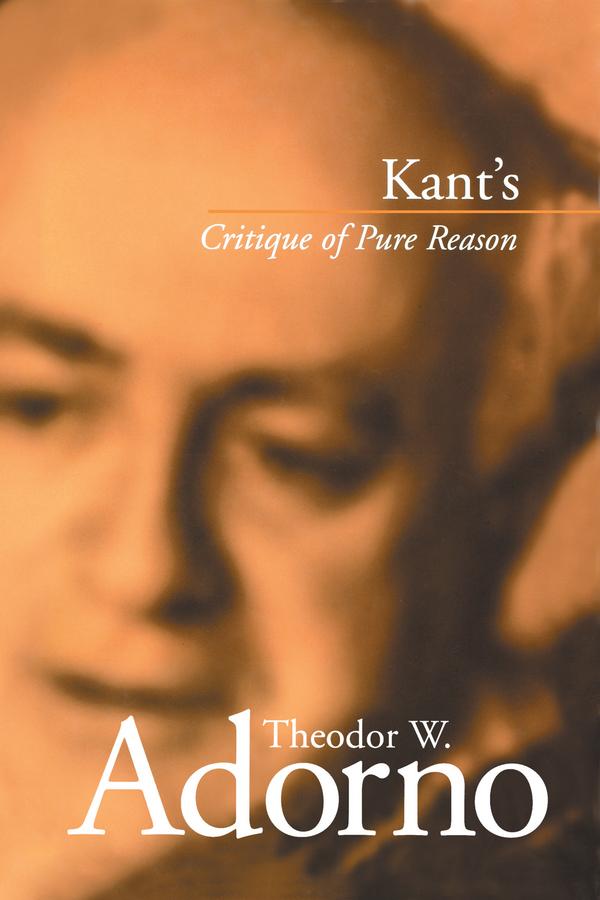
Kant is a pivotal thinker in Adorno's intellectual world. Yet although he wrote monographs on Hegel, Husserl and Kierkegaard, the closest he came to an extended discussion of Kant are two lecture courses, one concentrating on the Critique of Pure Reason and the other on the Critique of Practical Reason. This new volume by Adorno comprises his lectures on the former.
Adorno attempts to make Kant's thought comprehensible to students by focusing on what he regards as problematic aspects of Kant's philosophy. Adorno examines his dualism and what he calls the Kantian 'block': the contradictions arising from Kant's resistance to the idealism that his successors, Fichte, Schelling and Hegel, saw as the inevitable outcome of his ideas. But these lectures also provide an accessible introduction to and rationale for Adorno's own philosophy as expounded in Negative Dialectics and his other major writings. Adorno's view of Kant forms an integral part of his own philosophy, since he argues that the way out of the Kantian contradictions is to show the necessity of the dialectical thinking that Kant himself spurned. This in turn enables Adorno to criticize Anglo-Saxon scientistic or positivist thought, as well as the philosophy of existentialism.
This book will be of great interest to those working in philosophy and in social and political thought, and it will be essential reading for anyone interested in the foundations of Adorno's own work.
Adorno attempts to make Kant's thought comprehensible to students by focusing on what he regards as problematic aspects of Kant's philosophy. Adorno examines his dualism and what he calls the Kantian 'block': the contradictions arising from Kant's resistance to the idealism that his successors, Fichte, Schelling and Hegel, saw as the inevitable outcome of his ideas. But these lectures also provide an accessible introduction to and rationale for Adorno's own philosophy as expounded in Negative Dialectics and his other major writings. Adorno's view of Kant forms an integral part of his own philosophy, since he argues that the way out of the Kantian contradictions is to show the necessity of the dialectical thinking that Kant himself spurned. This in turn enables Adorno to criticize Anglo-Saxon scientistic or positivist thought, as well as the philosophy of existentialism.
This book will be of great interest to those working in philosophy and in social and political thought, and it will be essential reading for anyone interested in the foundations of Adorno's own work.
Zahle einfach mit Karte, Klarna, Apple Pay oder Google Pay. Nicht zufrieden? Du hast immer ein 14-tägiges Widerrufsrecht. Lies mehr in unseren AGB. Hast du Fragen, schreib uns eine E-Mail an hello@memmo.org.
Memmo macht das Lernen einfacher – wo auch immer du bist. Bei uns findest du deine Kursbücher und smarte Lerntools an einem Ort: Zusammenfassungen, Quizzes, Podcasts und Lernkarten. Und Ted, dein Lernbuddy, beantwortet alles, was du wissen möchtest. Über 50.000 Studierende lernen bereits hier – gemacht, damit du schneller lernst und weniger Stress hast.