
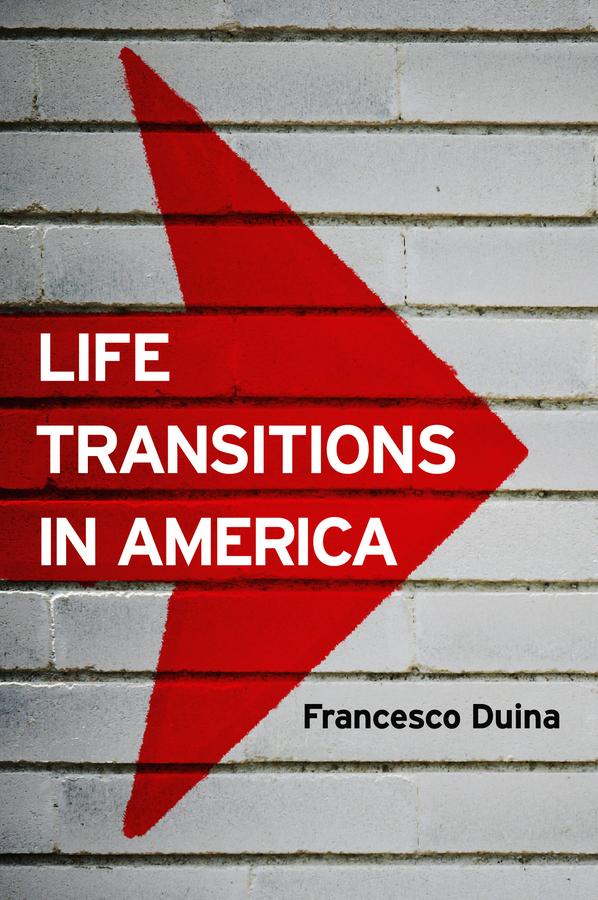
We celebrate, talk about, and worry a great deal about transitions in life. Going to college, having a first child, losing a job, and retiring constitute just a few of the pivotal moments in the lives of many. Sociologists and psychologists have devoted considerable attention to life transitions. Yet we know very little about whether there exists a common thread to our understandings of life transitions in general. How do journalists, leading politicians, sport icons, bestselling authors, government agencies, Hallmark cards, popular TV shows, and other “voices” of popular culture talk about transitions in life? Do these voices provide a coherent picture of how we make sense of life transitions?
In this book, Francesco Duina shows how the dominant American discourse articulates two basic approaches to transitions in life. The first approach depicts transitions as exciting, individualistic opportunities for new beginnings: the past is cast aside, the future is wide open, and the self has the opportunity to recreate itself anew. The second paints transitions as having to do with continuity, our connections to others, and the life-cycle, with an emphasis on acceptance and adaptation. Though contrasting, the two approaches ultimately complement each other. Their analysis reveals a great deal about American culture and society, and will be of great interest to students of the life course and the sociology of culture.
In this book, Francesco Duina shows how the dominant American discourse articulates two basic approaches to transitions in life. The first approach depicts transitions as exciting, individualistic opportunities for new beginnings: the past is cast aside, the future is wide open, and the self has the opportunity to recreate itself anew. The second paints transitions as having to do with continuity, our connections to others, and the life-cycle, with an emphasis on acceptance and adaptation. Though contrasting, the two approaches ultimately complement each other. Their analysis reveals a great deal about American culture and society, and will be of great interest to students of the life course and the sociology of culture.
Zahle einfach mit Karte, Klarna, Apple Pay oder Google Pay. Nicht zufrieden? Du hast immer ein 14-tägiges Widerrufsrecht. Lies mehr in unseren AGB. Hast du Fragen, schreib uns eine E-Mail an hello@memmo.org.
Memmo macht das Lernen einfacher – wo auch immer du bist. Bei uns findest du deine Kursbücher und smarte Lerntools an einem Ort: Zusammenfassungen, Quizzes, Podcasts und Lernkarten. Und Ted, dein Lernbuddy, beantwortet alles, was du wissen möchtest. Über 50.000 Studierende lernen bereits hier – gemacht, damit du schneller lernst und weniger Stress hast.
Das könnte dir auch gefallen
Buch kaufen0