
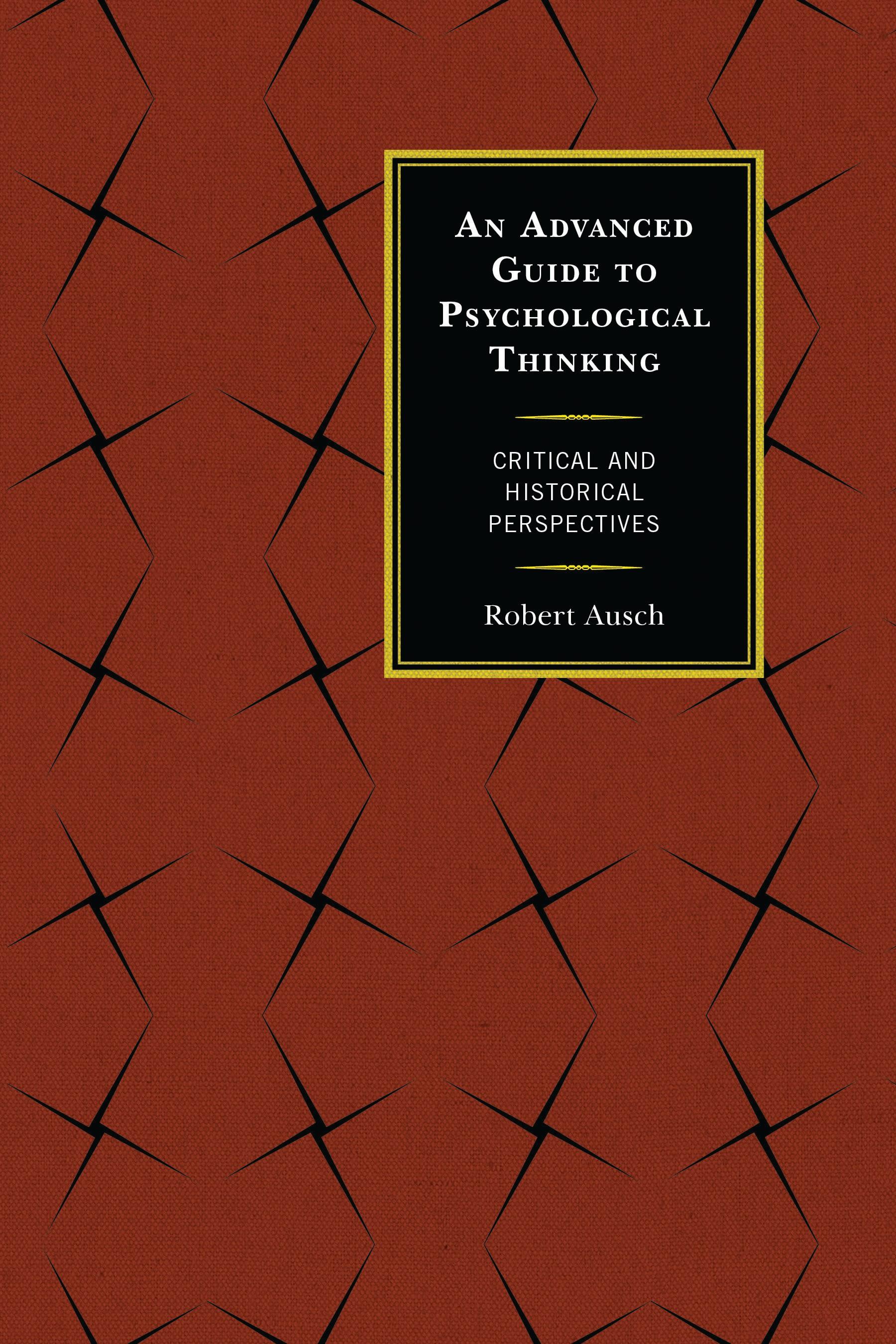
Psychology is a diverse assortment of fields with distinct referents, often using the same terms, and it is not always easy to identify its shared assumptions. At base, the academic variants tend to include the notion that mental activity takes place in hard-to-access inner spaces, making it more appropriate to study behavioral manifestations of it, yet all of it can be represented in an expert language with a confusing relationship to physiological mechanisms. An Advanced Guide to Psychological Thinking: Critical and Historical Perspectives focuses on several key areas in psychology: learning, the brain, child development, and psychotherapy, and identifies several conceptual tensions that ground psychological understanding of various phenomena. These include a tension between “inside” and “outside,” structure and function, higher and lower, and description and explanation; all have historically generated confusion at the heart of the discipline. As psychology was transformed into the study of consciousness in the late nineteenth century, and the science of behavior in the early twentieth, the disciplines of psychology struggled to distinguish between what was properly inside and what was outside mind, person, and organism as well as what forms the study of these “insides” would take. Additionally, it was unclear how to reconceive the traditional structures of the post-Cartesian mind in the terms of evolutionary functionalism without losing sight of the fact that the mind has its own organization or the historical connection between mind and higher forms of being. Psychology’s influence today, particularly that of post-Freudian therapeutics, has extended far beyond the university, creating a therapeutic sensibility by which Westerners make sense of themselves and their world. An Advanced Guide to Psychological Thinking performs the vital task of helping psychology recognize its own foundations.
Zahle einfach mit Karte, Klarna, Apple Pay oder Google Pay. Nicht zufrieden? Du hast immer ein 14-tägiges Widerrufsrecht. Lies mehr in unseren AGB. Hast du Fragen, schreib uns eine E-Mail an hello@memmo.org.
Memmo macht das Lernen einfacher – wo auch immer du bist. Bei uns findest du deine Kursbücher und smarte Lerntools an einem Ort: Zusammenfassungen, Quizzes, Podcasts und Lernkarten. Und Ted, dein Lernbuddy, beantwortet alles, was du wissen möchtest. Über 50.000 Studierende lernen bereits hier – gemacht, damit du schneller lernst und weniger Stress hast.