
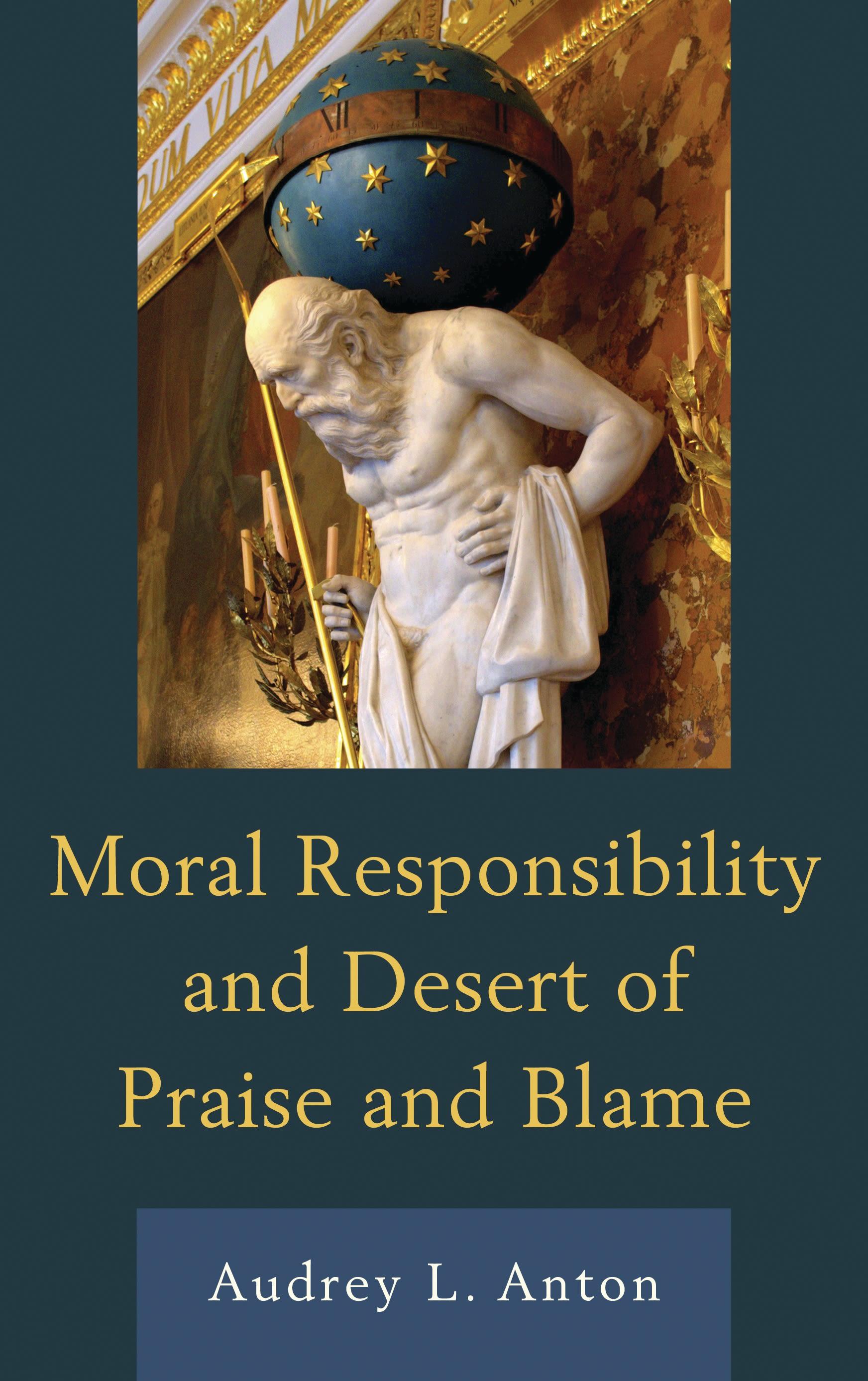
This book challenges a basic assumption held by many responsibility theorists: that agents must be morally responsible in the retrospective sense for anything in virtue of which they deserve praise or blame (the primacy assumption). Anton sets out to defeat this assumption by showing that accepting it as well as the much more intuitive causality assumption renders us incapable of making sense of cases whereby agents seem to deserve praise and blame. She argues that retrospective moral responsibility is a species of causal responsibility (the causality assumption). Then, she illustrates several examples in which agents are not causally responsible for any morally relevant consequences, but they seem to be deserving of praise or blame nonetheless. Anton concludes that such cases are counterexamples to the primacy assumption, and turns her attention towards discerning what grounds desert of praise and blame if not retrospective moral responsibility.
Anton advances the moral attitude account, whereby agents deserve praise and blame in virtue of moral attitudes they have in response to moral reasons. These moral attitudes must be sufficiently sincere, which means they reach a threshold that distinguishes such attitudes as eligible for praise and blame. Anton adds that whether one deserves praise or blame and to what degree is sensitive to the agent’s personal moral progress as well as the status quo of her society. This addition brings with it the welcome consequence that morality may be objective, but we are still justified in judging one another charitably based on personal and societal limitations.
Anton advances the moral attitude account, whereby agents deserve praise and blame in virtue of moral attitudes they have in response to moral reasons. These moral attitudes must be sufficiently sincere, which means they reach a threshold that distinguishes such attitudes as eligible for praise and blame. Anton adds that whether one deserves praise or blame and to what degree is sensitive to the agent’s personal moral progress as well as the status quo of her society. This addition brings with it the welcome consequence that morality may be objective, but we are still justified in judging one another charitably based on personal and societal limitations.
Zahle einfach mit Karte, Klarna, Apple Pay oder Google Pay. Nicht zufrieden? Du hast immer ein 14-tägiges Widerrufsrecht. Lies mehr in unseren AGB. Hast du Fragen, schreib uns eine E-Mail an hello@memmo.org.
Memmo macht das Lernen einfacher – wo auch immer du bist. Bei uns findest du deine Kursbücher und smarte Lerntools an einem Ort: Zusammenfassungen, Quizzes, Podcasts und Lernkarten. Und Ted, dein Lernbuddy, beantwortet alles, was du wissen möchtest. Über 50.000 Studierende lernen bereits hier – gemacht, damit du schneller lernst und weniger Stress hast.