
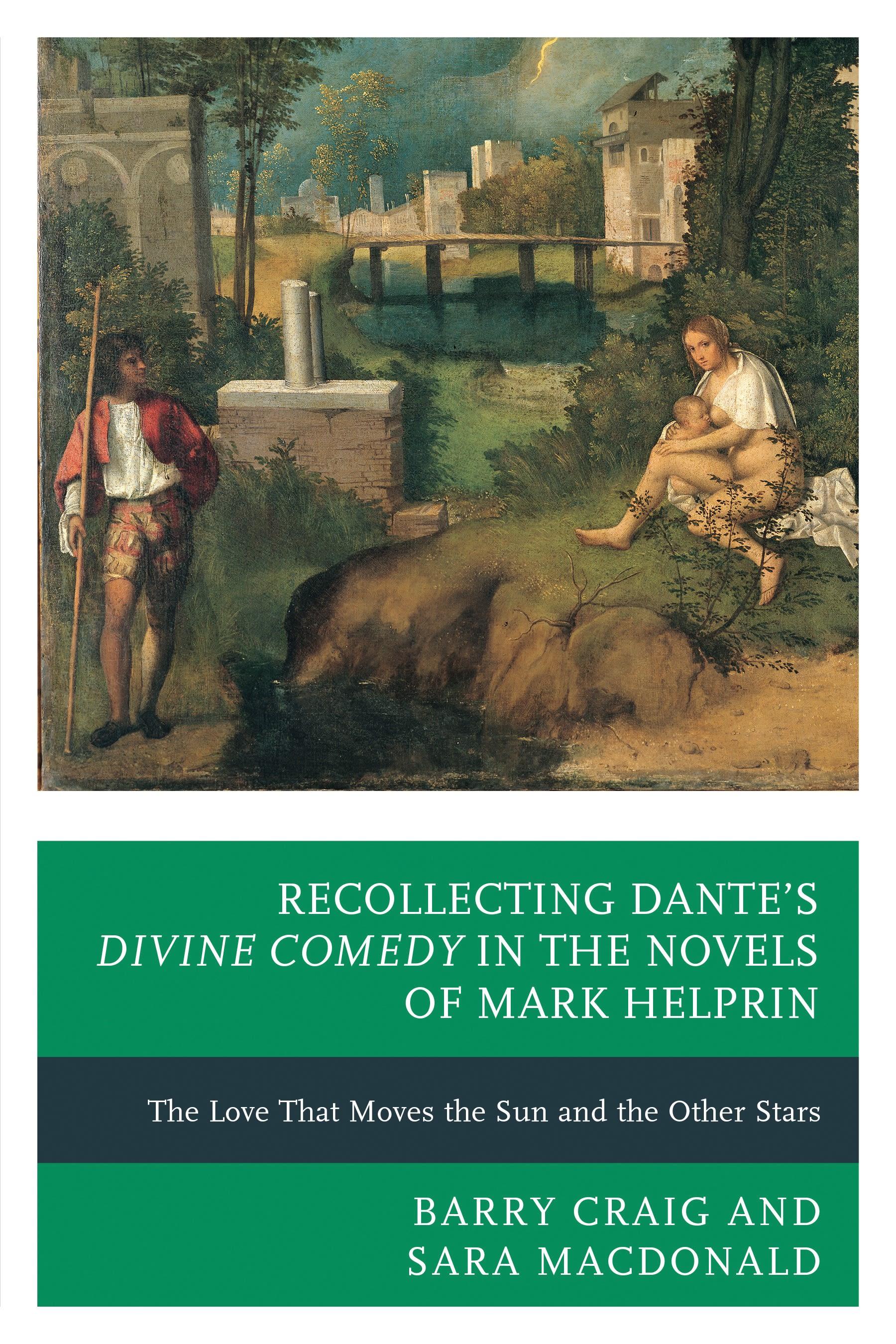
This book studies several of Mark Helprin’s novels in terms of their relation to Dante’s Divine Comedy. The authors demonstrate that A Soldier of the Great War, In Sunlight and in Shadow, and Winter’s Tale substantially correspond to, respectively, Dante’s Inferno, Purgatorio, and Paradiso. The author himself has acknowledged his debt to Dante and references to the Comedy appear throughout his works. It is not that Helprin’s novels track their Dantean antecedents slavishly, or even follow the structure of the Canticles explicitly. Rather, the central arguments of Dante’s three works are taken up by Helprin in his novels. In adopting Dante’s essentially Platonic doctrine of mediation, Helprin’s characters are fully instantiated human beings who also mediate and reveal the divine.
In his engagement with Dante, Helprin affirms the core philosophical, theological and psychological arguments of the Comedy, and then modifies those arguments in a distinctly modern way. Specifically, Helprin focuses on human freedom as the necessary precondition for justice to exist, both for individuals and for societies. In the final chapter of the book, the authors turn to Helprin’s Freddy and Fredericka. In this novel, Helprin both assumes Dante’s argument, and then radically alters it, by pointing to the possibility of a just regime on earth, rather than one that exists merely in heaven. While accepting much of Dante’s metaphysical argument, Helprin shows the virtues of liberal democracy as that form of political regime that is most able to unite human eros with eternal principles. In the end, Helprin’s novels are remarkable for the way in which they advocate for ancient virtues, while insisting upon the distinctly modern liberal account of human freedom as the necessary foundation for human flourishing.
In his engagement with Dante, Helprin affirms the core philosophical, theological and psychological arguments of the Comedy, and then modifies those arguments in a distinctly modern way. Specifically, Helprin focuses on human freedom as the necessary precondition for justice to exist, both for individuals and for societies. In the final chapter of the book, the authors turn to Helprin’s Freddy and Fredericka. In this novel, Helprin both assumes Dante’s argument, and then radically alters it, by pointing to the possibility of a just regime on earth, rather than one that exists merely in heaven. While accepting much of Dante’s metaphysical argument, Helprin shows the virtues of liberal democracy as that form of political regime that is most able to unite human eros with eternal principles. In the end, Helprin’s novels are remarkable for the way in which they advocate for ancient virtues, while insisting upon the distinctly modern liberal account of human freedom as the necessary foundation for human flourishing.
Zahle einfach mit Karte, Klarna, Apple Pay oder Google Pay. Nicht zufrieden? Du hast immer ein 14-tägiges Widerrufsrecht. Lies mehr in unseren AGB. Hast du Fragen, schreib uns eine E-Mail an hello@memmo.org.
Memmo macht das Lernen einfacher – wo auch immer du bist. Bei uns findest du deine Kursbücher und smarte Lerntools an einem Ort: Zusammenfassungen, Quizzes, Podcasts und Lernkarten. Und Ted, dein Lernbuddy, beantwortet alles, was du wissen möchtest. Über 50.000 Studierende lernen bereits hier – gemacht, damit du schneller lernst und weniger Stress hast.