
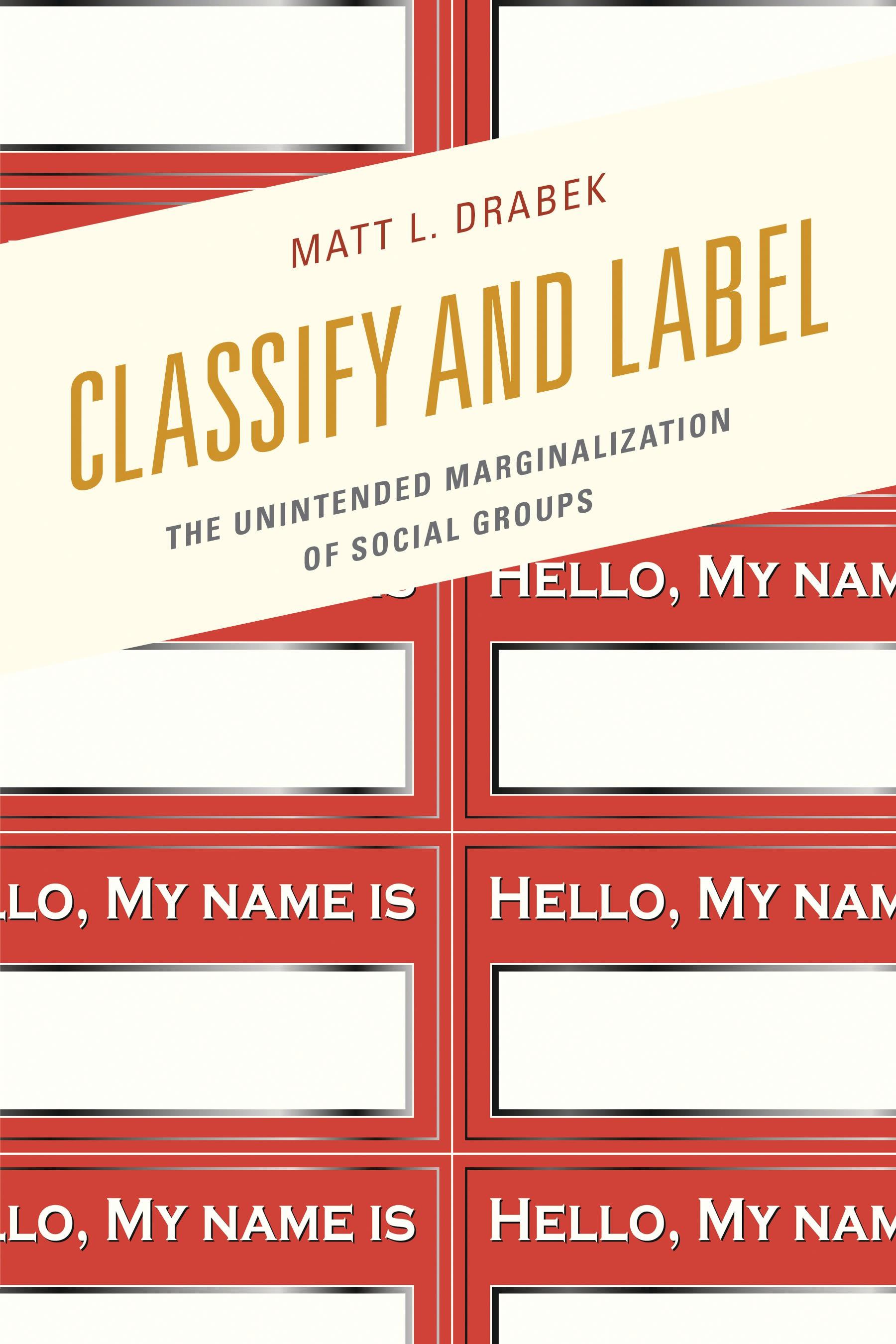
Classify and Label: The Unintended Marginalization of Social Groups is a philosophical treatment of classification in the social sciences and everyday life, focusing on moral, social, and political implications. The use of labels is essential to how people navigate and understand the world. Classifications and labels also have a dark side, as they may unintentionally misrepresent groups and individuals. These misrepresentations disrupt how people think about themselves and how they treat others, sometimes leading to marginalization.
Matt L. Drabek analyzes classification by considering rich case studies across a variety of domains, including the classification of gender and sexual orientation, the psychiatric classification of sadomasochism and gender disorders, and the classification of people in everyday life through the production of pornography and use of gender identities. This broad sample reveals deep connections between the classifications proposed by social scientists and the classifications used by society at large. Drabek explores how classifications evolve from and eventually affect such seemingly disconnected issues as the situation of under-represented groups in academia, new models of parenting and the family, the nature of sexual orientation, and the nature of scientific bias.
Matt L. Drabek analyzes classification by considering rich case studies across a variety of domains, including the classification of gender and sexual orientation, the psychiatric classification of sadomasochism and gender disorders, and the classification of people in everyday life through the production of pornography and use of gender identities. This broad sample reveals deep connections between the classifications proposed by social scientists and the classifications used by society at large. Drabek explores how classifications evolve from and eventually affect such seemingly disconnected issues as the situation of under-represented groups in academia, new models of parenting and the family, the nature of sexual orientation, and the nature of scientific bias.
Zahle einfach mit Karte, Klarna, Apple Pay oder Google Pay. Nicht zufrieden? Du hast immer ein 14-tägiges Widerrufsrecht. Lies mehr in unseren AGB. Hast du Fragen, schreib uns eine E-Mail an hello@memmo.org.
Memmo macht das Lernen einfacher – wo auch immer du bist. Bei uns findest du deine Kursbücher und smarte Lerntools an einem Ort: Zusammenfassungen, Quizzes, Podcasts und Lernkarten. Und Ted, dein Lernbuddy, beantwortet alles, was du wissen möchtest. Über 50.000 Studierende lernen bereits hier – gemacht, damit du schneller lernst und weniger Stress hast.