
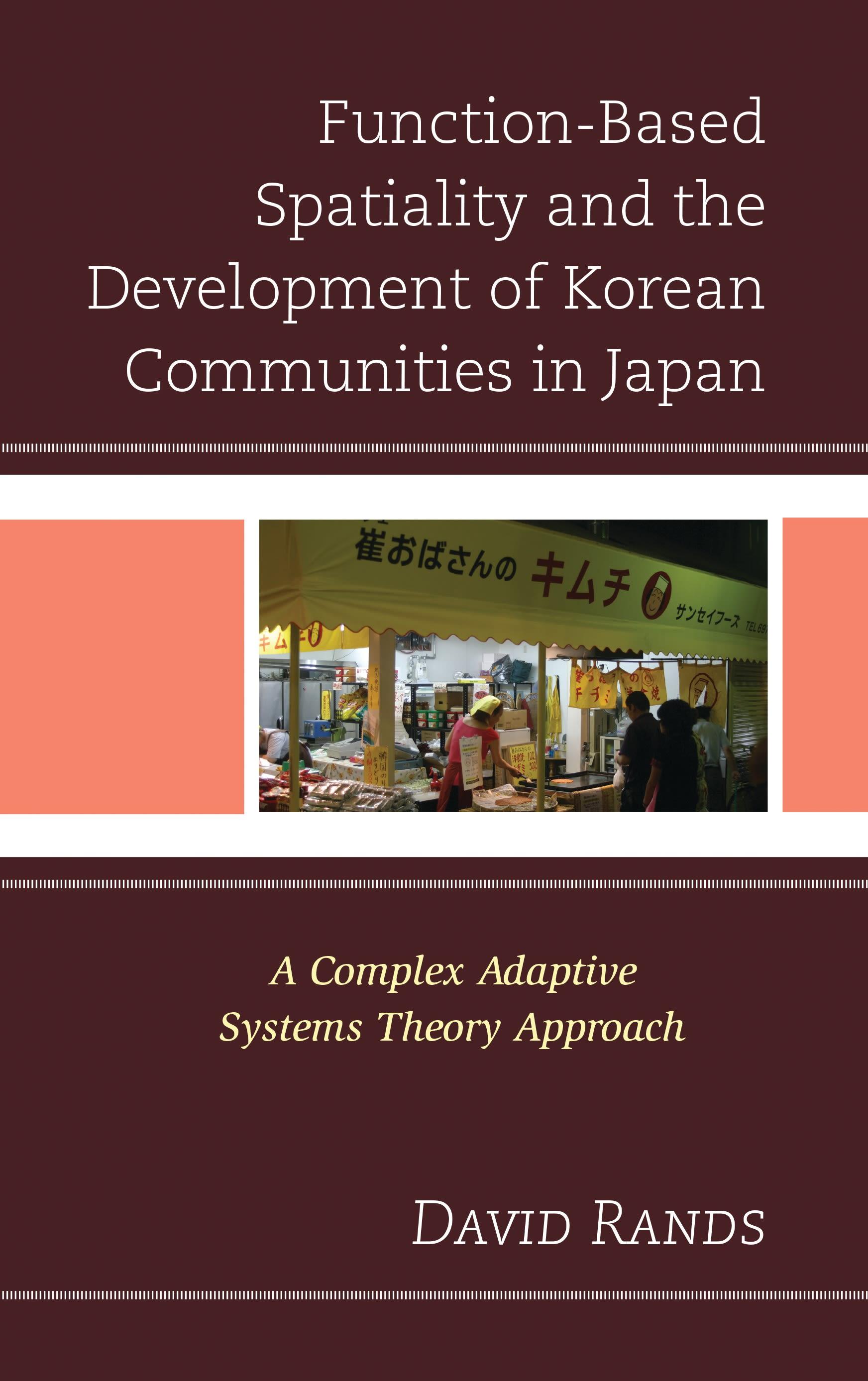
Function-Based Spatiality and the Development of Korean Communities in Japan utilizes the theoretical model of complex adaptive systems and introduces the concept of function-based spatiality to investigate the roles of the urban environments of Tokyo and Osaka in the development of Korean communities in Japan. Analysis of distinct Korean communities allows for the examination of urban factors of each city which contributed to the patterns of Korean immigration and community formation. By utilizing a comparative narrative of the two cities, distinctions between the organic growth of Osaka and the planned city of Tokyo are illuminated. Additionally, the discussion utilizes the concept of function-based spatiality to show how each city interacted with its surrounding regional, national, and global spheres. The functions of Tokyo, as a gateway to Western modernization and center of the Japanese state, shaped the interactions with Korean immigrants. Likewise, Osaka’s functions as a center of mercantilism and second city played a large role in how Koreans were incorporated into the urban ethnoscapes. Taken together, these two examples provide insight to the dynamics of urban systems on the development of immigrant communities.
Zahle einfach mit Karte, Klarna, Apple Pay oder Google Pay. Nicht zufrieden? Du hast immer ein 14-tägiges Widerrufsrecht. Lies mehr in unseren AGB. Hast du Fragen, schreib uns eine E-Mail an hello@memmo.org.
Memmo macht das Lernen einfacher – wo auch immer du bist. Bei uns findest du deine Kursbücher und smarte Lerntools an einem Ort: Zusammenfassungen, Quizzes, Podcasts und Lernkarten. Und Ted, dein Lernbuddy, beantwortet alles, was du wissen möchtest. Über 50.000 Studierende lernen bereits hier – gemacht, damit du schneller lernst und weniger Stress hast.