
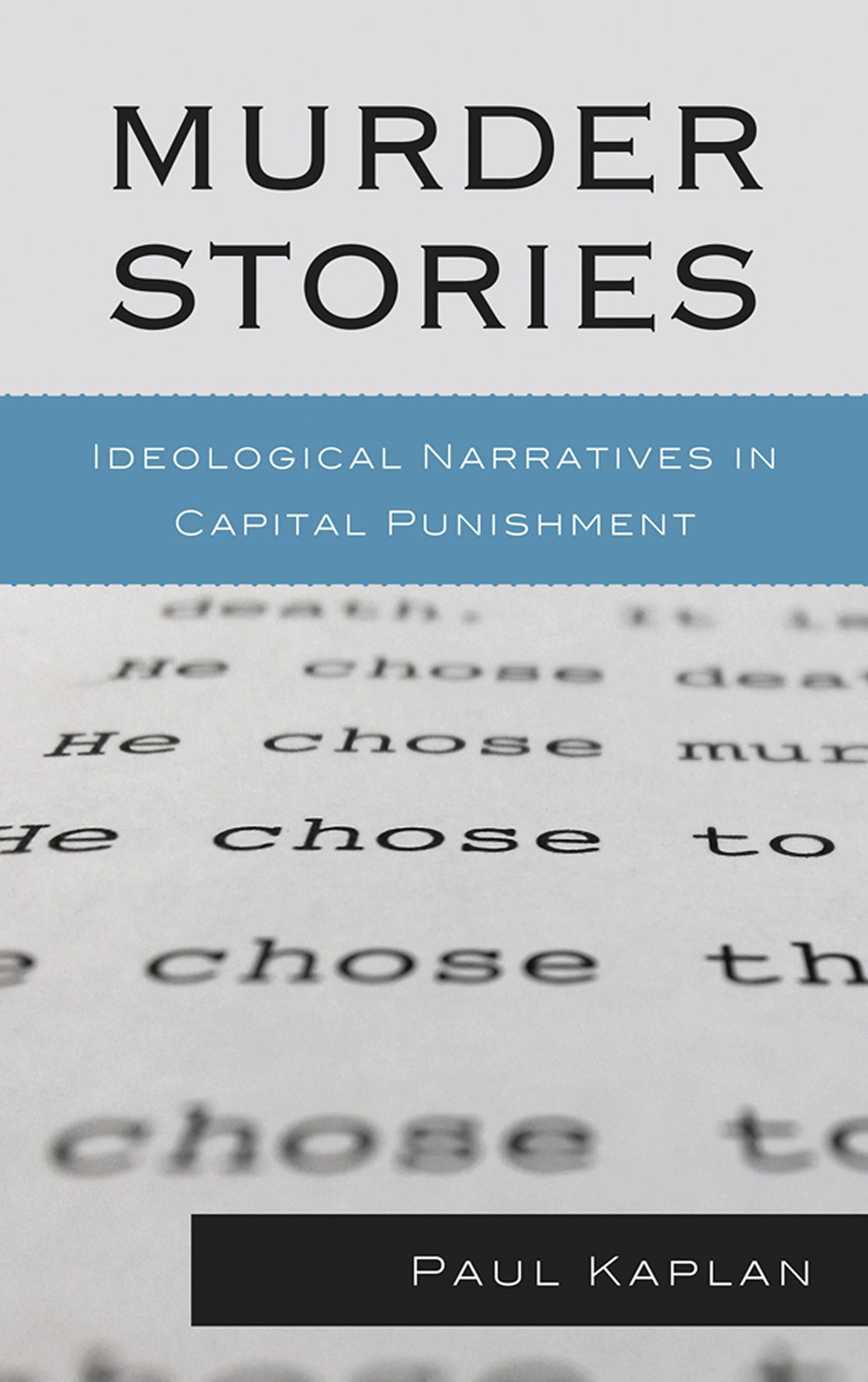
Murder Stories engages with the current theoretical debate in death penalty research on the role of cultural commitments to ‘American’ ideologies in the retention of capital punishment. The central aim of the study is to illuminate the elusive yet powerful role of ideology in legal discourses. Through analyzing the content and processes of death penalty narratives, this research illuminates the covert life of ‘the American Creed,’ (a nexus of ideologies—liberty, egalitarianism, individualism, populism, and laissez faire—said to be unique to the United States) in the law.
Murder Stories draws on the entire record of California death sentence resulting trials from three large and diverse California counties for the years 1996 – 2004, as well as interviews with 26 capital caseworkers (attorneys, judges, and investigators) from the same counties. Employing the theoretical framework proposed by Ewick and Silbey (1995) to study hegemonic and subversive narratives, and also the ethnographic approach advocated by Amsterdam and Hertz (1992) to study the producers and processes of constructing legal narratives, this book traces the ideological content carried within the stories told by everyday practitioners of capital punishment by investigating the content, process, and ideological implications of these narratives.
The central theoretical finding is that the narratives constructed by both prosecutors and defenders tend to instantiate rather than subvert the ideological tenets of the American Creed.
Murder Stories draws on the entire record of California death sentence resulting trials from three large and diverse California counties for the years 1996 – 2004, as well as interviews with 26 capital caseworkers (attorneys, judges, and investigators) from the same counties. Employing the theoretical framework proposed by Ewick and Silbey (1995) to study hegemonic and subversive narratives, and also the ethnographic approach advocated by Amsterdam and Hertz (1992) to study the producers and processes of constructing legal narratives, this book traces the ideological content carried within the stories told by everyday practitioners of capital punishment by investigating the content, process, and ideological implications of these narratives.
The central theoretical finding is that the narratives constructed by both prosecutors and defenders tend to instantiate rather than subvert the ideological tenets of the American Creed.
Zahle einfach mit Karte, Klarna, Apple Pay oder Google Pay. Nicht zufrieden? Du hast immer ein 14-tägiges Widerrufsrecht. Lies mehr in unseren AGB. Hast du Fragen, schreib uns eine E-Mail an hello@memmo.org.
Memmo macht das Lernen einfacher – wo auch immer du bist. Bei uns findest du deine Kursbücher und smarte Lerntools an einem Ort: Zusammenfassungen, Quizzes, Podcasts und Lernkarten. Und Ted, dein Lernbuddy, beantwortet alles, was du wissen möchtest. Über 50.000 Studierende lernen bereits hier – gemacht, damit du schneller lernst und weniger Stress hast.