
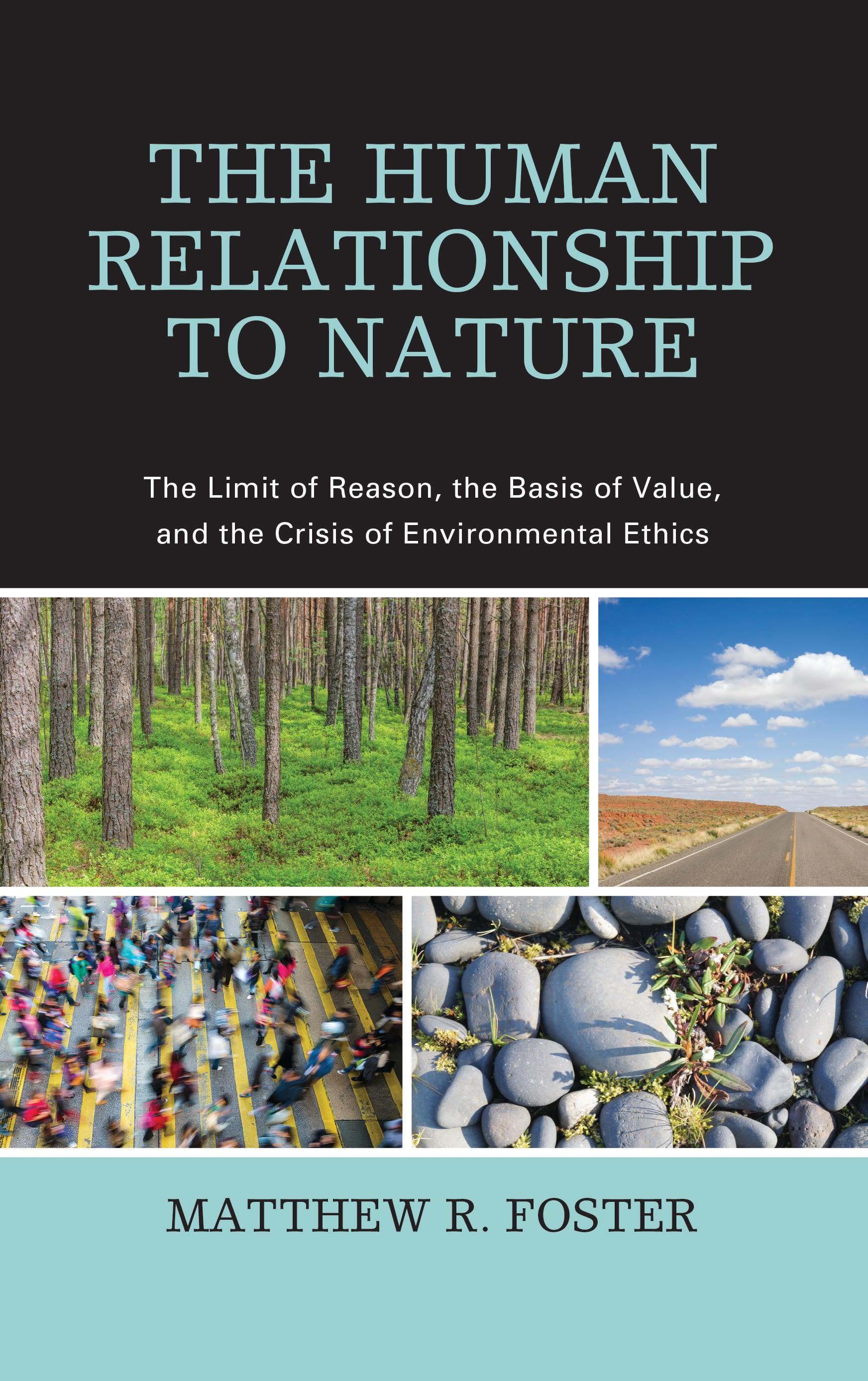
Growing alarm over the harm done by humans to the natural world, and even to the viability of our own industrial civilization, compels us to ask the deeper moral question: What should be the human relationship to nature? Matthew R. Foster starts by assessing three contrasting patterns of moral reasoning: the Progress Ethic that created the world we live in; the biblically-inspired Stewardship Ethic; and the Connection Ethic based on scientific understanding of the interdependence of all natural entities.
Critical analysis reveals that none of these ethics is able to sustain the values it advocates due to two unsupportable presumptions—that the norms of human morality are commensurate with the natural world, and that the value of an entity is an intrinsic property. Foster argues that in order for a future environmental ethic to be both logically coherent and environmentally constructive, it must start from unconventional notions. First, because nature will never be commensurate with human moral reasoning, non-rational resources must be employed despite the risks involved. Second, value resides in the relationship of one entity to another, and does not belong intrinsically to either—in short, value is foremost a verb, rather than a noun.
Foster proposes a new paradigm attentive to the realm of value relations among all natural entities, one which offers mediating opportunities between nature and morality. In this new ethic there are no “shoulds.” Rather, moral responsibilities to the natural entities around us are elective, placing us in an unfamiliar yet potentially liberating network of relationships.
This book will be of interest to scholars—both instructors and students—of environmental ethics, philosophy, religion, and intellectual history, and all who are concerned about the environmental challenges of our time.
Critical analysis reveals that none of these ethics is able to sustain the values it advocates due to two unsupportable presumptions—that the norms of human morality are commensurate with the natural world, and that the value of an entity is an intrinsic property. Foster argues that in order for a future environmental ethic to be both logically coherent and environmentally constructive, it must start from unconventional notions. First, because nature will never be commensurate with human moral reasoning, non-rational resources must be employed despite the risks involved. Second, value resides in the relationship of one entity to another, and does not belong intrinsically to either—in short, value is foremost a verb, rather than a noun.
Foster proposes a new paradigm attentive to the realm of value relations among all natural entities, one which offers mediating opportunities between nature and morality. In this new ethic there are no “shoulds.” Rather, moral responsibilities to the natural entities around us are elective, placing us in an unfamiliar yet potentially liberating network of relationships.
This book will be of interest to scholars—both instructors and students—of environmental ethics, philosophy, religion, and intellectual history, and all who are concerned about the environmental challenges of our time.
Zahle einfach mit Karte, Klarna, Apple Pay oder Google Pay. Nicht zufrieden? Du hast immer ein 14-tägiges Widerrufsrecht. Lies mehr in unseren AGB. Hast du Fragen, schreib uns eine E-Mail an hello@memmo.org.
Memmo macht das Lernen einfacher – wo auch immer du bist. Bei uns findest du deine Kursbücher und smarte Lerntools an einem Ort: Zusammenfassungen, Quizzes, Podcasts und Lernkarten. Und Ted, dein Lernbuddy, beantwortet alles, was du wissen möchtest. Über 50.000 Studierende lernen bereits hier – gemacht, damit du schneller lernst und weniger Stress hast.