
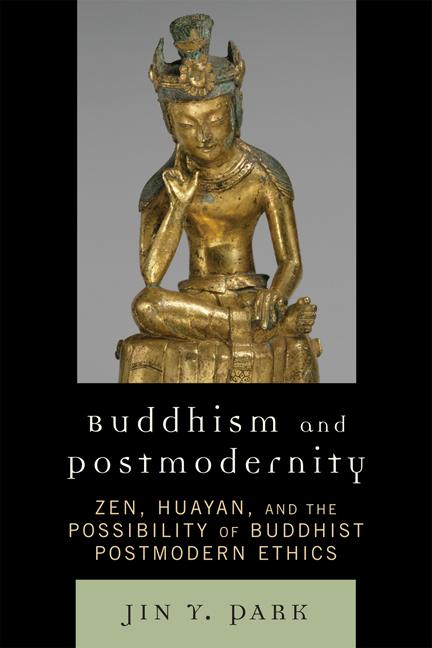
Buddhism and Postmodernity is a response to some of the questions that have emerged in the process of Buddhism's encounters with modernity and the West. Jin Y. Park broadly outlines these questions as follows: first, why are the interpretations and evaluations of Buddhism so different in Europe (in the nineteenth century), in the United States (in the twentieth century), and in traditional Asia; second, why does Zen Buddhism, which offers a radically egalitarian vision, maintain a strongly authoritarian leadership; and third, what ethical paradigm can be drawn from the Buddhist-postmodern form of philosophy?
Park argues that, as unrelated as these questions may seem, the issues that have generated them are related to perennial philosophical themes of identity, institutional power, and ethics, respectively. Each of these themes constitutes one section of Buddhism and Postmodernity. Park discusses the three issues in the book through the exploration of the Buddhist concepts of self and others, language and thinking, and universality and particularities. Most of this discussion is drawn from the East Asian Buddhist traditions of Zen and Huayan Buddhism in connection with the Continental philosophies of postmodernism, hermeneutics, and deconstruction. Self-critical from both the Buddhist and Western philosophical perspectives, Buddhism and Postmodernity points the reader toward a new understanding of Buddhist philosophy and offers a Buddhist-postmodern ethical paradigm that challenges normative ethics of metaphysical traditions.
Park argues that, as unrelated as these questions may seem, the issues that have generated them are related to perennial philosophical themes of identity, institutional power, and ethics, respectively. Each of these themes constitutes one section of Buddhism and Postmodernity. Park discusses the three issues in the book through the exploration of the Buddhist concepts of self and others, language and thinking, and universality and particularities. Most of this discussion is drawn from the East Asian Buddhist traditions of Zen and Huayan Buddhism in connection with the Continental philosophies of postmodernism, hermeneutics, and deconstruction. Self-critical from both the Buddhist and Western philosophical perspectives, Buddhism and Postmodernity points the reader toward a new understanding of Buddhist philosophy and offers a Buddhist-postmodern ethical paradigm that challenges normative ethics of metaphysical traditions.
Zahle einfach mit Karte, Klarna, Apple Pay oder Google Pay. Nicht zufrieden? Du hast immer ein 14-tägiges Widerrufsrecht. Lies mehr in unseren AGB. Hast du Fragen, schreib uns eine E-Mail an hello@memmo.org.
Memmo macht das Lernen einfacher – wo auch immer du bist. Bei uns findest du deine Kursbücher und smarte Lerntools an einem Ort: Zusammenfassungen, Quizzes, Podcasts und Lernkarten. Und Ted, dein Lernbuddy, beantwortet alles, was du wissen möchtest. Über 50.000 Studierende lernen bereits hier – gemacht, damit du schneller lernst und weniger Stress hast.