
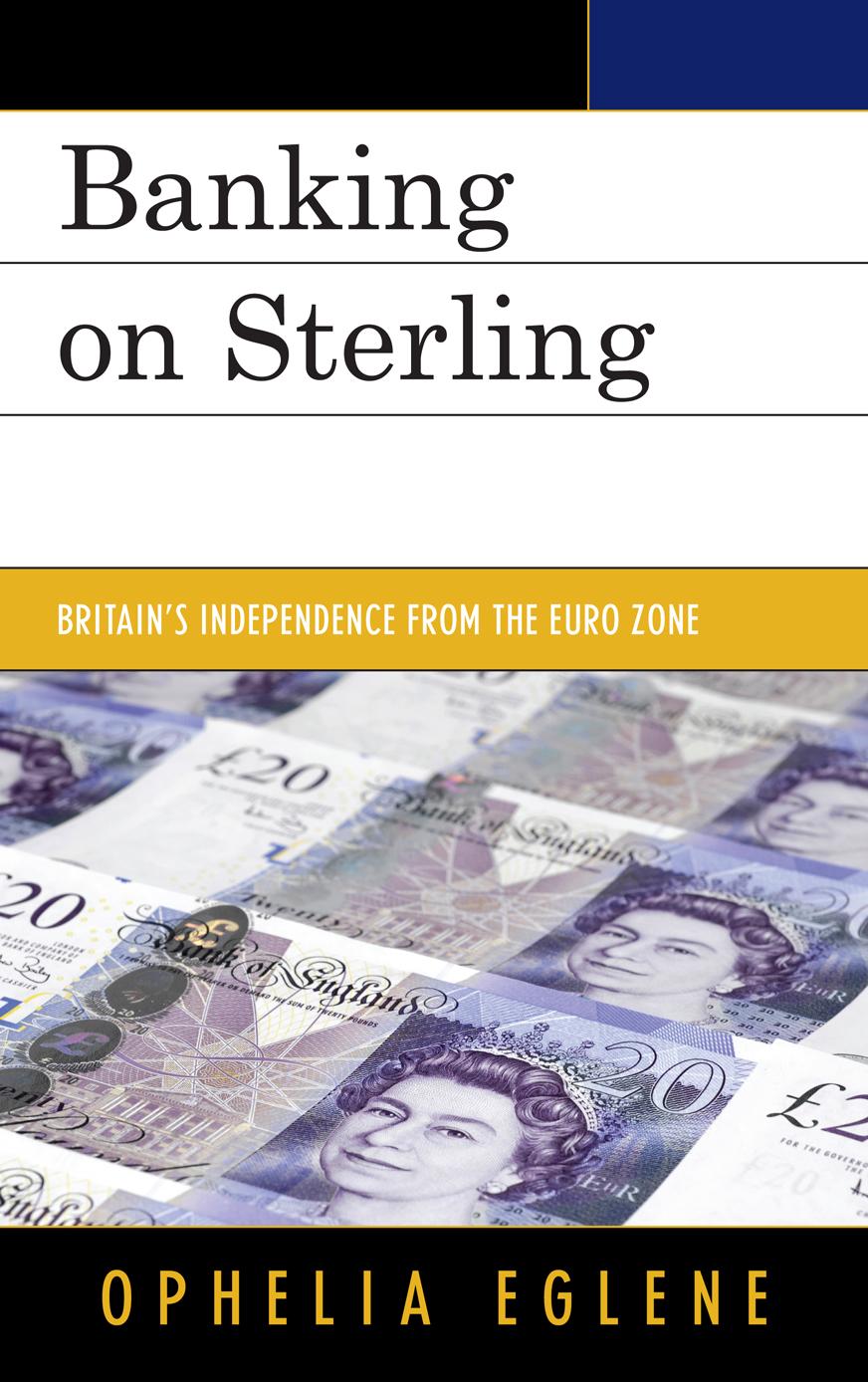
Banking on Sterling: Britain's Independence from the Euro Zone, by Ophelia Eglene, provides an in-depth analysis of the British policy on the European Economic and Monetary Union (EMU) over the past twenty years. Eglene demonstrates how the Conservative government of John Major and the Labour government of Tony Blair implemented policies that had the same overriding goals. The first of their shared goals was to continue being involved in decisions on the remaining details of the EMU and to avoid discrimination in the European Union by appearing as a member state willing to embrace the full European project at an indeterminate point. The second goal was to address the conflicting preferences of domestic economic actors with an ambiguous policy aimed at buying time.
Pressure on the British government came from both the business and financial sectors on the question of EMU membership. While the business community was divided on the euro, there was one sector, export-oriented producers, strongly in favor. The financial sector, for its part, needed more time to clearly assess where its interests lay, and it insisted that the government not rush a decision one way or the other.
Banking on Sterling demonstrates that the government-no matter which party was in power-always had in mind the welfare of the financial sector. When the conclusion was reached in London that its financial sector would benefit more from an offshore position than as a member of the EMU, the British government provided both direct and indirect compensation to the export-oriented business sector that had definitely lost the battle for the euro. Ophelia Eglene's Banking on Sterling: Britain's Independence from the Euro Zone effectively shows the unequal influence of business and finance on the British economy.
Pressure on the British government came from both the business and financial sectors on the question of EMU membership. While the business community was divided on the euro, there was one sector, export-oriented producers, strongly in favor. The financial sector, for its part, needed more time to clearly assess where its interests lay, and it insisted that the government not rush a decision one way or the other.
Banking on Sterling demonstrates that the government-no matter which party was in power-always had in mind the welfare of the financial sector. When the conclusion was reached in London that its financial sector would benefit more from an offshore position than as a member of the EMU, the British government provided both direct and indirect compensation to the export-oriented business sector that had definitely lost the battle for the euro. Ophelia Eglene's Banking on Sterling: Britain's Independence from the Euro Zone effectively shows the unequal influence of business and finance on the British economy.
Seiten: 167
Kategorie: Redovisning, Finans & Investering
e-ISBN: 9780739144121
Versandgewicht: 1.2 kg
Versand in: 1-2 Tage
Zahle einfach mit Karte, Klarna, Apple Pay oder Google Pay. Nicht zufrieden? Du hast immer ein 14-tägiges Widerrufsrecht. Lies mehr in unseren AGB. Hast du Fragen, schreib uns eine E-Mail an hello@memmo.org.
Memmo macht das Lernen einfacher – wo auch immer du bist. Bei uns findest du deine Kursbücher und smarte Lerntools an einem Ort: Zusammenfassungen, Quizzes, Podcasts und Lernkarten. Und Ted, dein Lernbuddy, beantwortet alles, was du wissen möchtest. Über 50.000 Studierende lernen bereits hier – gemacht, damit du schneller lernst und weniger Stress hast.