
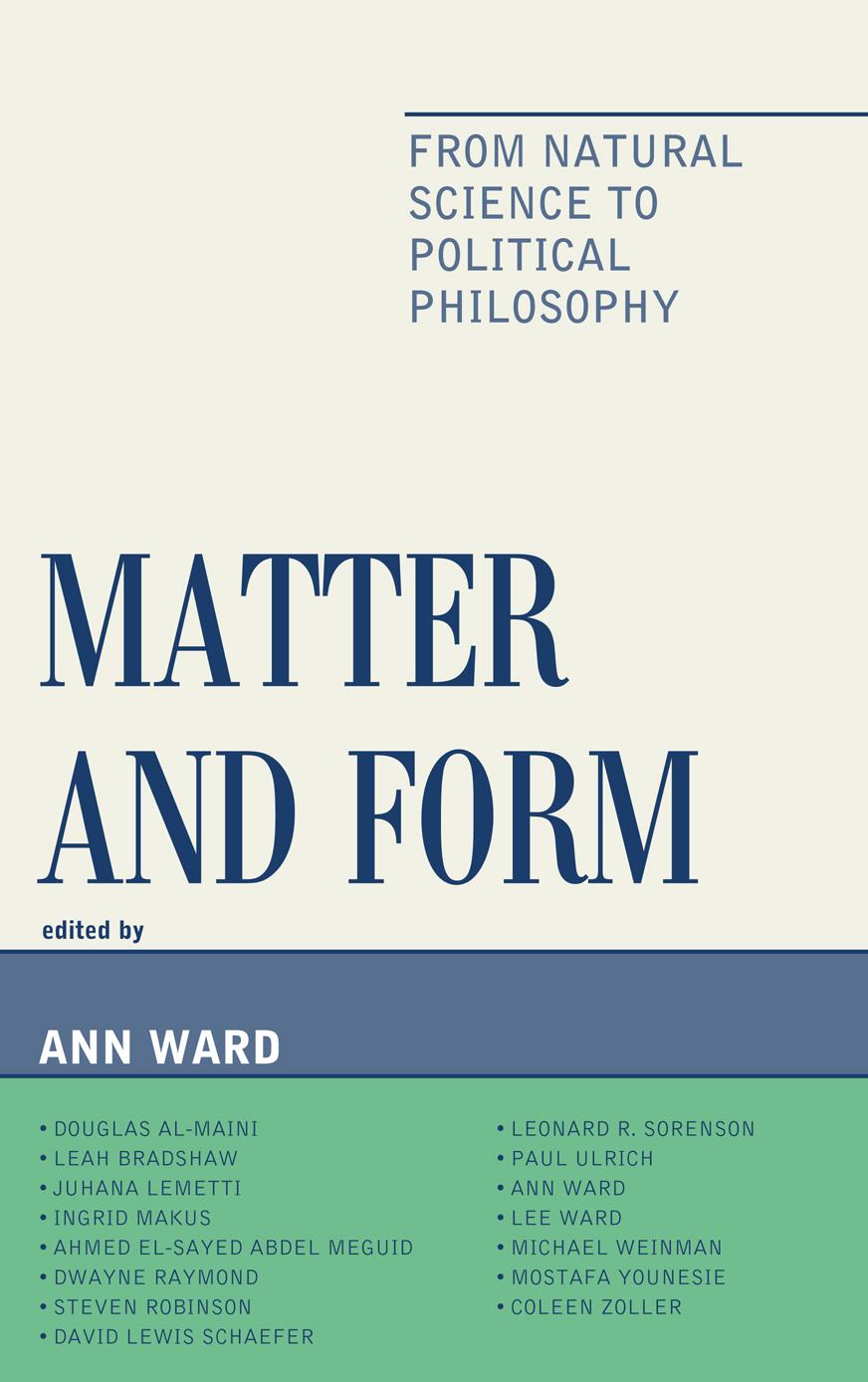
Matter and Form
Autor: Lee Ward, Ann Ward, Juhana Lemetti, Leah Bradshaw, Michael Weinman, Douglas Al-Maini, Coleen Zoller, Mostafa Younesie, Ahmed Abdel Meguid, David Lewis Schaefer, Dwayne Raymond, Paul Ulrich, Ingrid Makus, Leonard R. Sorenson, Steven Robinson
Verlag: Bloomsbury Publishing
Ausgabe: 1
Erscheinungsdatum: 2009
ISBN: 9780739135686
Matter and Form explores the relationship that has long existed between natural science and political philosophy. Plato's Socrates articulates the Ideas or Forms as an account of the ultimate source of causality in the cosmos. Aristotle's natural philosophy had a significant impact on his political philosophy: he argues that humans are by nature political animals, having their natural end in the city whose regime is hierarchically structured based on differences in moral and intellectual capacity. Medieval theorists attempt to synthesize classical natural and political philosophy with the revealed truths of scripture; they argue that divine reason structures an ordered universe, the awareness of which allows for psychic and political harmony among human beings.
Enlightenment thinkers challenge the natural philosophy of classical and medieval philosophers, ushering in a more liberal political order. For example, for Hobbes, there is no rest in nature as there are no Aristotelian forms or natural places that govern matter. Hobbes applies his mechanistic understanding of material nature to his understanding of human nature: individuals are by nature locked in an endless pursuit of power until death. However, from this mechanistic understanding of humanity's natural condition, Hobbes develops a social contract theory in which civil and political society is constituted from consent. Later thinkers, such as Locke and Rousseau, modify this Hobbesian premise in their pursuit of the protection of rights and a free society. Nevertheless, materialist conceptions of the cosmos have not always given rise to liberal democratic philosophies. Historicist influence on scientific inquiry in the nineteenth century is connected to Darwin's theory of evolution; Darwin reasoned that over time the process of natural selection produces ever newer and more highly adapted species. Reflecting a form of social Darwinism, Nietzsche envisions an aristocratic order that draws its inspiration from art rather than the rationalism
Enlightenment thinkers challenge the natural philosophy of classical and medieval philosophers, ushering in a more liberal political order. For example, for Hobbes, there is no rest in nature as there are no Aristotelian forms or natural places that govern matter. Hobbes applies his mechanistic understanding of material nature to his understanding of human nature: individuals are by nature locked in an endless pursuit of power until death. However, from this mechanistic understanding of humanity's natural condition, Hobbes develops a social contract theory in which civil and political society is constituted from consent. Later thinkers, such as Locke and Rousseau, modify this Hobbesian premise in their pursuit of the protection of rights and a free society. Nevertheless, materialist conceptions of the cosmos have not always given rise to liberal democratic philosophies. Historicist influence on scientific inquiry in the nineteenth century is connected to Darwin's theory of evolution; Darwin reasoned that over time the process of natural selection produces ever newer and more highly adapted species. Reflecting a form of social Darwinism, Nietzsche envisions an aristocratic order that draws its inspiration from art rather than the rationalism
Zahle einfach mit Karte, Klarna, Apple Pay oder Google Pay. Nicht zufrieden? Du hast immer ein 14-tägiges Widerrufsrecht. Lies mehr in unseren AGB. Hast du Fragen, schreib uns eine E-Mail an hello@memmo.org.
Memmo macht das Lernen einfacher – wo auch immer du bist. Bei uns findest du deine Kursbücher und smarte Lerntools an einem Ort: Zusammenfassungen, Quizzes, Podcasts und Lernkarten. Und Ted, dein Lernbuddy, beantwortet alles, was du wissen möchtest. Über 50.000 Studierende lernen bereits hier – gemacht, damit du schneller lernst und weniger Stress hast.