
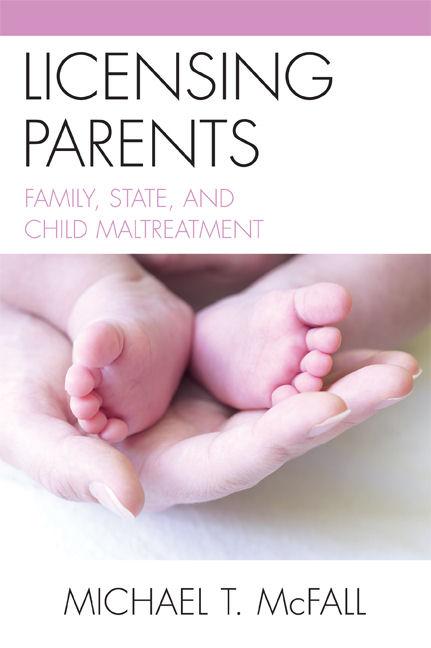
In Licensing Parents, Michael McFall argues that political structures, economics, education, racism, and sexism are secondary in importance to the inequality caused by families, and that the family plays the primary role in a child's acquisition of a sense of justice. He demonstrates that examination of the family is necessary in political philosophy and that informal structures (families) and considerations (character formation) must be taken seriously. McFall advocates a threshold that should be accepted by all political philosophers: children should not be severely abused or neglected because child maltreatment often causes deep and irreparable individual and societal harm. The implications of this threshold are revolutionary, but this is not recognized fully because no philosophical book has systematically considered the ethical or political ramifications of child maltreatment.
By exposing a tension between the rights of children and adults, McFall reveals pervasive ageism; parental rights usually trump children's rights, and this is often justified because children are not fully autonomous. Yet parental rights should not always trump children's rights. Ethics and political philosophy are not only about rights, but also about duties-especially when considering potential parents who are unable or unwilling to provide minimally decent nurturance. While contemporary political philosophy focuses on adult rights, McFall examines systems whereby the interests and rights of children and parents are better balanced. This entails exploring when parental rights are defeasible and defending the ethics of licensing parents, whereby some people are precluded from rearing children. He argues that, if a sense of justice is largely developed in childhood, parents directly influence the character of future generations of adults in political society. A completely stable and well-ordered society needs stable and psychologically healthy citizens in addition to just laws, and McFall demonstrates how parental love
By exposing a tension between the rights of children and adults, McFall reveals pervasive ageism; parental rights usually trump children's rights, and this is often justified because children are not fully autonomous. Yet parental rights should not always trump children's rights. Ethics and political philosophy are not only about rights, but also about duties-especially when considering potential parents who are unable or unwilling to provide minimally decent nurturance. While contemporary political philosophy focuses on adult rights, McFall examines systems whereby the interests and rights of children and parents are better balanced. This entails exploring when parental rights are defeasible and defending the ethics of licensing parents, whereby some people are precluded from rearing children. He argues that, if a sense of justice is largely developed in childhood, parents directly influence the character of future generations of adults in political society. A completely stable and well-ordered society needs stable and psychologically healthy citizens in addition to just laws, and McFall demonstrates how parental love
Zahle einfach mit Karte, Klarna, Apple Pay oder Google Pay. Nicht zufrieden? Du hast immer ein 14-tägiges Widerrufsrecht. Lies mehr in unseren AGB. Hast du Fragen, schreib uns eine E-Mail an hello@memmo.org.
Memmo macht das Lernen einfacher – wo auch immer du bist. Bei uns findest du deine Kursbücher und smarte Lerntools an einem Ort: Zusammenfassungen, Quizzes, Podcasts und Lernkarten. Und Ted, dein Lernbuddy, beantwortet alles, was du wissen möchtest. Über 50.000 Studierende lernen bereits hier – gemacht, damit du schneller lernst und weniger Stress hast.