
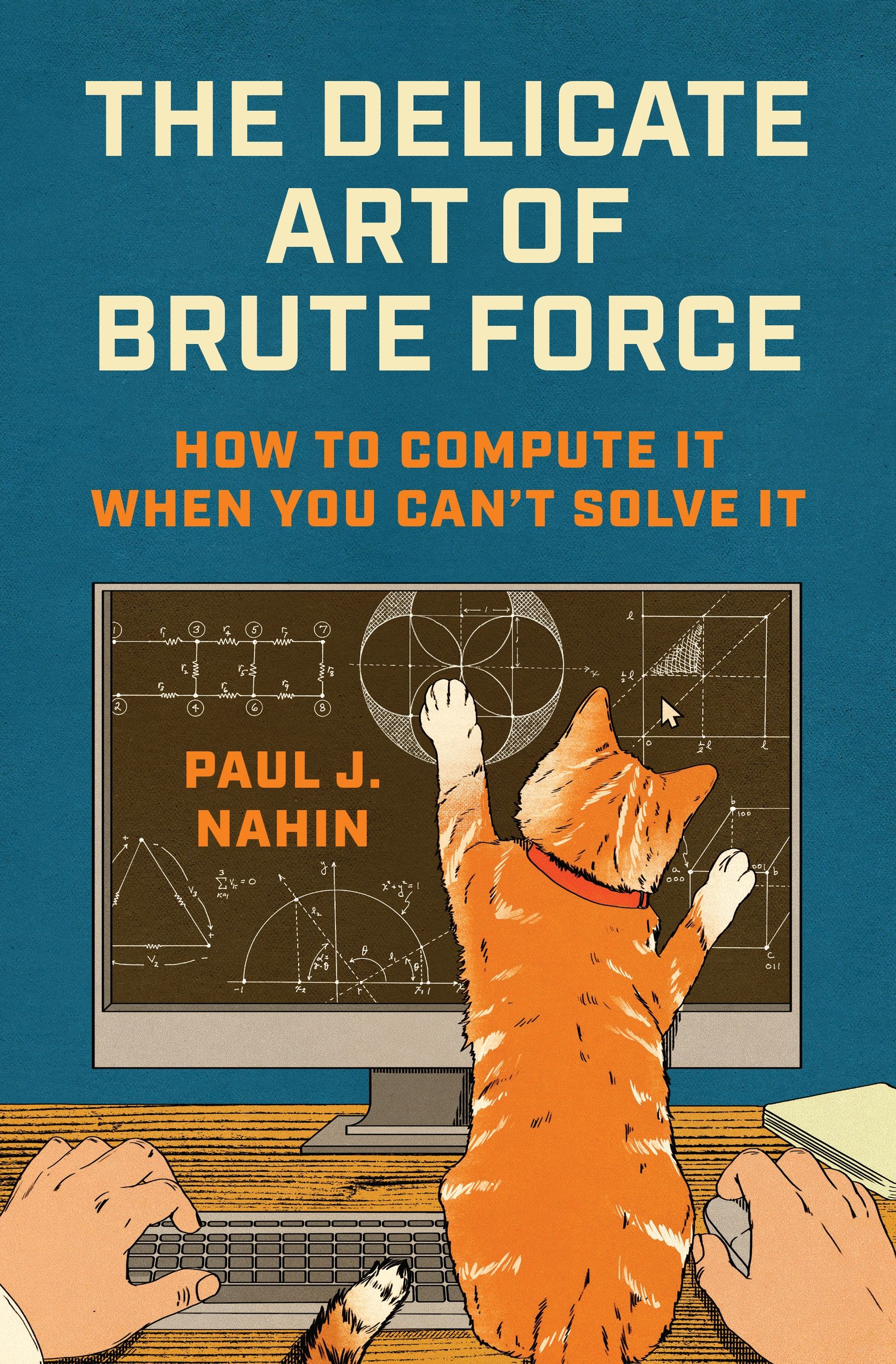
Using everyday computational power to tackle complex—and seemingly unsolvable—math problems
Confronted by a math problem of seemingly impenetrable difficulty, what can you do? In The Delicate Art of Brute Force, Paul Nahin shows how even if you can’t solve such a problem, you can still get an answer. The computational power of your own computer—the desktop in your home office, the laptop on your coffee table—can be deployed to overwhelm a problem’s complexity through a massive number-crunching assault. Nahin presents a series of apparently intractable math problems and shows the thought process that allows computational solution. Most of the problems are not abstract constructions but originate in the real world—one chapter is titled “How Wi-Fi Coverage and Anti-Submarine Warfare Are the Same.” For each one, Nahin compares computational and analytical approaches, demonstrating how well the computer solutions agree with theory. As a bonus, sometimes the computational solution is better, giving more insight or greater flexibility.
Along the way, Nahin traces the evolution of high-speed electronic computation, explaining that it upended the way analysts approach complex math problems. After the postwar debut of ENIAC (Electronic Numerical Integrator and Computer) and the ever more powerful electronic computers that came afterward, problems that were simply too difficult or messy for analytical treatment could be defeated by the application of pure brute force—the ability of computers to perform an enormous number of simple operations in just minutes. Today, we can harness that computational power from our couches. Accessible to anyone who’s mastered high school calculus, this engaging book gives both mathematicians and nonmathematicians plenty to think about.
Zahle einfach mit Karte, Klarna, Apple Pay oder Google Pay. Nicht zufrieden? Du hast immer ein 14-tägiges Widerrufsrecht. Lies mehr in unseren AGB. Hast du Fragen, schreib uns eine E-Mail an hello@memmo.org.
Memmo macht das Lernen einfacher – wo auch immer du bist. Bei uns findest du deine Kursbücher und smarte Lerntools an einem Ort: Zusammenfassungen, Quizzes, Podcasts und Lernkarten. Und Ted, dein Lernbuddy, beantwortet alles, was du wissen möchtest. Über 50.000 Studierende lernen bereits hier – gemacht, damit du schneller lernst und weniger Stress hast.