
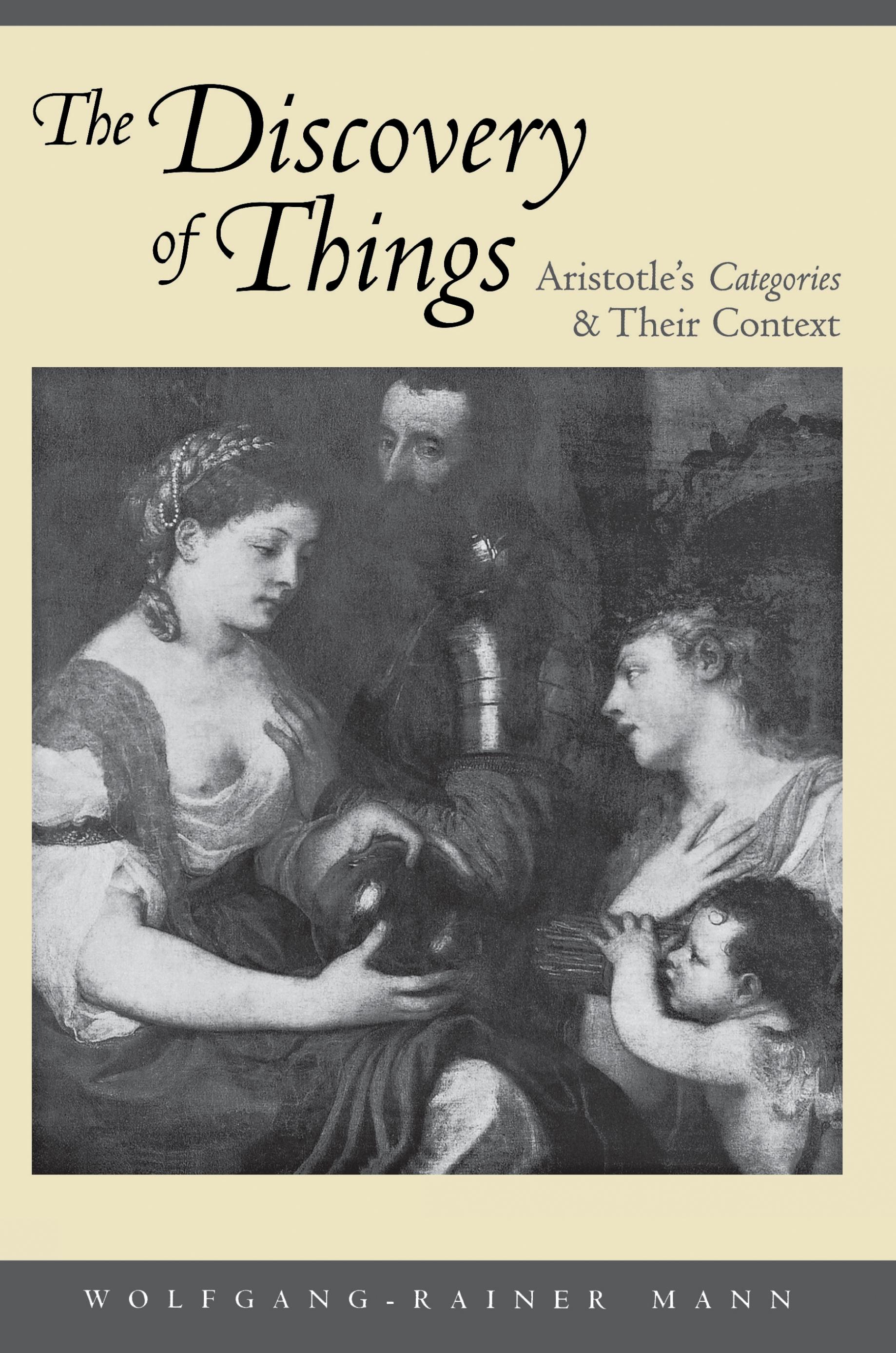
Aristotle's Categories can easily seem to be a statement of a naïve, pre-philosophical ontology, centered around ordinary items. Wolfgang-Rainer Mann argues that the treatise, in fact, presents a revolutionary metaphysical picture, one Aristotle arrives at by (implicitly) criticizing Plato and Plato's strange counterparts, the "Late-Learners" of the Sophist. As Mann shows, the Categories reflects Aristotle's discovery that ordinary items are things (objects with properties). Put most starkly, Mann contends that there were no things before Aristotle.
The author's argument consists of two main elements. First, a careful investigation of Plato which aims to make sense of the odd-sounding suggestion that things do not show up as things in his ontology. Secondly, an exposition of the theoretical apparatus Aristotle introduces in the Categories--an exposition which shows how Plato's and the Late-Learners' metaphysical pictures cannot help but seem inadequate in light of that apparatus. In doing so, Mann reveals that Aristotle's conception of things--now so engrained in Western thought as to seem a natural expression of common sense--was really a hard-won philosophical achievement.
Clear, subtle, and rigorously argued, The Discovery of Things will reshape our understanding of some of Aristotle's--and Plato's--most basic ideas.
Zahle einfach mit Karte, Klarna, Apple Pay oder Google Pay. Nicht zufrieden? Du hast immer ein 14-tägiges Widerrufsrecht. Lies mehr in unseren AGB. Hast du Fragen, schreib uns eine E-Mail an hello@memmo.org.
Memmo macht das Lernen einfacher – wo auch immer du bist. Bei uns findest du deine Kursbücher und smarte Lerntools an einem Ort: Zusammenfassungen, Quizzes, Podcasts und Lernkarten. Und Ted, dein Lernbuddy, beantwortet alles, was du wissen möchtest. Über 50.000 Studierende lernen bereits hier – gemacht, damit du schneller lernst und weniger Stress hast.