
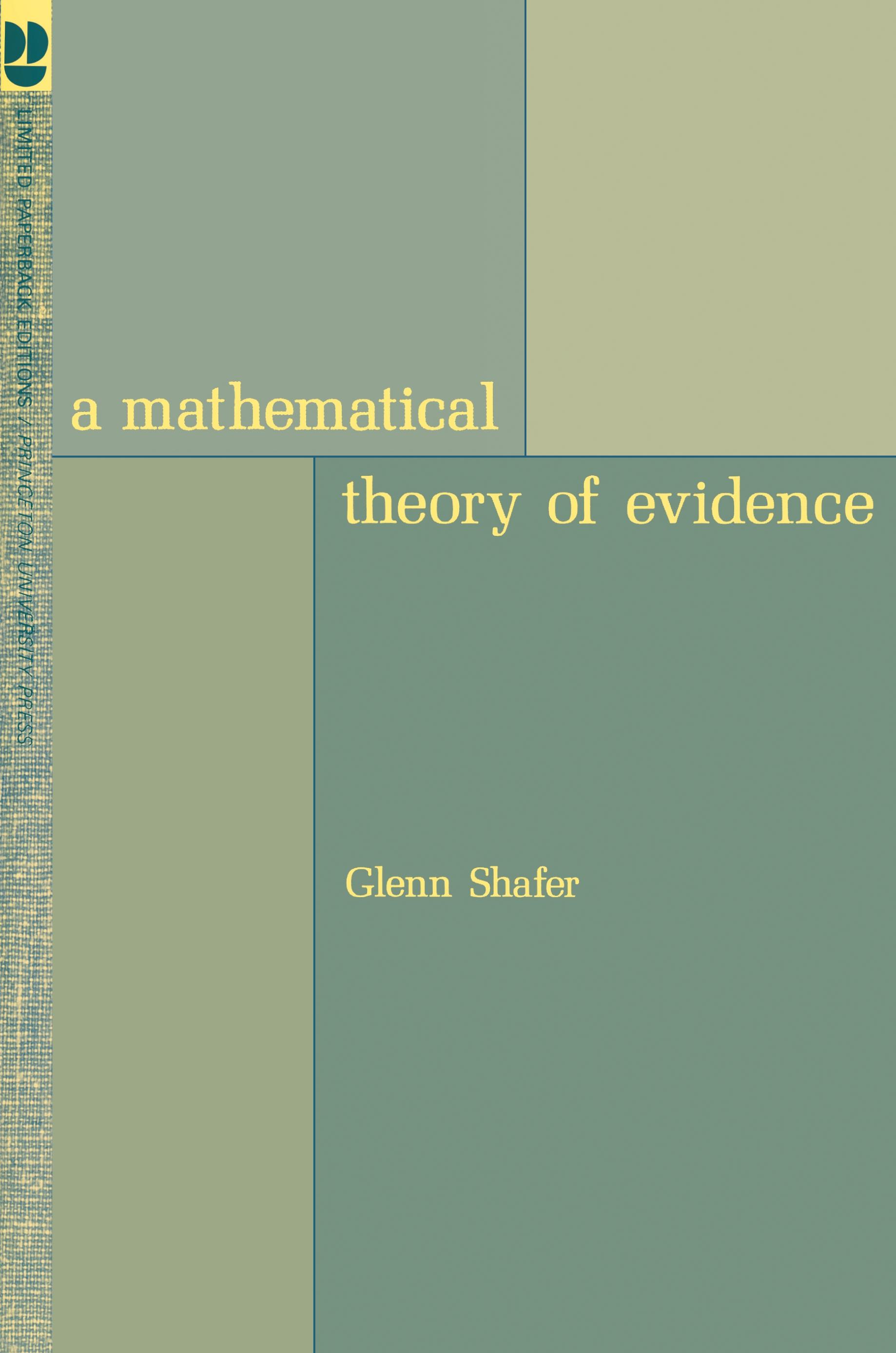
Both in science and in practical affairs we reason by combining facts only inconclusively supported by evidence. Building on an abstract understanding of this process of combination, this book constructs a new theory of epistemic probability. The theory draws on the work of A. P. Dempster but diverges from Depster's viewpoint by identifying his "lower probabilities" as epistemic probabilities and taking his rule for combining "upper and lower probabilities" as fundamental.
The book opens with a critique of the well-known Bayesian theory of epistemic probability. It then proceeds to develop an alternative to the additive set functions and the rule of conditioning of the Bayesian theory: set functions that need only be what Choquet called "monotone of order of infinity." and Dempster's rule for combining such set functions. This rule, together with the idea of "weights of evidence," leads to both an extensive new theory and a better understanding of the Bayesian theory. The book concludes with a brief treatment of statistical inference and a discussion of the limitations of epistemic probability. Appendices contain mathematical proofs, which are relatively elementary and seldom depend on mathematics more advanced that the binomial theorem.
Zahle einfach mit Karte, Klarna, Apple Pay oder Google Pay. Nicht zufrieden? Du hast immer ein 14-tägiges Widerrufsrecht. Lies mehr in unseren AGB. Hast du Fragen, schreib uns eine E-Mail an hello@memmo.org.
Memmo macht das Lernen einfacher – wo auch immer du bist. Bei uns findest du deine Kursbücher und smarte Lerntools an einem Ort: Zusammenfassungen, Quizzes, Podcasts und Lernkarten. Und Ted, dein Lernbuddy, beantwortet alles, was du wissen möchtest. Über 50.000 Studierende lernen bereits hier – gemacht, damit du schneller lernst und weniger Stress hast.