
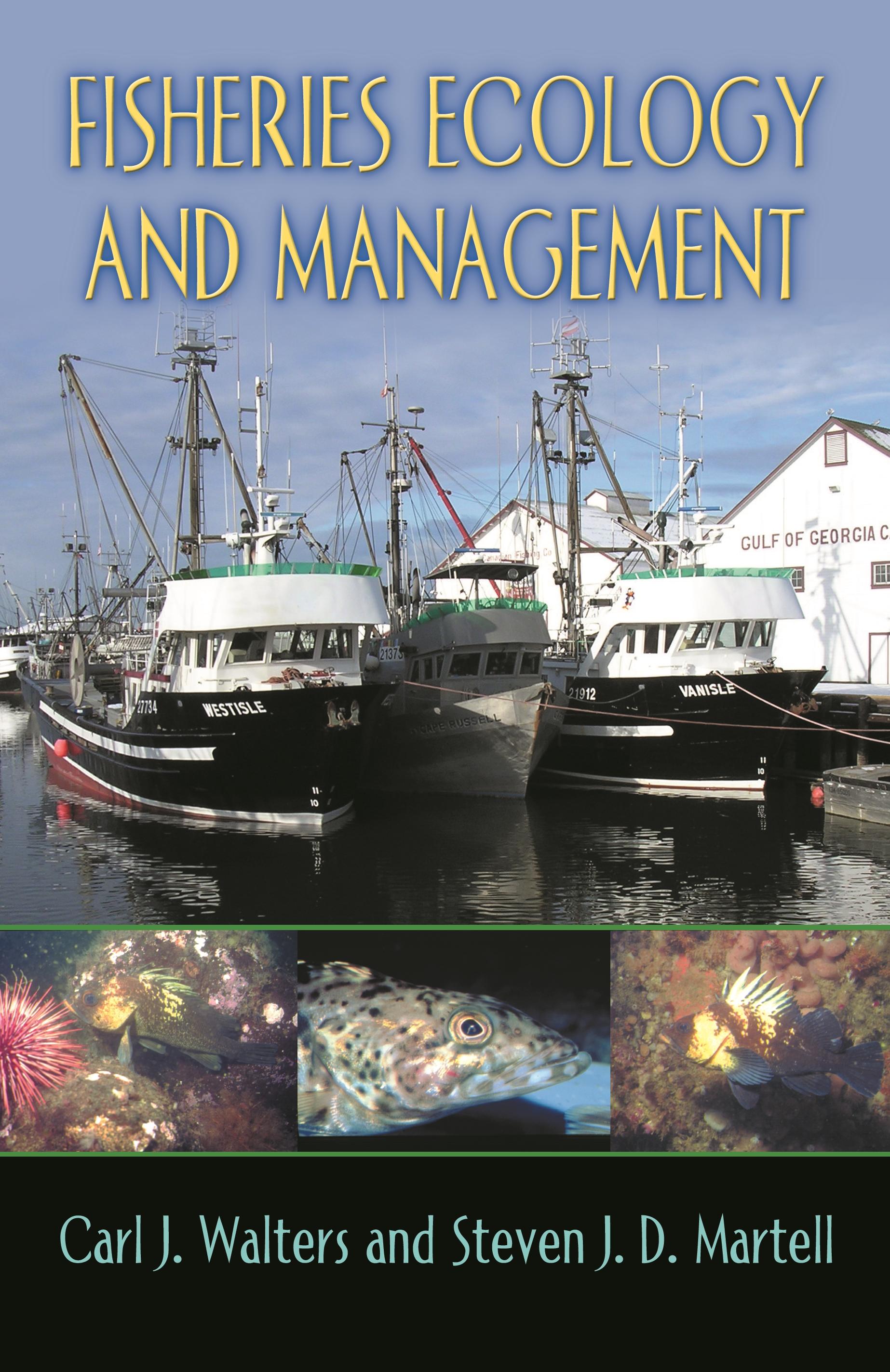
Quantitative modeling methods have become a central tool in the management of harvested fish populations. This book examines how these modeling methods work, why they sometimes fail, and how they might be improved by incorporating larger ecological interactions. Fisheries Ecology and Management provides a broad introduction to the concepts and quantitative models needed to successfully manage fisheries.
Walters and Martell develop models that account for key ecological dynamics such as trophic interactions, food webs, multi-species dynamics, risk-avoidance behavior, habitat selection and density-dependence. They treat fisheries policy development as a two-stage process, first identifying strategies for varying harvest in relation to changes in abundance, then finding ways to implement such strategies in terms of monitoring and regulatory procedures. This book provides a general framework for developing assessment models in terms of state-observation dynamics hypotheses, and points out that most fisheries assessment failures have been due to inappropriate observation model hypotheses rather than faulty models for ecological dynamics.
Intended as a text in upper division and graduate classes on fisheries assessment and management, this useful guide will also be widely read by ecologists and fisheries scientists.
Zahle einfach mit Karte, Klarna, Apple Pay oder Google Pay. Nicht zufrieden? Du hast immer ein 14-tägiges Widerrufsrecht. Lies mehr in unseren AGB. Hast du Fragen, schreib uns eine E-Mail an hello@memmo.org.
Memmo macht das Lernen einfacher – wo auch immer du bist. Bei uns findest du deine Kursbücher und smarte Lerntools an einem Ort: Zusammenfassungen, Quizzes, Podcasts und Lernkarten. Und Ted, dein Lernbuddy, beantwortet alles, was du wissen möchtest. Über 50.000 Studierende lernen bereits hier – gemacht, damit du schneller lernst und weniger Stress hast.