
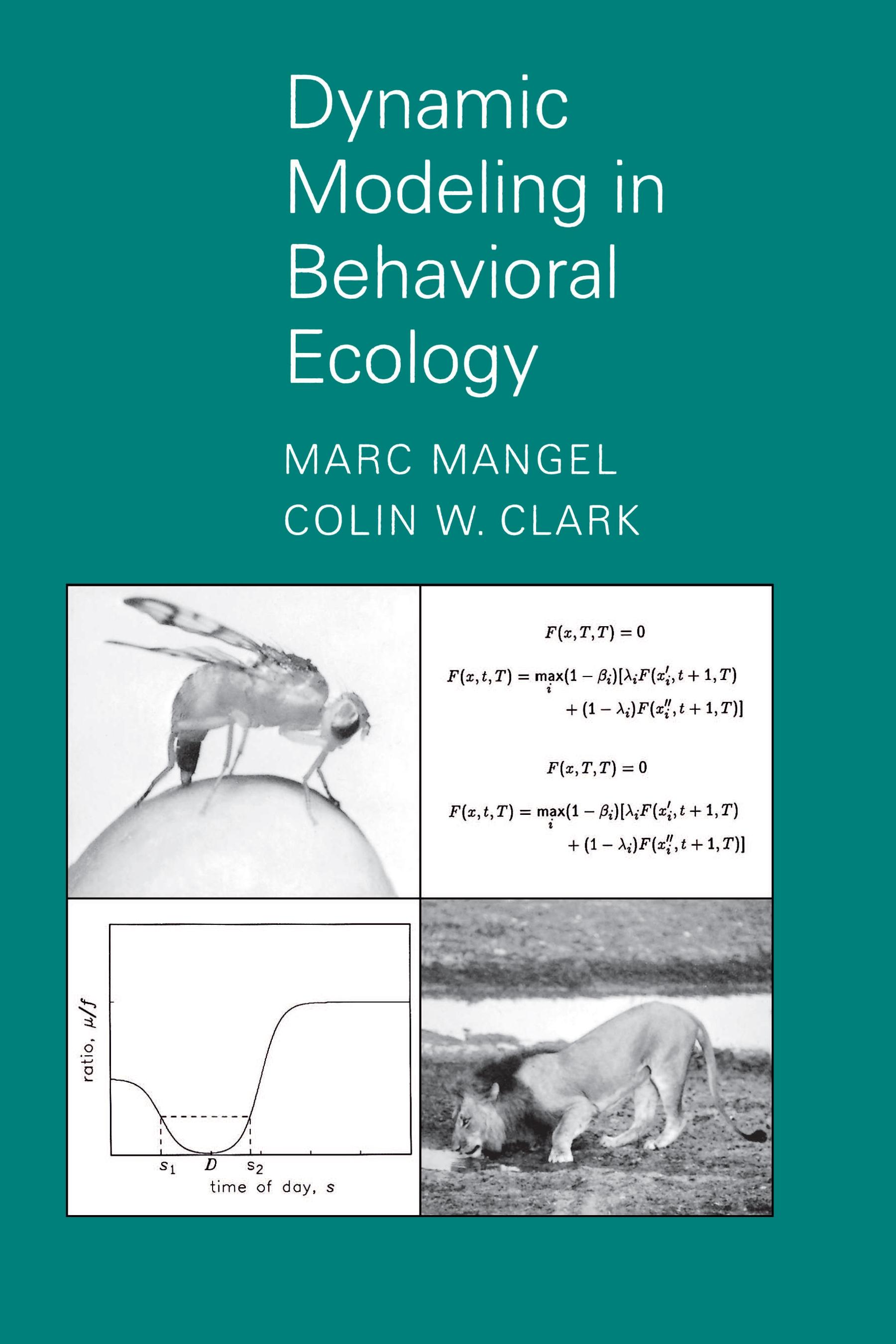
This book describes a powerful and flexible technique for the modeling of behavior, based on evolutionary principles. The technique employs stochastic dynamic programming and permits the analysis of behavioral adaptations wherein organisms respond to changes in their environment and in their own current physiological state. Models can be constructed to reflect sequential decisions concerned simultaneously with foraging, reproduction, predator avoidance, and other activities.
The authors show how to construct and use dynamic behavioral models. Part I covers the mathematical background and computer programming, and then uses a paradigm of foraging under risk of predation to exemplify the general modeling technique. Part II consists of five "applied" chapters illustrating the scope of the dynamic modeling approach. They treat hunting behavior in lions, reproduction in insects, migrations of aquatic organisms, clutch size and parental care in birds, and movement of spiders and raptors. Advanced topics, including the study of dynamic evolutionarily stable strategies, are discussed in Part III.
Zahle einfach mit Karte, Klarna, Apple Pay oder Google Pay. Nicht zufrieden? Du hast immer ein 14-tägiges Widerrufsrecht. Lies mehr in unseren AGB. Hast du Fragen, schreib uns eine E-Mail an hello@memmo.org.
Memmo macht das Lernen einfacher – wo auch immer du bist. Bei uns findest du deine Kursbücher und smarte Lerntools an einem Ort: Zusammenfassungen, Quizzes, Podcasts und Lernkarten. Und Ted, dein Lernbuddy, beantwortet alles, was du wissen möchtest. Über 50.000 Studierende lernen bereits hier – gemacht, damit du schneller lernst und weniger Stress hast.