
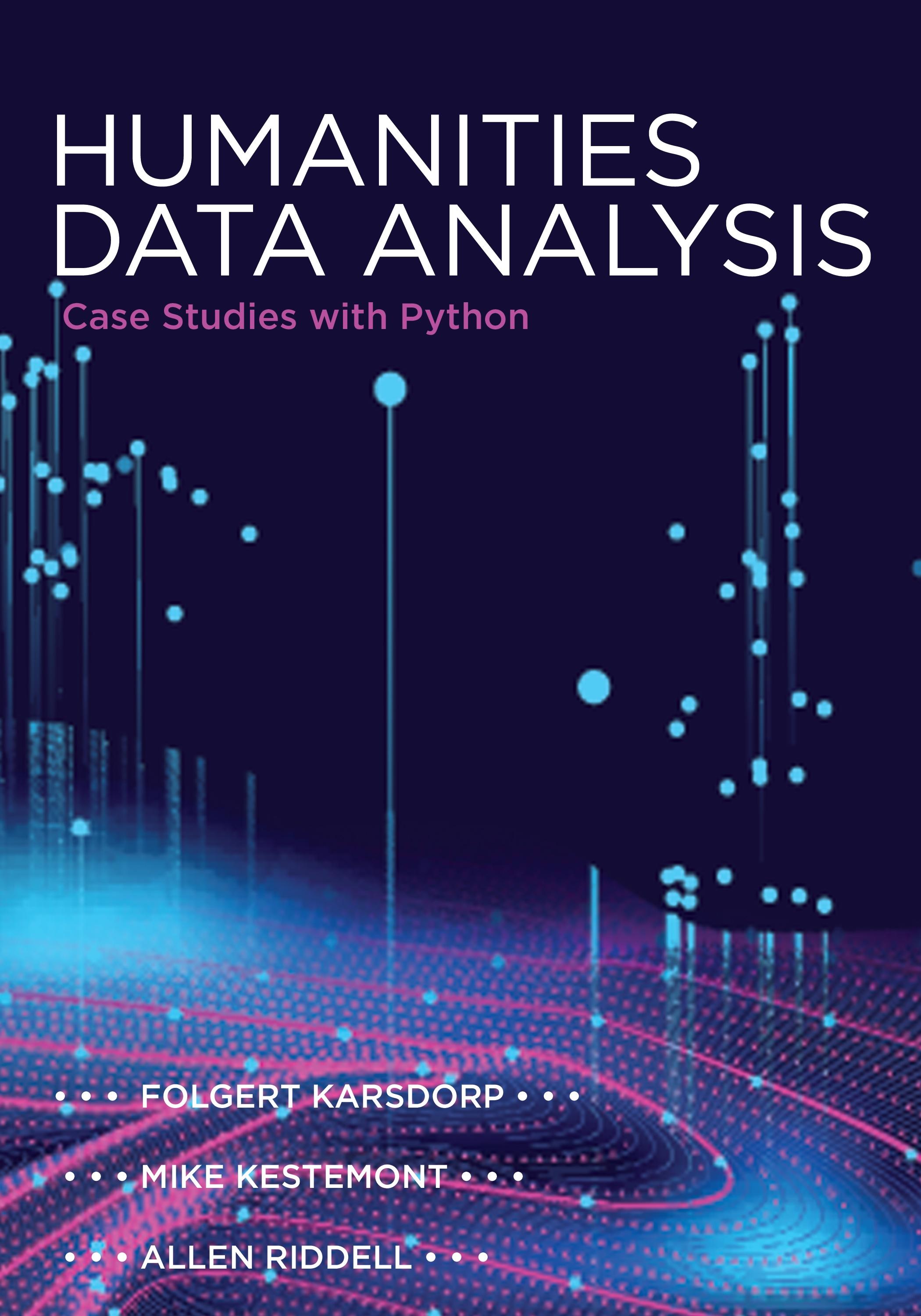
A practical guide to data-intensive humanities research using the Python programming language
The use of quantitative methods in the humanities and related social sciences has increased considerably in recent years, allowing researchers to discover patterns in a vast range of source materials. Despite this growth, there are few resources addressed to students and scholars who wish to take advantage of these powerful tools. Humanities Data Analysis offers the first intermediate-level guide to quantitative data analysis for humanities students and scholars using the Python programming language. This practical textbook, which assumes a basic knowledge of Python, teaches readers the necessary skills for conducting humanities research in the rapidly developing digital environment.
The book begins with an overview of the place of data science in the humanities, and proceeds to cover data carpentry: the essential techniques for gathering, cleaning, representing, and transforming textual and tabular data. Then, drawing from real-world, publicly available data sets that cover a variety of scholarly domains, the book delves into detailed case studies. Focusing on textual data analysis, the authors explore such diverse topics as network analysis, genre theory, onomastics, literacy, author attribution, mapping, stylometry, topic modeling, and time series analysis. Exercises and resources for further reading are provided at the end of each chapter.
An ideal resource for humanities students and scholars aiming to take their Python skills to the next level, Humanities Data Analysis illustrates the benefits that quantitative methods can bring to complex research questions.
- Appropriate for advanced undergraduates, graduate students, and scholars with a basic knowledge of Python
- Applicable to many humanities disciplines, including history, literature, and sociology
- Offers real-world case studies using publicly available data sets
- Provides exercises at the end of each chapter for students to test acquired skills
- Emphasizes visual storytelling via data visualizations
Zahle einfach mit Karte, Klarna, Apple Pay oder Google Pay. Nicht zufrieden? Du hast immer ein 14-tägiges Widerrufsrecht. Lies mehr in unseren AGB. Hast du Fragen, schreib uns eine E-Mail an hello@memmo.org.
Memmo macht das Lernen einfacher – wo auch immer du bist. Bei uns findest du deine Kursbücher und smarte Lerntools an einem Ort: Zusammenfassungen, Quizzes, Podcasts und Lernkarten. Und Ted, dein Lernbuddy, beantwortet alles, was du wissen möchtest. Über 50.000 Studierende lernen bereits hier – gemacht, damit du schneller lernst und weniger Stress hast.