
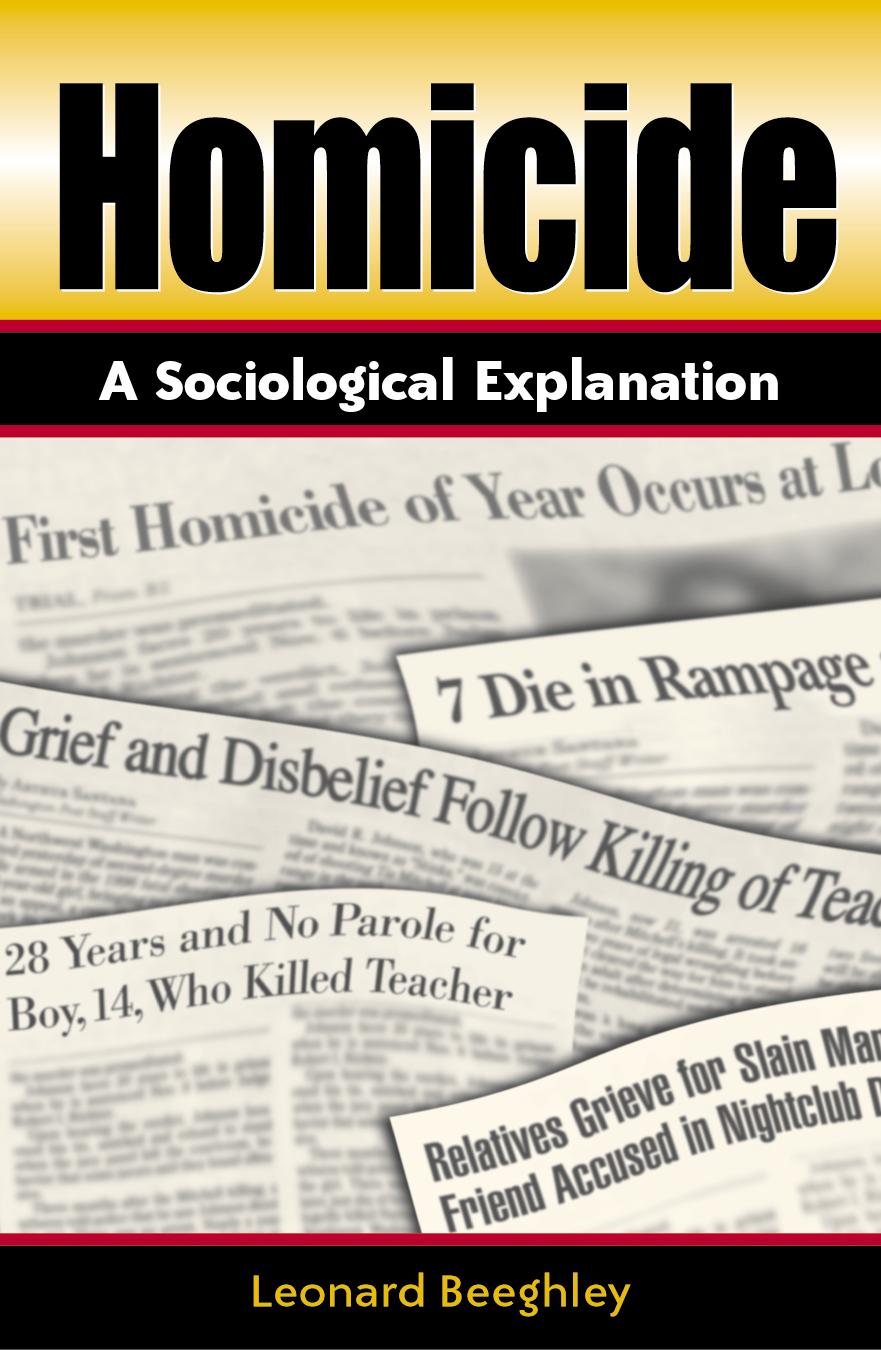
The American homicide rate remains dramatically higher than that in other Western nations. News of a murder has become a routine event. How do we explain such high levels of lethal violence in the world's leading democracy?
Echoing Durkheim's Suicide, this book focuses on one important phenomenon to explain larger currents in American society. Leonard Beeghley examines the historical and cross-national dimensions of homicides and evaluates previous attempts to explain it. He finds the sources of America's murder rate in the greater availability of guns, the expansion of illegal drug markets, greater racial discrimination, more exposure to violence, and sharper economic inequalities. He deftly blends the evidence related to each of these factors into a well-reasoned sociological analysis of the nature of American society.
Features
Highlights how sociology can be used to explain problems and seek solutions
Distinguishes between structural and social psychological levels of analysis
Provides a constrasting perspective to Messner & Rosenfeld's widely assigned Crime and the American Dream
Uses metaphors and analogies in order to make sociological ideas meaningful to students
Employs an engaging writing style to place the analysis in the scholarly literature
Offers clear explanations of Durkheim, Weber, Merton, and others, that show their usefulness for understanding modern life
Echoing Durkheim's Suicide, this book focuses on one important phenomenon to explain larger currents in American society. Leonard Beeghley examines the historical and cross-national dimensions of homicides and evaluates previous attempts to explain it. He finds the sources of America's murder rate in the greater availability of guns, the expansion of illegal drug markets, greater racial discrimination, more exposure to violence, and sharper economic inequalities. He deftly blends the evidence related to each of these factors into a well-reasoned sociological analysis of the nature of American society.
Features
Highlights how sociology can be used to explain problems and seek solutions
Distinguishes between structural and social psychological levels of analysis
Provides a constrasting perspective to Messner & Rosenfeld's widely assigned Crime and the American Dream
Uses metaphors and analogies in order to make sociological ideas meaningful to students
Employs an engaging writing style to place the analysis in the scholarly literature
Offers clear explanations of Durkheim, Weber, Merton, and others, that show their usefulness for understanding modern life
Zahle einfach mit Karte, Klarna, Apple Pay oder Google Pay. Nicht zufrieden? Du hast immer ein 14-tägiges Widerrufsrecht. Lies mehr in unseren AGB. Hast du Fragen, schreib uns eine E-Mail an hello@memmo.org.
Memmo macht das Lernen einfacher – wo auch immer du bist. Bei uns findest du deine Kursbücher und smarte Lerntools an einem Ort: Zusammenfassungen, Quizzes, Podcasts und Lernkarten. Und Ted, dein Lernbuddy, beantwortet alles, was du wissen möchtest. Über 50.000 Studierende lernen bereits hier – gemacht, damit du schneller lernst und weniger Stress hast.