
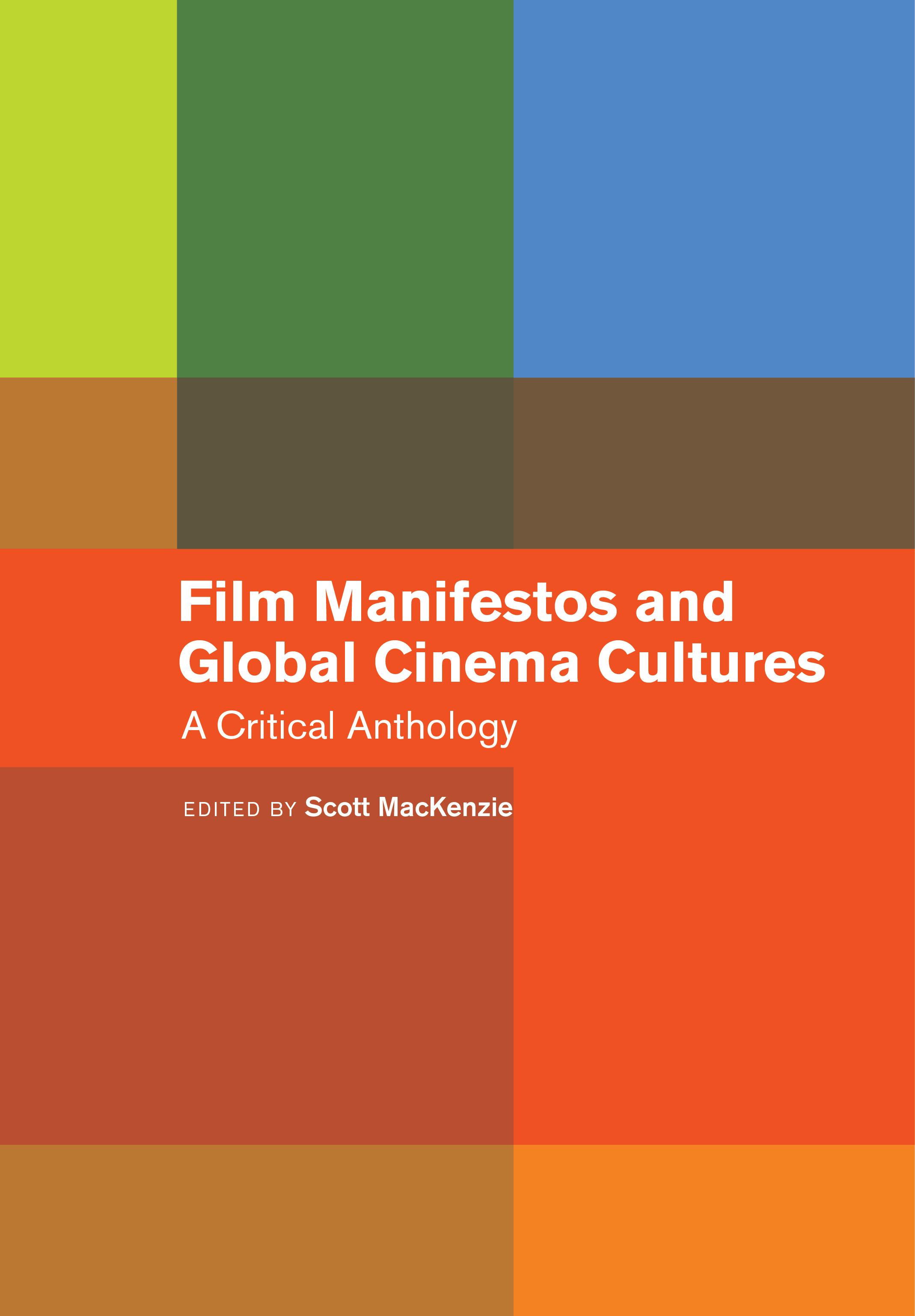
Film Manifestos and Global Cinema Cultures is the first book to collect manifestoes from the global history of cinema, providing the first historical and theoretical account of the role played by film manifestos in filmmaking and film culture. Focusing equally on political and aesthetic manifestoes, Scott MacKenzie uncovers a neglected, yet nevertheless central history of the cinema, exploring a series of documents that postulate ways in which to re-imagine the cinema and, in the process, re-imagine the world.
This volume collects the major European “waves” and figures (Eisenstein, Truffaut, Bergman, Free Cinema, Oberhausen, Dogme ‘95); Latin American Third Cinemas (Birri, Sanjinés, Espinosa, Solanas); radical art and the avant-garde (Buñuel, Brakhage, Deren, Mekas, Ono, Sanborn); and world cinemas (Iimura, Makhmalbaf, Sembene, Sen). It also contains previously untranslated manifestos co-written by figures including Bollaín, Debord, Hermosillo, Isou, Kieslowski, Painlevé, Straub, and many others. Thematic sections address documentary cinema, aesthetics, feminist and queer film cultures, pornography, film archives, Hollywood, and film and digital media. Also included are texts traditionally left out of the film manifestos canon, such as the Motion Picture Production Code and Pius XI's Vigilanti Cura, which nevertheless played a central role in film culture.
This volume collects the major European “waves” and figures (Eisenstein, Truffaut, Bergman, Free Cinema, Oberhausen, Dogme ‘95); Latin American Third Cinemas (Birri, Sanjinés, Espinosa, Solanas); radical art and the avant-garde (Buñuel, Brakhage, Deren, Mekas, Ono, Sanborn); and world cinemas (Iimura, Makhmalbaf, Sembene, Sen). It also contains previously untranslated manifestos co-written by figures including Bollaín, Debord, Hermosillo, Isou, Kieslowski, Painlevé, Straub, and many others. Thematic sections address documentary cinema, aesthetics, feminist and queer film cultures, pornography, film archives, Hollywood, and film and digital media. Also included are texts traditionally left out of the film manifestos canon, such as the Motion Picture Production Code and Pius XI's Vigilanti Cura, which nevertheless played a central role in film culture.
Zahle einfach mit Karte, Klarna, Apple Pay oder Google Pay. Nicht zufrieden? Du hast immer ein 14-tägiges Widerrufsrecht. Lies mehr in unseren AGB. Hast du Fragen, schreib uns eine E-Mail an hello@memmo.org.
Memmo macht das Lernen einfacher – wo auch immer du bist. Bei uns findest du deine Kursbücher und smarte Lerntools an einem Ort: Zusammenfassungen, Quizzes, Podcasts und Lernkarten. Und Ted, dein Lernbuddy, beantwortet alles, was du wissen möchtest. Über 50.000 Studierende lernen bereits hier – gemacht, damit du schneller lernst und weniger Stress hast.
Das könnte dir auch gefallen
Buch kaufen0