
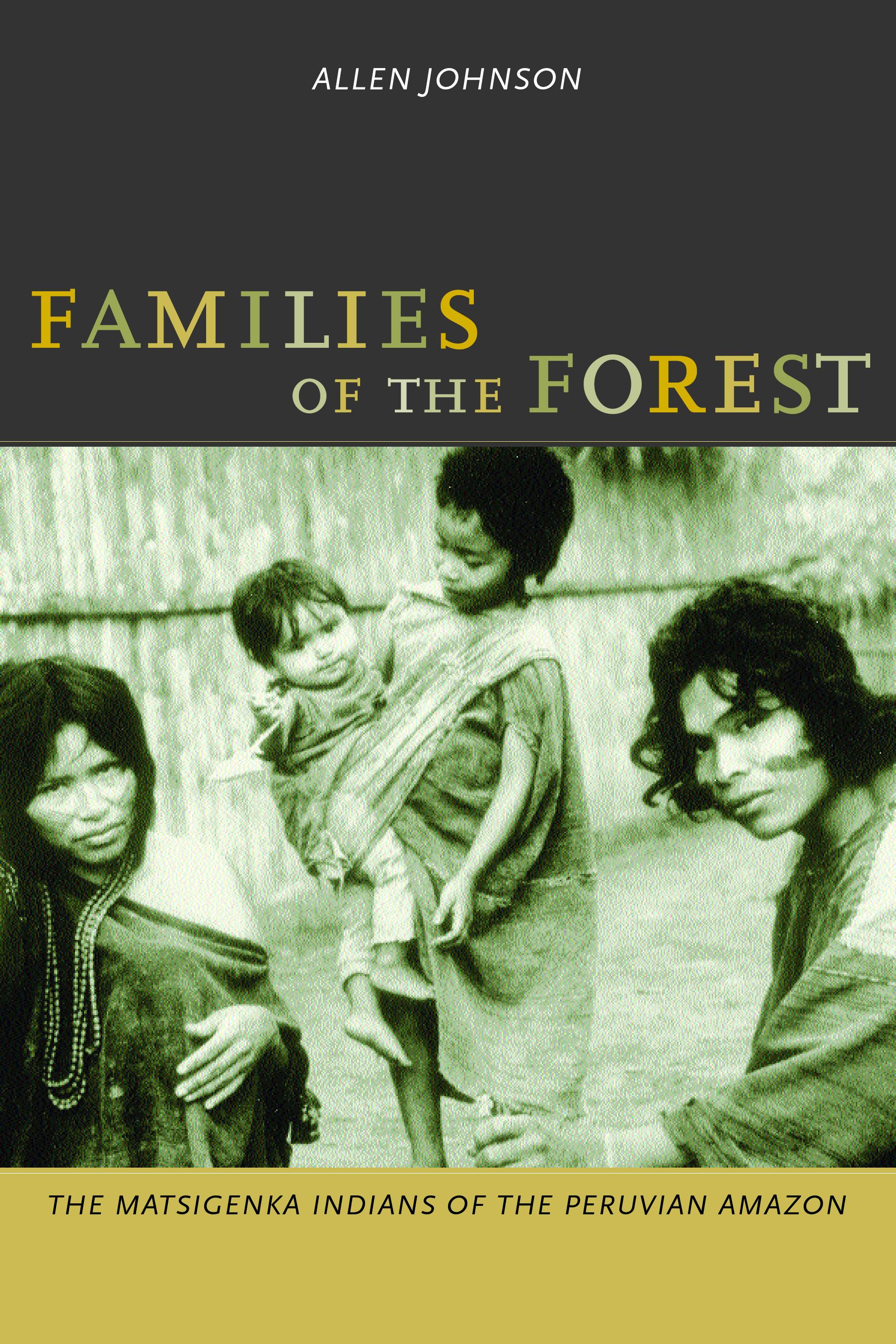
The idea of a family level society, discussed and disputed by anthropologists for nearly half a century, assumes moving, breathing form in Families of the Forest. According to Allen Johnson’s deft ethnography, the Matsigenka people of southeastern Peru cannot be understood or appreciated except as a family level society; the family level of sociocultural integration is for them a lived reality. Under ordinary circumstances, the largest social units are individual households or small extended-family hamlets. In the absence of such "tribal" features as villages, territorial defense and warfare, local or regional leaders, and public ceremonials, these people put a premium on economic self-reliance, control of aggression within intimate family settings, and freedom to believe and act in their own perceived self-interest.
Johnson shows how the Matsigenka, whose home is the Amazon rainforest, are able to meet virtually all their material needs with the skills and labor available to the individual household. They try to raise their children to be independent and self-reliant, yet in control of their emotional, impulsive natures, so that they can get along in intimate, cooperative living groups. Their belief that self-centered impulsiveness is dangerous and self-control is fulfilling anchors their moral framework, which is expressed in abundant stories and myths. Although, as Johnson points out, such people are often described in negative terms as lacking in features of social and cultural complexity, he finds their small-community lifestyle efficient, rewarding, and very well adapted to their environment.
Johnson shows how the Matsigenka, whose home is the Amazon rainforest, are able to meet virtually all their material needs with the skills and labor available to the individual household. They try to raise their children to be independent and self-reliant, yet in control of their emotional, impulsive natures, so that they can get along in intimate, cooperative living groups. Their belief that self-centered impulsiveness is dangerous and self-control is fulfilling anchors their moral framework, which is expressed in abundant stories and myths. Although, as Johnson points out, such people are often described in negative terms as lacking in features of social and cultural complexity, he finds their small-community lifestyle efficient, rewarding, and very well adapted to their environment.
Zahle einfach mit Karte, Klarna, Apple Pay oder Google Pay. Nicht zufrieden? Du hast immer ein 14-tägiges Widerrufsrecht. Lies mehr in unseren AGB. Hast du Fragen, schreib uns eine E-Mail an hello@memmo.org.
Memmo macht das Lernen einfacher – wo auch immer du bist. Bei uns findest du deine Kursbücher und smarte Lerntools an einem Ort: Zusammenfassungen, Quizzes, Podcasts und Lernkarten. Und Ted, dein Lernbuddy, beantwortet alles, was du wissen möchtest. Über 50.000 Studierende lernen bereits hier – gemacht, damit du schneller lernst und weniger Stress hast.
Das könnte dir auch gefallen
Buch kaufen0