
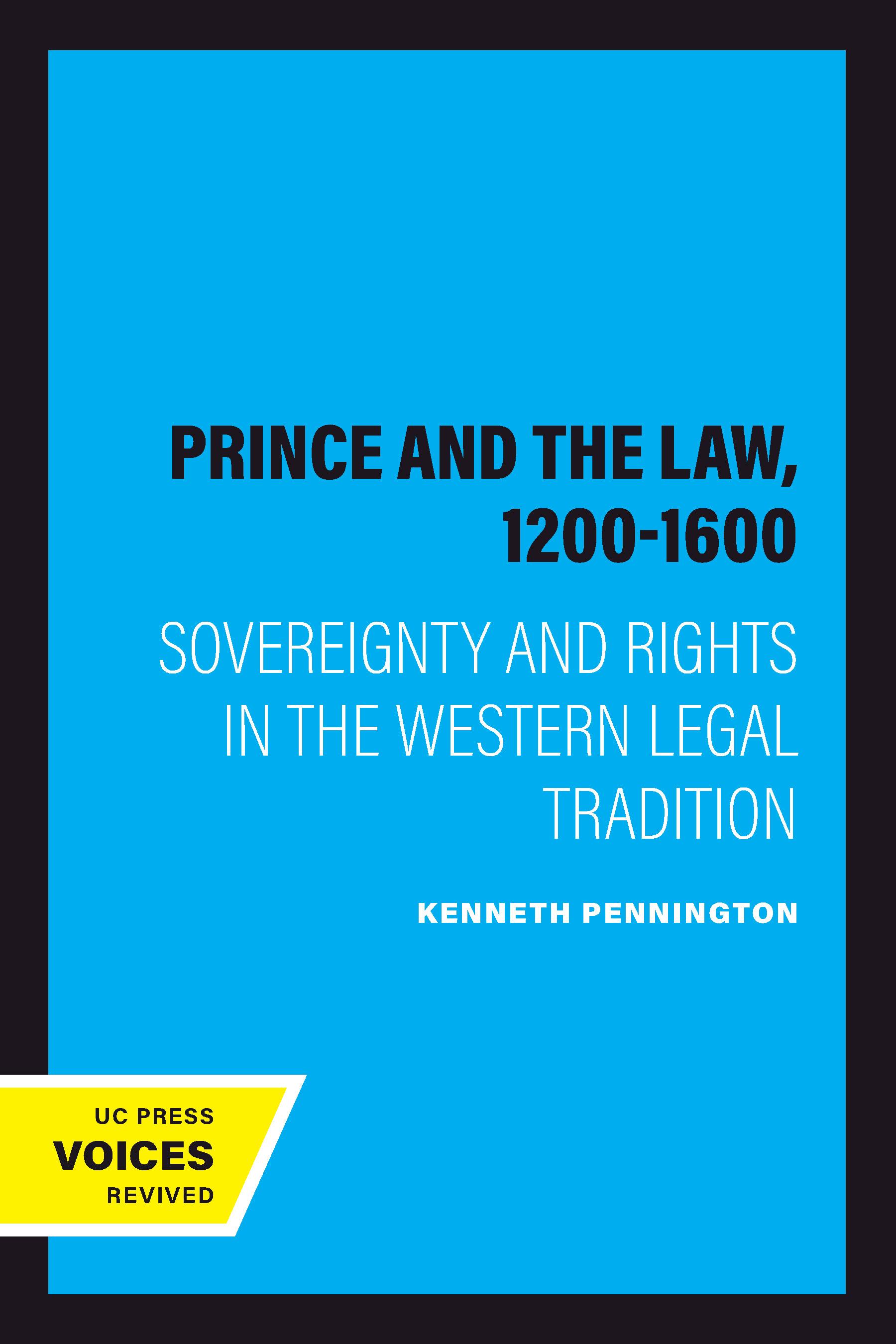
The power of the prince versus the rights of his subjects is one of the basic struggles in the history of law and government. In this masterful history of monarchy, conceptions of law, and due process, Kenneth Pennington addresses that struggle and opens an entirely new vista in the study of Western legal tradition.
Pennington investigates legal interpretations of the monarch's power from the twelfth to the seventeenth century. Then, tracing the evolution of defendants' rights, he demonstrates that the origins of due process are not rooted in English common law as is generally assumed. It was not a sturdy Anglo-Saxon, but, most probably, a French jurist of the late thirteenth century who wrote, "A man is innocent until proven guilty."
This is the first book to examine in detail the origins of our concept of due process. It also reveals a fascinating paradox: while a theory of individual rights was evolving, so, too, was the concept of the prince's "absolute power." Pennington illuminates this paradox with a clarity that will greatly interest students of political theory as well as legal historians.
The power of the prince versus the rights of his subjects is one of the basic struggles in the history of law and government. In this masterful history of monarchy, conceptions of law, and due process, Kenneth Pennington addresses that struggle and opens
Pennington investigates legal interpretations of the monarch's power from the twelfth to the seventeenth century. Then, tracing the evolution of defendants' rights, he demonstrates that the origins of due process are not rooted in English common law as is generally assumed. It was not a sturdy Anglo-Saxon, but, most probably, a French jurist of the late thirteenth century who wrote, "A man is innocent until proven guilty."
This is the first book to examine in detail the origins of our concept of due process. It also reveals a fascinating paradox: while a theory of individual rights was evolving, so, too, was the concept of the prince's "absolute power." Pennington illuminates this paradox with a clarity that will greatly interest students of political theory as well as legal historians.
The power of the prince versus the rights of his subjects is one of the basic struggles in the history of law and government. In this masterful history of monarchy, conceptions of law, and due process, Kenneth Pennington addresses that struggle and opens
Zahle einfach mit Karte, Klarna, Apple Pay oder Google Pay. Nicht zufrieden? Du hast immer ein 14-tägiges Widerrufsrecht. Lies mehr in unseren AGB. Hast du Fragen, schreib uns eine E-Mail an hello@memmo.org.
Memmo macht das Lernen einfacher – wo auch immer du bist. Bei uns findest du deine Kursbücher und smarte Lerntools an einem Ort: Zusammenfassungen, Quizzes, Podcasts und Lernkarten. Und Ted, dein Lernbuddy, beantwortet alles, was du wissen möchtest. Über 50.000 Studierende lernen bereits hier – gemacht, damit du schneller lernst und weniger Stress hast.
Das könnte dir auch gefallen
Buch kaufen0