
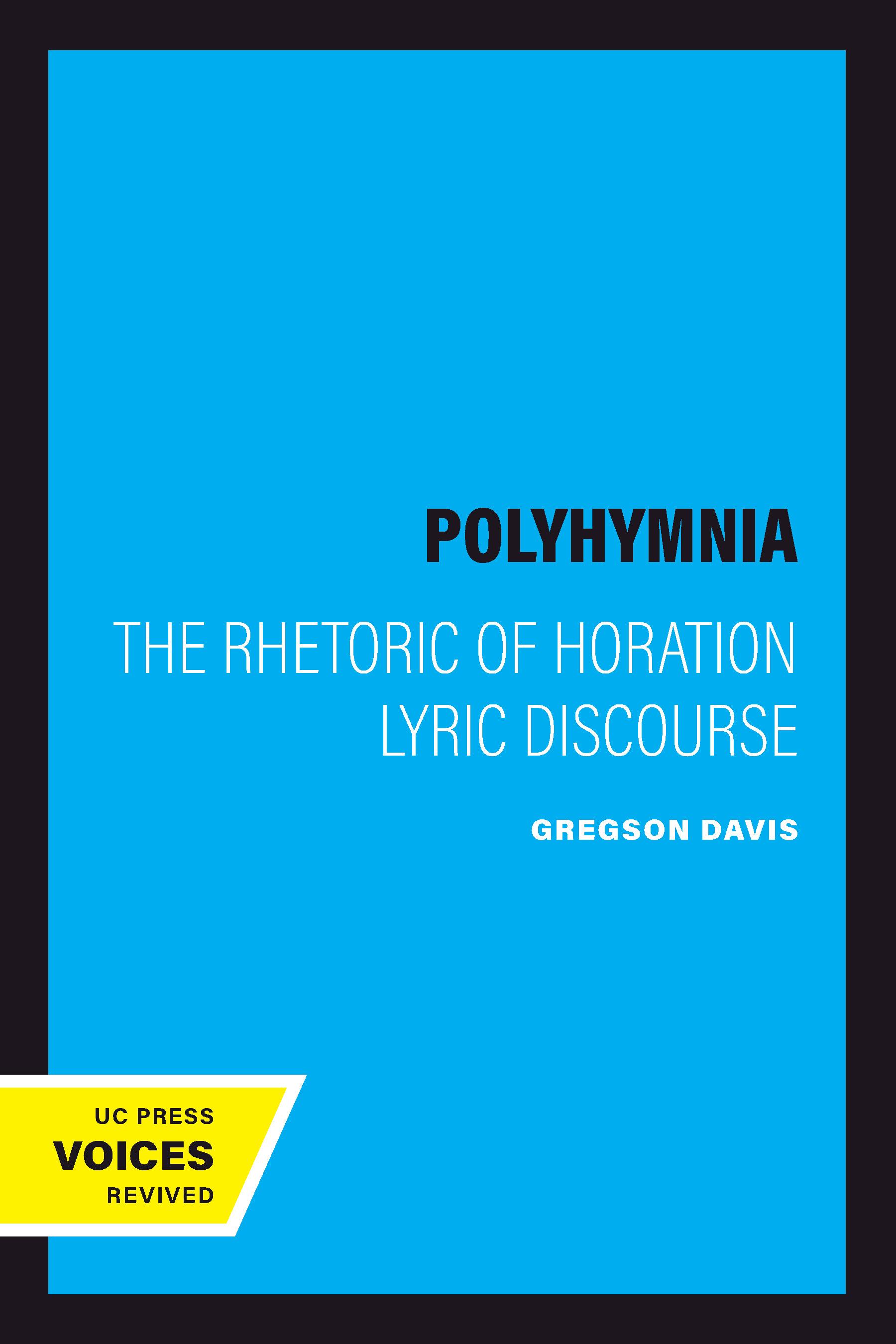
Horace's Odes have a surface translucency that belies their rhetorical sophistication. Gregson Davis brings together recent trends in the study of Augustan poetry and critical theory and deftly applies them to individual poems. Exploring four rhetorical strategies—what he calls modes of assimilation, authentication, consolation, and praise and dispraise—Davis produces enlightening, new interpretations of this classic work.
Polyhymnia, named after one of the Muses invoked in Horace's opening poem, revises the common image of Horace as a complacent, uncomplicated, and basically superficial singer. Focusing on the artistic persona—the lyric "self" that is constituted in the text—Davis explores how the lyric speaker constructs subtle "arguments" whose building-blocks are topoi, recurrent motifs, and generic conventions. By examining the substructure of lyric argument in groupings of poems sharing similar strategies, the author discloses the major principles that inform Horatian lyric composition.
Horace's Odes have a surface translucency that belies their rhetorical sophistication. Gregson Davis brings together recent trends in the study of Augustan poetry and critical theory and deftly applies them to individual poems. Exploring four rheto
Polyhymnia, named after one of the Muses invoked in Horace's opening poem, revises the common image of Horace as a complacent, uncomplicated, and basically superficial singer. Focusing on the artistic persona—the lyric "self" that is constituted in the text—Davis explores how the lyric speaker constructs subtle "arguments" whose building-blocks are topoi, recurrent motifs, and generic conventions. By examining the substructure of lyric argument in groupings of poems sharing similar strategies, the author discloses the major principles that inform Horatian lyric composition.
Horace's Odes have a surface translucency that belies their rhetorical sophistication. Gregson Davis brings together recent trends in the study of Augustan poetry and critical theory and deftly applies them to individual poems. Exploring four rheto
Zahle einfach mit Karte, Klarna, Apple Pay oder Google Pay. Nicht zufrieden? Du hast immer ein 14-tägiges Widerrufsrecht. Lies mehr in unseren AGB. Hast du Fragen, schreib uns eine E-Mail an hello@memmo.org.
Memmo macht das Lernen einfacher – wo auch immer du bist. Bei uns findest du deine Kursbücher und smarte Lerntools an einem Ort: Zusammenfassungen, Quizzes, Podcasts und Lernkarten. Und Ted, dein Lernbuddy, beantwortet alles, was du wissen möchtest. Über 50.000 Studierende lernen bereits hier – gemacht, damit du schneller lernst und weniger Stress hast.
Das könnte dir auch gefallen
Buch kaufen0