
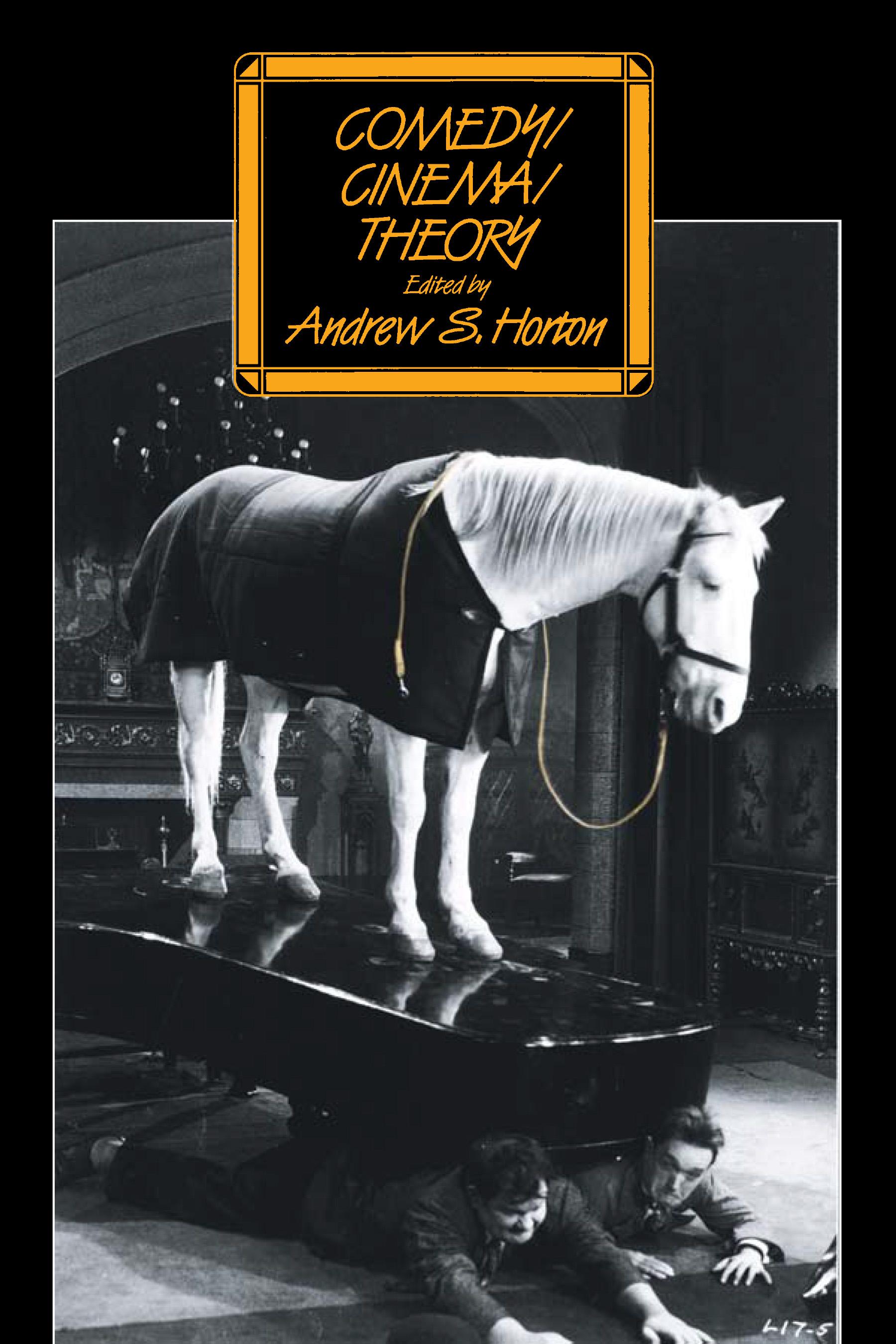
The nature of comedy has interested many thinkers, from Plato to Freud, but film comedy has not received much theoretical attention in recent years. The essays in Comedy/Cinema/Theory use a range of critical and theoretical approaches to explore this curious and fascinating subject. The result is a stimulating, informative book for anyone interested in film, humor, and the art of bringing the two together.
Comedy remains a central human preoccupation, despite the vagaries in form that it has assumed over the centuries in different media. In his introduction, Horton surveys the history of the study of comedy, from Aristophanes to the present, and he also offers a perspective on other related comic forms: printed fiction, comic books, TV sitcoms, jokes and gags.
Some essays in the collection focus on general issues concerning comedy and cinema. In lively (and often humorous) prose, such scholars as Lucy Fischer, Noel Carroll, Peter Lehman, and Brian Henderson employ feminist, post-Freudian, neo-Marxist, and Bakhtinian methodologies. The remaining essays bring theoretical considerations to bear on specific works and comic filmmakers. Peter Brunette, William Paul, Scott Bukatman, Dana Polan, Charles Eidsvik, Ruth Perlmutter, Stephen Mamber, and Andrew Horton provide different perspectives for analyzing The Three Stooges, Chaplin, Jerry Lewis, Woody Allen, Dusan Makavejev, and Alfred Hitchcock's sole comedy, Mr. and Mrs. Smith, as well as the peculiar genre of cynical humor from Eastern Europe.
As editor Horton notes, an over-arching theory of film comedy does not emanate from these essays. Yet the diversity and originality of the contributions reflect vital and growing interest in the subject, and both students of film and general moviegoers will relish the results.
The nature of comedy has interested many thinkers, from Plato to Freud, but film comedy has not received much theoretical attention in recent years. The essays in Comedy/Cinema/Theory use a range of critical and theoretical approaches to explore th
Comedy remains a central human preoccupation, despite the vagaries in form that it has assumed over the centuries in different media. In his introduction, Horton surveys the history of the study of comedy, from Aristophanes to the present, and he also offers a perspective on other related comic forms: printed fiction, comic books, TV sitcoms, jokes and gags.
Some essays in the collection focus on general issues concerning comedy and cinema. In lively (and often humorous) prose, such scholars as Lucy Fischer, Noel Carroll, Peter Lehman, and Brian Henderson employ feminist, post-Freudian, neo-Marxist, and Bakhtinian methodologies. The remaining essays bring theoretical considerations to bear on specific works and comic filmmakers. Peter Brunette, William Paul, Scott Bukatman, Dana Polan, Charles Eidsvik, Ruth Perlmutter, Stephen Mamber, and Andrew Horton provide different perspectives for analyzing The Three Stooges, Chaplin, Jerry Lewis, Woody Allen, Dusan Makavejev, and Alfred Hitchcock's sole comedy, Mr. and Mrs. Smith, as well as the peculiar genre of cynical humor from Eastern Europe.
As editor Horton notes, an over-arching theory of film comedy does not emanate from these essays. Yet the diversity and originality of the contributions reflect vital and growing interest in the subject, and both students of film and general moviegoers will relish the results.
The nature of comedy has interested many thinkers, from Plato to Freud, but film comedy has not received much theoretical attention in recent years. The essays in Comedy/Cinema/Theory use a range of critical and theoretical approaches to explore th
Zahle einfach mit Karte, Klarna, Apple Pay oder Google Pay. Nicht zufrieden? Du hast immer ein 14-tägiges Widerrufsrecht. Lies mehr in unseren AGB. Hast du Fragen, schreib uns eine E-Mail an hello@memmo.org.
Memmo macht das Lernen einfacher – wo auch immer du bist. Bei uns findest du deine Kursbücher und smarte Lerntools an einem Ort: Zusammenfassungen, Quizzes, Podcasts und Lernkarten. Und Ted, dein Lernbuddy, beantwortet alles, was du wissen möchtest. Über 50.000 Studierende lernen bereits hier – gemacht, damit du schneller lernst und weniger Stress hast.
Das könnte dir auch gefallen
Buch kaufen0