
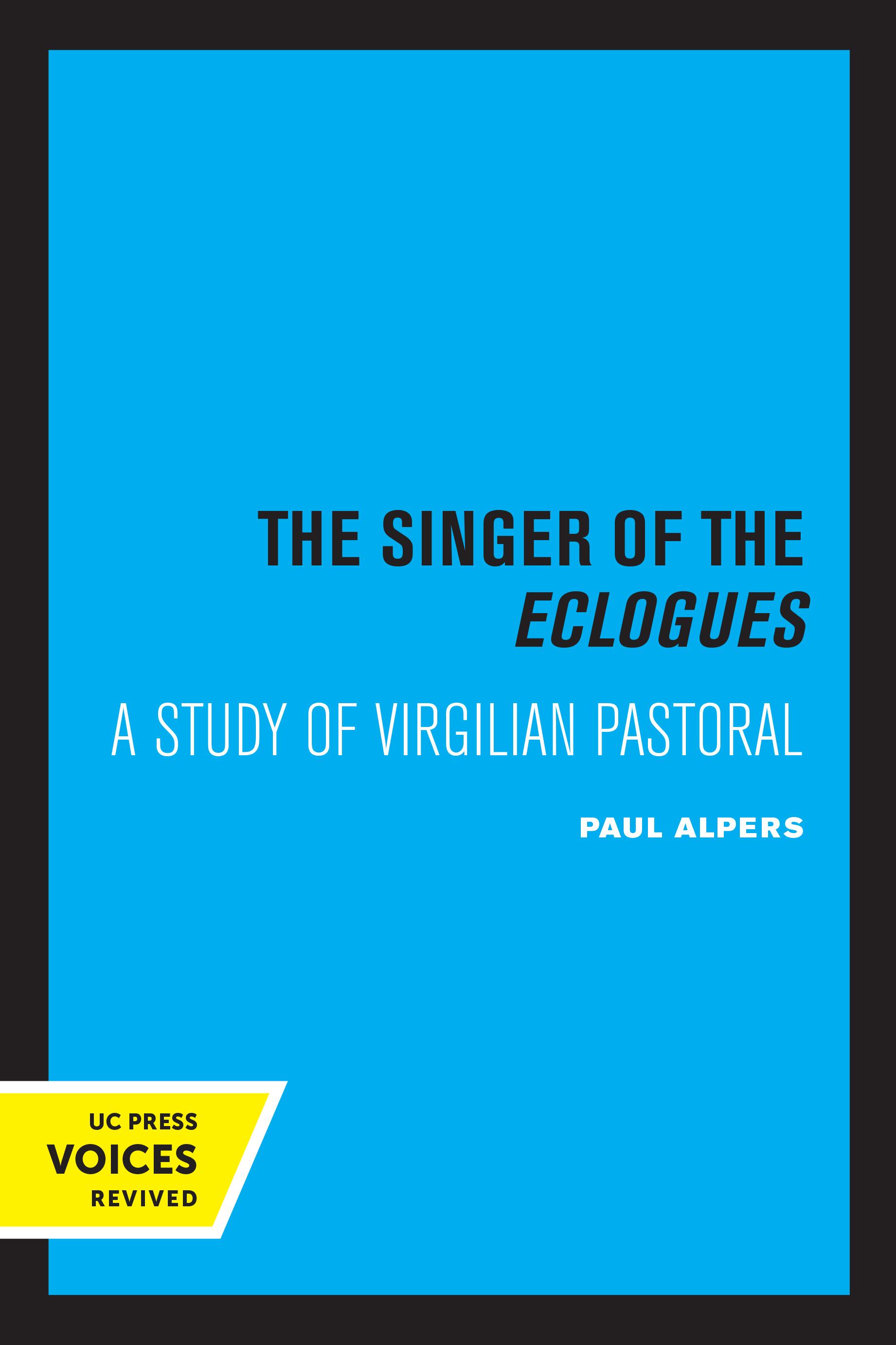
Paul Alpers's Singer of the Eclogues argues that Virgil's ten*Eclogues (composed c. 42–38 BCE) are the single most consequential document in the pastoral tradition—formative for Renaissance poetry and exemplary of the mode's possibilities—yet oddly neglected outside classics. Written under the first triumvirate amid civil war, not under Augustan stability, the poems imitate and converse with Theocritus without making him a lesser poet. Alpers pairs a new, reader-oriented translation with granular lexical and grammatical guidance, but refuses to simplify critical stakes. He stresses order and design (the book's transmitted sequence is purposeful) and reframes pastoral not as escapist landscape painting but as a **mode**—a self-conscious poetry of song, voice, and human community that measures "man's strength relative to the world." Drawing on Dante's reverent epithet, "the singer of the bucolic songs," Alpers shows how pastoral binds poets across time, holding humility and tradition together with a claim to essential truths. Against romanticized "golden age" readings (Poggioli) or allegory-hunting that values the genre only when it cancels itself, he follows Empson and Rosenmeyer in treating pastoral as an ethical fiction: human lives equated with shepherds' lives, their talk, songs, and shared pleasures. That lens clarifies the famous opening of **Eclogue 1**, where dispossessed Meliboeus envies Tityrus's shade and flute: the God who grants Tityrus otium (politically Octavian, poetically a patron) is named within a world of eviction and fear. For Alpers, such scenes dramatize pastoral's power and its limits: it cannot speak to everything, but it can model how poetry faces historical burden through modest means—song, fellowship, tradition. In an era skeptical of voice, presence, and inherited forms, Alpers contends, pastoral's diffident self-awareness remains timely: it admits the pains of life and the dilemmas of language, yet still forges communities of recognition among singers, listeners, and later readers. This title is part of UC Press's Voices Revived program, which commemorates University of California Press's mission to seek out and cultivate the brightest minds and give them voice, reach, and impact. Drawing on a backlist dating to 1893, Voices Revived makes high-quality, peer-reviewed scholarship accessible once again using print-on-demand technology. This title was originally published in 1979.
Many titles in the Voices Revived program are also newly available as books, offered at a discounted price to support wider access to scholarly work.
Many titles in the Voices Revived program are also newly available as books, offered at a discounted price to support wider access to scholarly work.
Zahle einfach mit Karte, Klarna, Apple Pay oder Google Pay. Nicht zufrieden? Du hast immer ein 14-tägiges Widerrufsrecht. Lies mehr in unseren AGB. Hast du Fragen, schreib uns eine E-Mail an hello@memmo.org.
Memmo macht das Lernen einfacher – wo auch immer du bist. Bei uns findest du deine Kursbücher und smarte Lerntools an einem Ort: Zusammenfassungen, Quizzes, Podcasts und Lernkarten. Und Ted, dein Lernbuddy, beantwortet alles, was du wissen möchtest. Über 50.000 Studierende lernen bereits hier – gemacht, damit du schneller lernst und weniger Stress hast.
Das könnte dir auch gefallen
Buch kaufen0