
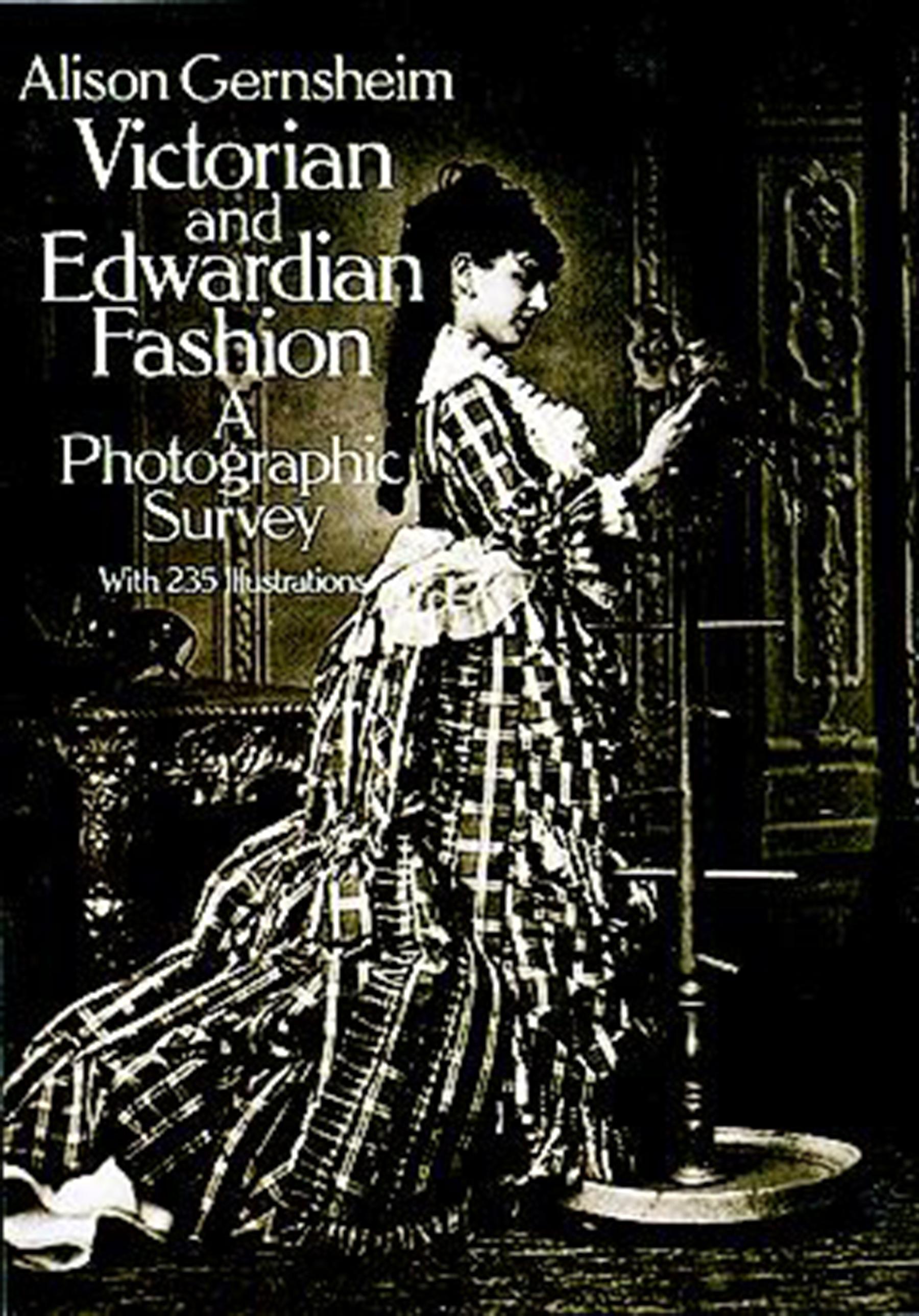
Since the invention of photography there has not been a history of fashion completely illustrated by photographs — until this one. Photography historian Alison Gernsheim first studied Victorian and Edwardian fashion in order to be able to date photographs in her collection. Of course the photos soon proved to be the best of all fashion plates — authentic, detailed, as decorative and charming as top fashion illustration. When united with identifications and descriptions of the chief costume articles, and a commentary that includes childhood memories of the period, the resulting history is doubly indispensable — equally useful and delightful to serious and casual readers.
The invention of photography preceded that of the crinoline by about a decade. Pre-crinoline bonnets, stovepipe hats, and deep décolletage are featured in the first of these 235 illustrations — including a beautiful 1840 daguerreotype portrait of a lady that is the earliest study of its kind extant. From 1855 to the 1870s the crinoline gave shape (whether barrel, bell, teapot, or otherwise) to English women, and their shapes fill many of these full and half-page photos. English men went beardless in top hats and frock coats; as in other eras, the sporting wear of the previous generation became acceptable morning and evening town attire. Styles and accoutrements came and went — moustaches, straw hats, bustles and bodice line, petticoats, corsets, shawls and falsies, flounces, ruffles, lace, and materials — satin, silk, velvet, woolen underwear, full-length sable, and osprey feathers. Many of the models for these fashions were already fashionable enough — Oscar Wilde, Aubrey Beardsley, Lillie Langtry, Winston Churchill, many archdukes, duchesses, counts, princes, and Queen Victoria herself. Photographers are identified where possible, and include Nadar, Lewis Carroll, and the Downeys. Every photograph is captioned and annotated.
The invention of photography preceded that of the crinoline by about a decade. Pre-crinoline bonnets, stovepipe hats, and deep décolletage are featured in the first of these 235 illustrations — including a beautiful 1840 daguerreotype portrait of a lady that is the earliest study of its kind extant. From 1855 to the 1870s the crinoline gave shape (whether barrel, bell, teapot, or otherwise) to English women, and their shapes fill many of these full and half-page photos. English men went beardless in top hats and frock coats; as in other eras, the sporting wear of the previous generation became acceptable morning and evening town attire. Styles and accoutrements came and went — moustaches, straw hats, bustles and bodice line, petticoats, corsets, shawls and falsies, flounces, ruffles, lace, and materials — satin, silk, velvet, woolen underwear, full-length sable, and osprey feathers. Many of the models for these fashions were already fashionable enough — Oscar Wilde, Aubrey Beardsley, Lillie Langtry, Winston Churchill, many archdukes, duchesses, counts, princes, and Queen Victoria herself. Photographers are identified where possible, and include Nadar, Lewis Carroll, and the Downeys. Every photograph is captioned and annotated.
Zahle einfach mit Karte, Klarna, Apple Pay oder Google Pay. Nicht zufrieden? Du hast immer ein 14-tägiges Widerrufsrecht. Lies mehr in unseren AGB. Hast du Fragen, schreib uns eine E-Mail an hello@memmo.org.
Memmo macht das Lernen einfacher – wo auch immer du bist. Bei uns findest du deine Kursbücher und smarte Lerntools an einem Ort: Zusammenfassungen, Quizzes, Podcasts und Lernkarten. Und Ted, dein Lernbuddy, beantwortet alles, was du wissen möchtest. Über 50.000 Studierende lernen bereits hier – gemacht, damit du schneller lernst und weniger Stress hast.
Das könnte dir auch gefallen
Buch kaufen0