
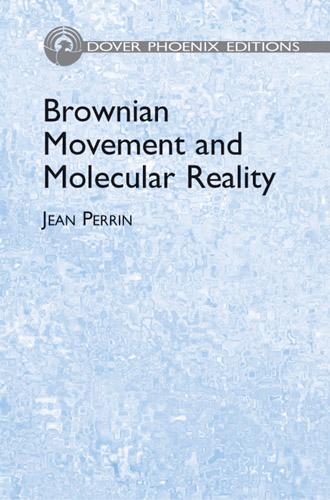
How do we know that molecules really exist? An important clue came from Brownian movement, a concept developed in 1827 by botanist Robert Brown, who noticed that tiny objects like pollen grains shook and moved erratically when viewed under a microscope. Nearly 80 years later, in 1905, Albert Einstein explained this "Brownian motion" as the result of bombardment by molecules. Einstein offered a quantitative explanation by mathematically estimating the average distance covered by the particles over time as a result of molecular bombardment. Four years later, Jean Baptiste Perrin wrote Brownian Movement and Molecular Reality, a work that explains his painstaking measurements of the displacements of particles of a resin suspended in water — experiments that yielded average displacements in excellent accord with Einstein's theoretical prediction.
The studies of Einstein and Perrin provided some of the first concrete evidence for the existence of molecules. Perrin, whose name is familiar to all who employ his methods for calculations in molecular dynamics, received the 1926 Nobel Prize in physics. In this classic paper, he introduced the concept of Avogadro's number, along with other groundbreaking work. Originally published in the French journal Annates de chimie et de physique, it was translated into English by Frederick Soddy to enduring influence and acclaim.
Zahle einfach mit Karte, Klarna, Apple Pay oder Google Pay. Nicht zufrieden? Du hast immer ein 14-tägiges Widerrufsrecht. Lies mehr in unseren AGB. Hast du Fragen, schreib uns eine E-Mail an hello@memmo.org.
Memmo macht das Lernen einfacher – wo auch immer du bist. Bei uns findest du deine Kursbücher und smarte Lerntools an einem Ort: Zusammenfassungen, Quizzes, Podcasts und Lernkarten. Und Ted, dein Lernbuddy, beantwortet alles, was du wissen möchtest. Über 50.000 Studierende lernen bereits hier – gemacht, damit du schneller lernst und weniger Stress hast.