
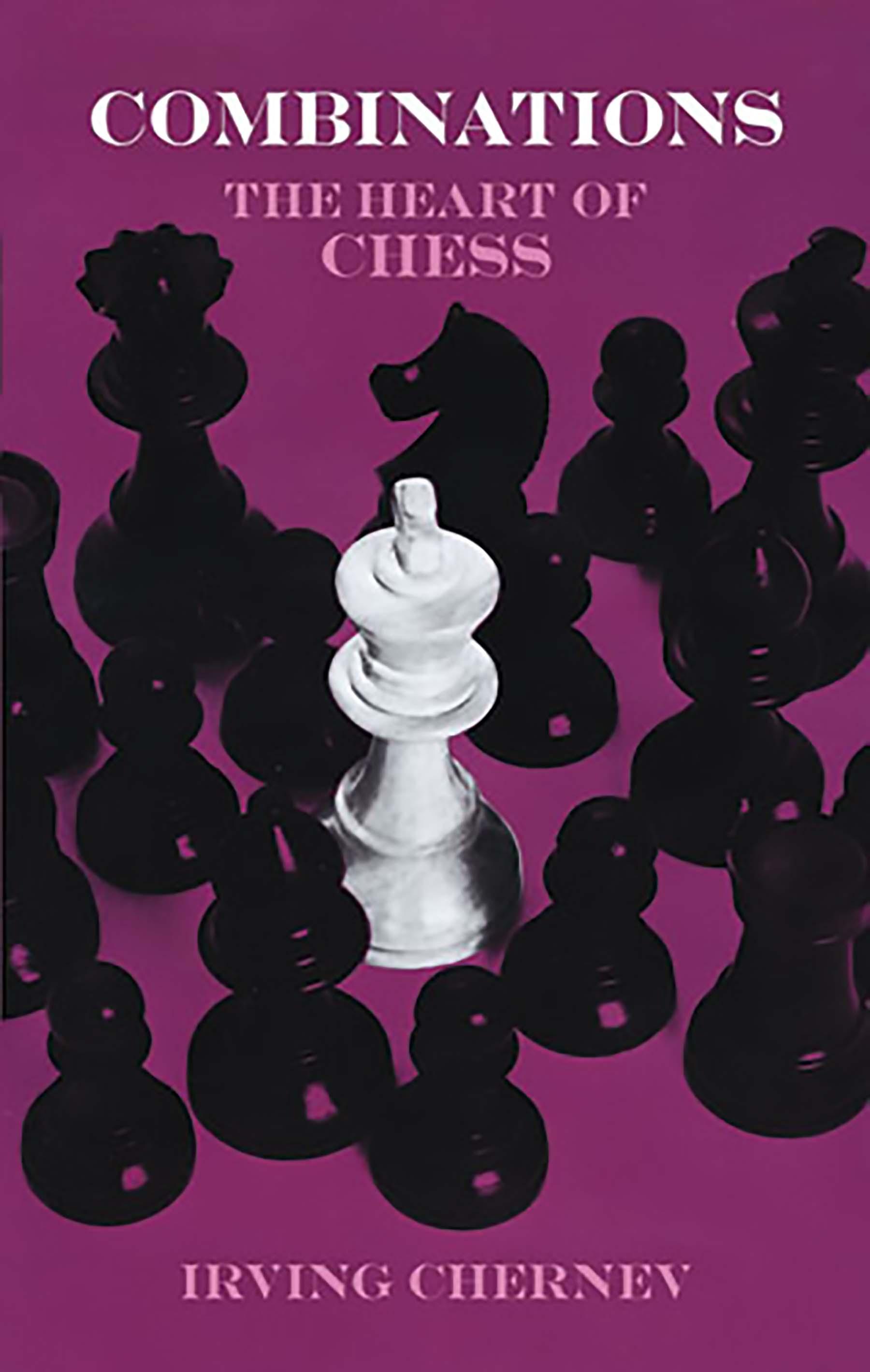
Irving Chernev's outstanding chess books earn him a high rank among the world's top chess authors. In this well-annotated text, Mr. Chernev guides his readers to an understanding of the subtleties of combinative play.
Step-by-step from the simplest combinations to the most complex, the book explains the intricacies of pins and counter-pins, Knight forks, smothered mates, and other elements of combination play. There is a discussion in chapter five of combinations lurking in roads not taken — alternate lines of play show up in Chernev's notes to the game, while the sixth chapter, "Convincing the Kibitzers," shows the second-guessers what would have happened had the masters done the obvious. (Some disastrous combinations show up here.) A host of boomerangs follow — cases where the player didn't look far enough ahead and his combination, instead of bringing about the opponent's ruin, paved the way to his defeat. Chapters eight through twenty one take up combinations used by such great players as Tarrasch, Botvinnik, Nimzovich, Steinitz, Rubinstein, and Pillsbury; the sacrificial combinations of Anderssen and Spielmann; the dazzling brilliancies of Morphy, Keres, and Alekhine; the deadly attacks of Marshall; the almost unfathomable ideas of Lasker; and the matchless creations of Capablanca. Mr. Chernev's thoughtful annotations unravel the secrets of each of these plans. A diagram accompanies each combination; an index, by player, leads the reader to the combination he is looking for.
Step-by-step from the simplest combinations to the most complex, the book explains the intricacies of pins and counter-pins, Knight forks, smothered mates, and other elements of combination play. There is a discussion in chapter five of combinations lurking in roads not taken — alternate lines of play show up in Chernev's notes to the game, while the sixth chapter, "Convincing the Kibitzers," shows the second-guessers what would have happened had the masters done the obvious. (Some disastrous combinations show up here.) A host of boomerangs follow — cases where the player didn't look far enough ahead and his combination, instead of bringing about the opponent's ruin, paved the way to his defeat. Chapters eight through twenty one take up combinations used by such great players as Tarrasch, Botvinnik, Nimzovich, Steinitz, Rubinstein, and Pillsbury; the sacrificial combinations of Anderssen and Spielmann; the dazzling brilliancies of Morphy, Keres, and Alekhine; the deadly attacks of Marshall; the almost unfathomable ideas of Lasker; and the matchless creations of Capablanca. Mr. Chernev's thoughtful annotations unravel the secrets of each of these plans. A diagram accompanies each combination; an index, by player, leads the reader to the combination he is looking for.
Zahle einfach mit Karte, Klarna, Apple Pay oder Google Pay. Nicht zufrieden? Du hast immer ein 14-tägiges Widerrufsrecht. Lies mehr in unseren AGB. Hast du Fragen, schreib uns eine E-Mail an hello@memmo.org.
Memmo macht das Lernen einfacher – wo auch immer du bist. Bei uns findest du deine Kursbücher und smarte Lerntools an einem Ort: Zusammenfassungen, Quizzes, Podcasts und Lernkarten. Und Ted, dein Lernbuddy, beantwortet alles, was du wissen möchtest. Über 50.000 Studierende lernen bereits hier – gemacht, damit du schneller lernst und weniger Stress hast.
Das könnte dir auch gefallen
Buch kaufen0