
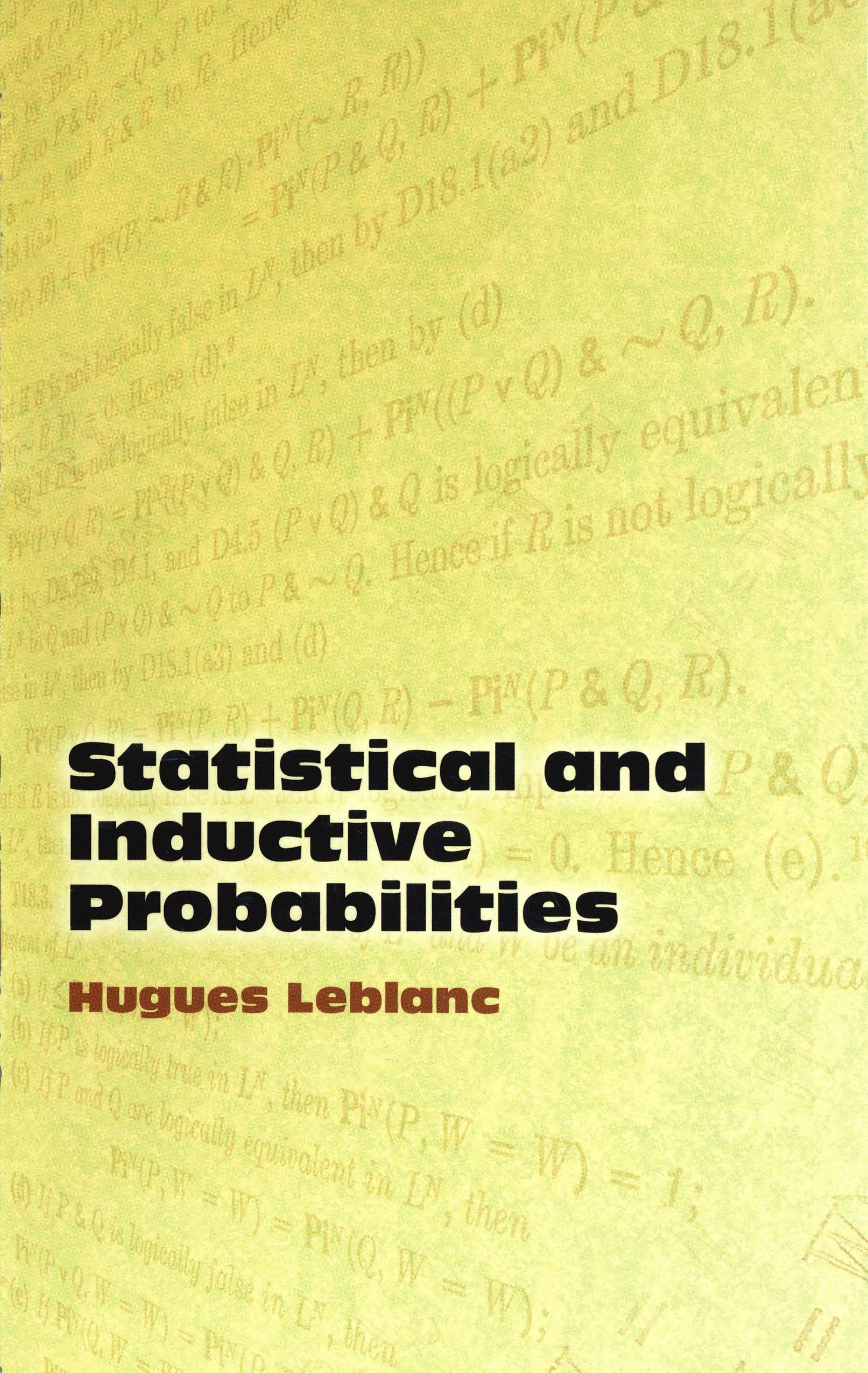
Among probability theorists, a bitter controversy has raged for decades between the adherents of John Maynard Keynes' A Treatise on Probability (1921) and those of Richard von Mises' "Grundlagen der Wahrscheinlichkeitsrechnung" (1919). Keynes declared that probabilities measure the extent to which a so-called evidence proposition supports another sentence. Von Mises insisted that they measure the relative frequency with which the members of a so-called reference set belong to another set. Statistical and Inductive Probabilities offers an evenhanded treatment of this issue, asserting that both statistical and inductive probabilities may be treated as sentence-theoretic measurements, and that the latter qualify as estimates of the former.
Beginning with a survey of the essentials of sentence theory and of set theory, author Hugues Leblanc examines statistical probabilities (which are allotted to sets by von Mises' followers), showing that statistical probabilities may be passed on to sentences, and thereby qualify as truth-values. Leblanc concludes with an exploration of inductive probabilities (which Keynes' followers allot to sentences), demonstrating their reinterpretation as estimates of truth-values.
Each chapter is preceded by a summary of its contents. Illustrations accompany most definitions and theorems, and footnotes elucidate technicalities and bibliographical references.
Beginning with a survey of the essentials of sentence theory and of set theory, author Hugues Leblanc examines statistical probabilities (which are allotted to sets by von Mises' followers), showing that statistical probabilities may be passed on to sentences, and thereby qualify as truth-values. Leblanc concludes with an exploration of inductive probabilities (which Keynes' followers allot to sentences), demonstrating their reinterpretation as estimates of truth-values.
Each chapter is preceded by a summary of its contents. Illustrations accompany most definitions and theorems, and footnotes elucidate technicalities and bibliographical references.
Zahle einfach mit Karte, Klarna, Apple Pay oder Google Pay. Nicht zufrieden? Du hast immer ein 14-tägiges Widerrufsrecht. Lies mehr in unseren AGB. Hast du Fragen, schreib uns eine E-Mail an hello@memmo.org.
Memmo macht das Lernen einfacher – wo auch immer du bist. Bei uns findest du deine Kursbücher und smarte Lerntools an einem Ort: Zusammenfassungen, Quizzes, Podcasts und Lernkarten. Und Ted, dein Lernbuddy, beantwortet alles, was du wissen möchtest. Über 50.000 Studierende lernen bereits hier – gemacht, damit du schneller lernst und weniger Stress hast.
Das könnte dir auch gefallen
Buch kaufen0