
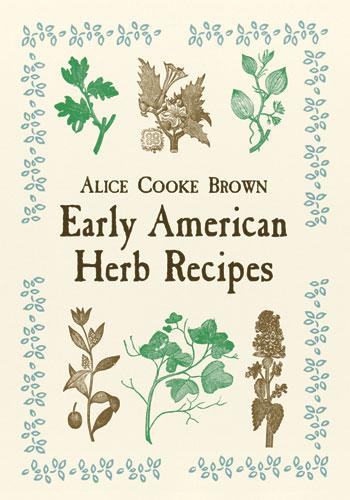
For early American households, the herb garden was an all-purpose medicine chest. Herbs were used to treat apoplexy (lily of the valley), asthma (burdock, horehound), boils (onion), tuberculosis (chickweed, coltsfoot), palpitations (saffron, valerian), jaundice (speedwell, nettles, toad flax), toothache (dittander), hemorrhage (yarrow), hypochondria (mustard, viper grass), wrinkles (cowslip juice), cancers (bean-leaf juice), and various other ailments. But herbs were used for a host of other purposes as well — and in this fascinating book, readers will find a wealth of information on the uses of herbs by homemakers of the past, including more than 500 authentic recipes, given exactly as they appeared in their original sources.
Selected from such early American cookbook classics as Miss Leslie's Directions for Cookery, Mary Randolph's The Virginia Housewife, Lydia Child's The American Frugal Housewife, and other rare publications, the recipes cover the use of herbs for medicinal, culinary, cosmetic, and other purposes. Readers will discover not only how herbs were used in making vegetable and meat dishes, gravies and sauces, cakes, pies, soups, and beverages, but also how our ancestors employed them in making dyes, furniture polish, insecticides, spot removers, perfumes, hair tonics, soaps, tooth powders, and numerous other products. While some formulas are completely fantastic, others (such as a sunburn ointment made from hog's lard and elder flowers) were based on long experience and produced excellent results.
More than 100 fine nineteenth-century engravings of herbs add to the charm of this enchanting volume — an invaluable reference and guide for plant lovers and herb enthusiasts that will "delight and astound the twentieth-century reader." (Library Journal).
Selected from such early American cookbook classics as Miss Leslie's Directions for Cookery, Mary Randolph's The Virginia Housewife, Lydia Child's The American Frugal Housewife, and other rare publications, the recipes cover the use of herbs for medicinal, culinary, cosmetic, and other purposes. Readers will discover not only how herbs were used in making vegetable and meat dishes, gravies and sauces, cakes, pies, soups, and beverages, but also how our ancestors employed them in making dyes, furniture polish, insecticides, spot removers, perfumes, hair tonics, soaps, tooth powders, and numerous other products. While some formulas are completely fantastic, others (such as a sunburn ointment made from hog's lard and elder flowers) were based on long experience and produced excellent results.
More than 100 fine nineteenth-century engravings of herbs add to the charm of this enchanting volume — an invaluable reference and guide for plant lovers and herb enthusiasts that will "delight and astound the twentieth-century reader." (Library Journal).
Zahle einfach mit Karte, Klarna, Apple Pay oder Google Pay. Nicht zufrieden? Du hast immer ein 14-tägiges Widerrufsrecht. Lies mehr in unseren AGB. Hast du Fragen, schreib uns eine E-Mail an hello@memmo.org.
Memmo macht das Lernen einfacher – wo auch immer du bist. Bei uns findest du deine Kursbücher und smarte Lerntools an einem Ort: Zusammenfassungen, Quizzes, Podcasts und Lernkarten. Und Ted, dein Lernbuddy, beantwortet alles, was du wissen möchtest. Über 50.000 Studierende lernen bereits hier – gemacht, damit du schneller lernst und weniger Stress hast.
Das könnte dir auch gefallen
Buch kaufen0