
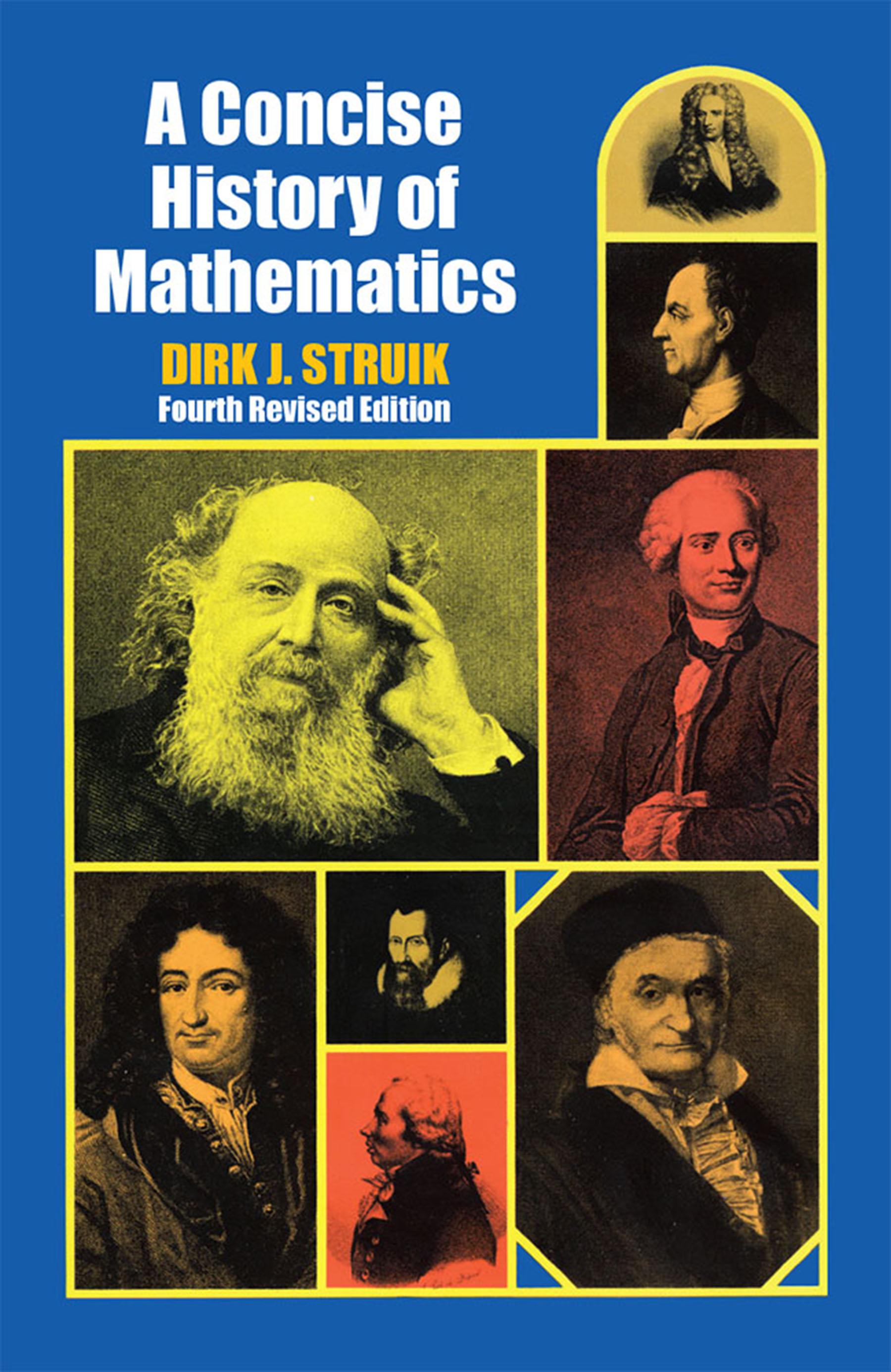
This compact, well-written history — first published in 1948, and now in its fourth revised edition — describes the main trends in the development of all fields of mathematics from the first available records to the middle of the 20th century. Students, researchers, historians, specialists — in short, everyone with an interest in mathematics — will find it engrossing and stimulating.
Beginning with the ancient Near East, the author traces the ideas and techniques developed in Egypt, Babylonia, China, and Arabia, looking into such manuscripts as the Egyptian Papyrus Rhind, the Ten Classics of China, and the Siddhantas of India. He considers Greek and Roman developments from their beginnings in Ionian rationalism to the fall of Constantinople; covers medieval European ideas and Renaissance trends; analyzes 17th- and 18th-century contributions; and offers an illuminating exposition of 19th century concepts. Every important figure in mathematical history is dealt with — Euclid, Archimedes, Diophantus, Omar Khayyam, Boethius, Fermat, Pascal, Newton, Leibniz, Fourier, Gauss, Riemann, Cantor, and many others.
Beginning with the ancient Near East, the author traces the ideas and techniques developed in Egypt, Babylonia, China, and Arabia, looking into such manuscripts as the Egyptian Papyrus Rhind, the Ten Classics of China, and the Siddhantas of India. He considers Greek and Roman developments from their beginnings in Ionian rationalism to the fall of Constantinople; covers medieval European ideas and Renaissance trends; analyzes 17th- and 18th-century contributions; and offers an illuminating exposition of 19th century concepts. Every important figure in mathematical history is dealt with — Euclid, Archimedes, Diophantus, Omar Khayyam, Boethius, Fermat, Pascal, Newton, Leibniz, Fourier, Gauss, Riemann, Cantor, and many others.
For this latest edition, Dr. Struik has both revised and updated the existing text, and also added a new chapter on the mathematics of the first half of the 20th century. Concise coverage is given to set theory, the influence of relativity and quantum theory, tensor calculus, the Lebesgue integral, the calculus of variations, and other important ideas and concepts. The book concludes with the beginnings of the computer era and the seminal work of von Neumann, Turing, Wiener, and others.
"The author's ability as a first-class historian as well as an able mathematician has enabled him to produce a work which is unquestionably one of the best." — Nature Magazine.
"The author's ability as a first-class historian as well as an able mathematician has enabled him to produce a work which is unquestionably one of the best." — Nature Magazine.
Zahle einfach mit Karte, Klarna, Apple Pay oder Google Pay. Nicht zufrieden? Du hast immer ein 14-tägiges Widerrufsrecht. Lies mehr in unseren AGB. Hast du Fragen, schreib uns eine E-Mail an hello@memmo.org.
Memmo macht das Lernen einfacher – wo auch immer du bist. Bei uns findest du deine Kursbücher und smarte Lerntools an einem Ort: Zusammenfassungen, Quizzes, Podcasts und Lernkarten. Und Ted, dein Lernbuddy, beantwortet alles, was du wissen möchtest. Über 50.000 Studierende lernen bereits hier – gemacht, damit du schneller lernst und weniger Stress hast.
Das könnte dir auch gefallen
Buch kaufen0