
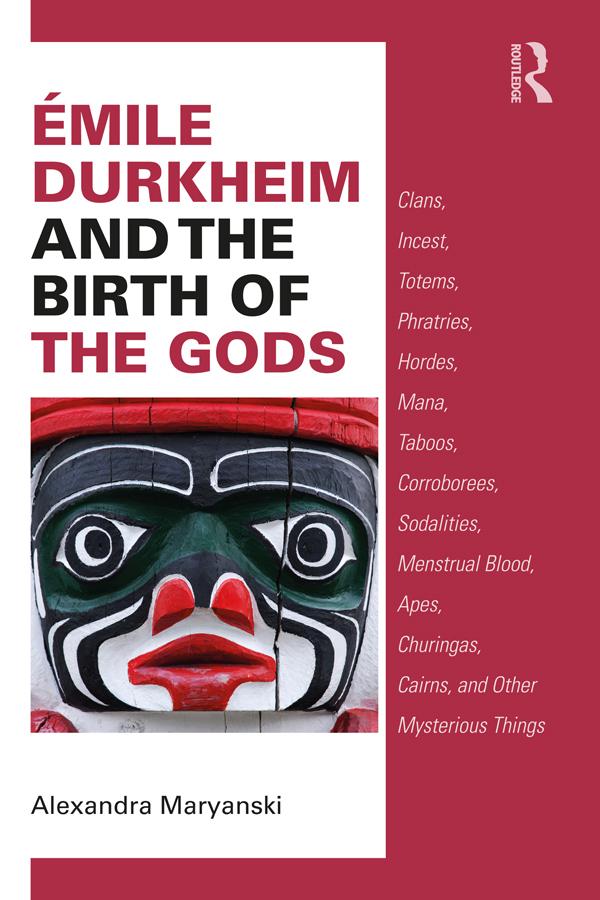
The Birth of the Gods is dedicated to Durkheim's effort to understand the basis of social integration. Unlike most social scientists, then and now, Durkheim concluded that humans are naturally more individualistic than collectivistic, that the primal social unit for humans is the macro-level unit ('the horde'), rather than the family, and that social cohesion is easily disrupted by human self-interest. Hence, for Durkheim, one of the "gravest" problems facing sociology is how to mold these human proclivities to serve the collective good. The analysis of elementary religions, Durkheim believed, would allow social scientists to see the fundamental basis of solidarity in human societies, built around collective representations, totems marking sacred forces, and emotion-arousing rituals directed at these totems.
The first half of the book traces the key influences and events that led Durkheim to embrace such novel generalizations. The second part makes a significant contribution to sociological theory with an analysis that essentially "tests" Durkheim's core assumptions using cladistic analysis, social network tools and theory, and data on humans closest living relatives—the great apes. Maryanski marshals hard data from primatology, paleontology, archaeology, genetics, and neuroscience that enlightens and, surprisingly, confirms many of Durkheim’s speculations. These data show that integration among both humans and great apes is not so much group or kin oriented, per se, but orientation to a community standing outside each individual that includes a sense of self, but also encompassing a cognitive awareness of a "sense of community" or a connectedness that transcends sensory reality and concrete social relations. This "community complex," as Maryanski terms it, is what Durkheim was beginning to see, although he did not have the data to buttress his arguments as Maryanski is able to do.
Zahle einfach mit Karte, Klarna, Apple Pay oder Google Pay. Nicht zufrieden? Du hast immer ein 14-tägiges Widerrufsrecht. Lies mehr in unseren AGB. Hast du Fragen, schreib uns eine E-Mail an hello@memmo.org.
Memmo macht das Lernen einfacher – wo auch immer du bist. Bei uns findest du deine Kursbücher und smarte Lerntools an einem Ort: Zusammenfassungen, Quizzes, Podcasts und Lernkarten. Und Ted, dein Lernbuddy, beantwortet alles, was du wissen möchtest. Über 50.000 Studierende lernen bereits hier – gemacht, damit du schneller lernst und weniger Stress hast.