
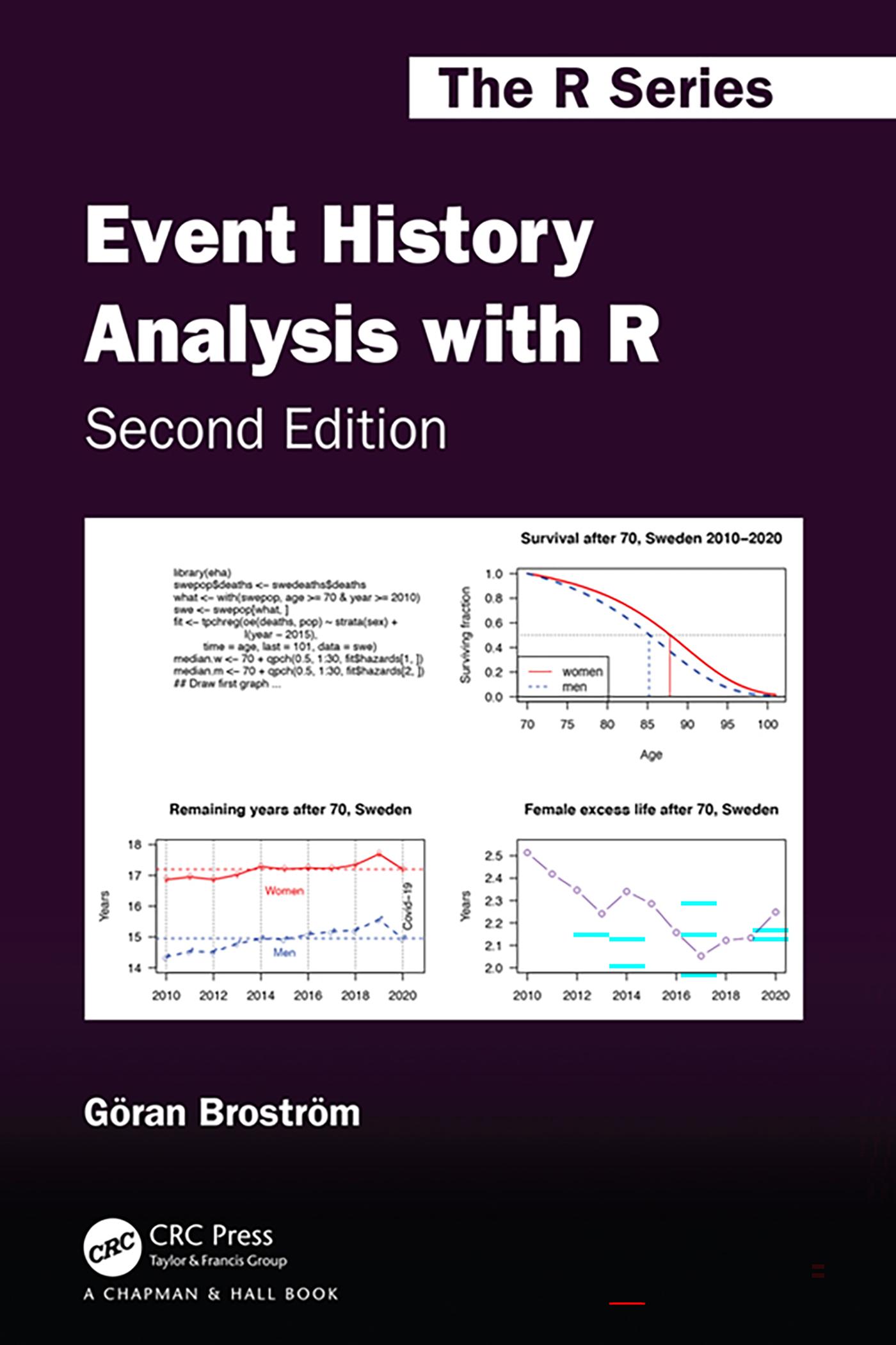
With an emphasis on social science applications, Event History Analysis with R, Second Edition, presents an introduction to survival and event history analysis using real-life examples. Since publication of the first edition, focus in the field has gradually shifted towards the analysis of large and complex datasets. This has led to new ways of tabulating and analysing tabulated data with the same precision and power as that of an analysis of the full data set. Tabulation also makes it possible to share sensitive data with others without violating integrity.
The new edition extends on the content of the first by both improving on already given methods and introducing new methods. There are two new chapters, Explanatory Variables and Regression, and Register- Based Survival Data Models. The book has been restructured to improve the flow, and there are significant updates to the computing in the supporting R package.
Features
• Introduction to survival and event history analysis and how to solve problems with incomplete data
using Cox regression.
• Parametric proportional hazards models, including the Weibull, Exponential, Extreme Value, and
Gompertz distributions.
• Parametric accelerated failure time models with the Lognormal, Loglogistic, Gompertz, Exponential,
Extreme Value, and Weibull distributions.
• Proportional hazards models for occurrence/exposure data, useful with tabular and register based data,
often with a huge amount of observed events.
• Special treatments of external communal covariates, selections from the Lexis diagram, and creating
period as well as cohort statistics.
• “Weird bootstrap” sampling suitable for Cox regression with small to medium-sized data sets.
• Supported by an R package (https://CRAN.R-project.org/package=eha), including code and data for
most examples in the book.
• A dedicated home page for the book at http://ehar.se/r/ehar2
This substantial update to this popular book remains an excellent resource for researchers and practitioners
of applied event history analysis and survival analysis. It can be used as a text for a course for graduate
students or for self-study.
Zahle einfach mit Karte, Klarna, Apple Pay oder Google Pay. Nicht zufrieden? Du hast immer ein 14-tägiges Widerrufsrecht. Lies mehr in unseren AGB. Hast du Fragen, schreib uns eine E-Mail an hello@memmo.org.
Memmo macht das Lernen einfacher – wo auch immer du bist. Bei uns findest du deine Kursbücher und smarte Lerntools an einem Ort: Zusammenfassungen, Quizzes, Podcasts und Lernkarten. Und Ted, dein Lernbuddy, beantwortet alles, was du wissen möchtest. Über 50.000 Studierende lernen bereits hier – gemacht, damit du schneller lernst und weniger Stress hast.