
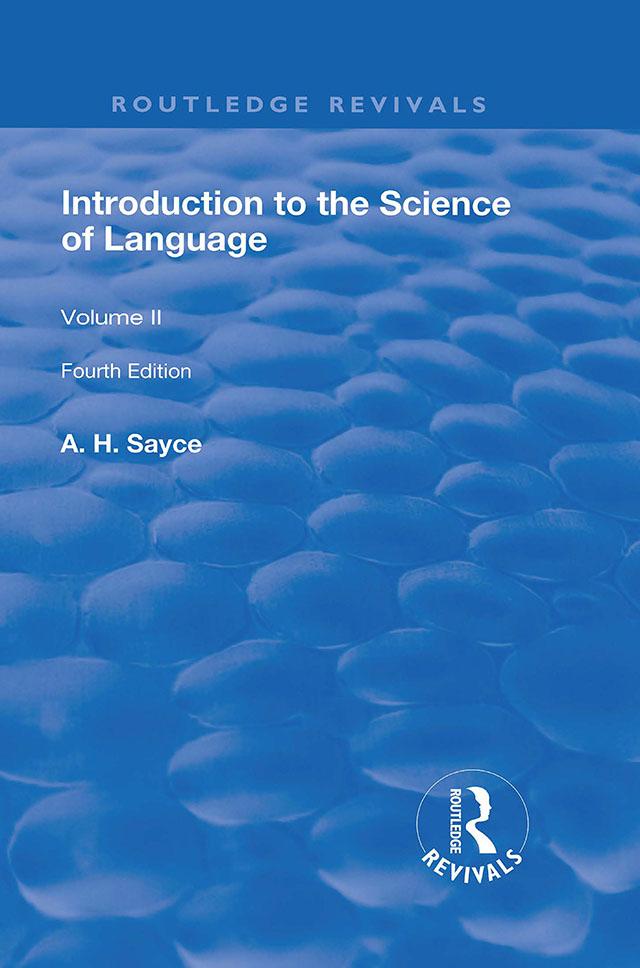
First published in 1900, this is the second of two volumes of the magnum opus from pioneer assyriologist and linguist Rev. Archibald Sayce and continues directly from the first, providing an introduction to linguistic roots, inflectional families of speech, agglutinative, incorporating, polysynthetic and isolating languages, comparative mythology, the science of religion, the origin of language and the relation of language to ethnology, logic and education. In it, Sayce was the first to emphasize the principle of partial assimilation and the linguistic principle of analogy. This 4th edition, ten years after the first, reflected on the limitations of science revealed since 1890, in an era when languages, like other humanities subjects, still idealised scientific approaches.
Archibald Henry Sayce was one of the greatest comparative linguists of the time, being proficient in Accadian, Arabic, Cuneiform, Chinese, Egyptian, Greek, Hebrew, Hittite, Japanese, Latin, Persian, Phoenician, Sanscrit and Sumerian. He had a good knowledge of every Semitic and Indo-European language and could write good prose in at least twenty languages. Sayce's first major contribution to scholarship was a highly significant translation of an Accadian seal, a 'bilingual text' from which to translate cuneiform, similar to the Rosetta Stone. Here then, no doubt, the reader learns from a master of comparative linguistics.
Zahle einfach mit Karte, Klarna, Apple Pay oder Google Pay. Nicht zufrieden? Du hast immer ein 14-tägiges Widerrufsrecht. Lies mehr in unseren AGB. Hast du Fragen, schreib uns eine E-Mail an hello@memmo.org.
Memmo macht das Lernen einfacher – wo auch immer du bist. Bei uns findest du deine Kursbücher und smarte Lerntools an einem Ort: Zusammenfassungen, Quizzes, Podcasts und Lernkarten. Und Ted, dein Lernbuddy, beantwortet alles, was du wissen möchtest. Über 50.000 Studierende lernen bereits hier – gemacht, damit du schneller lernst und weniger Stress hast.