
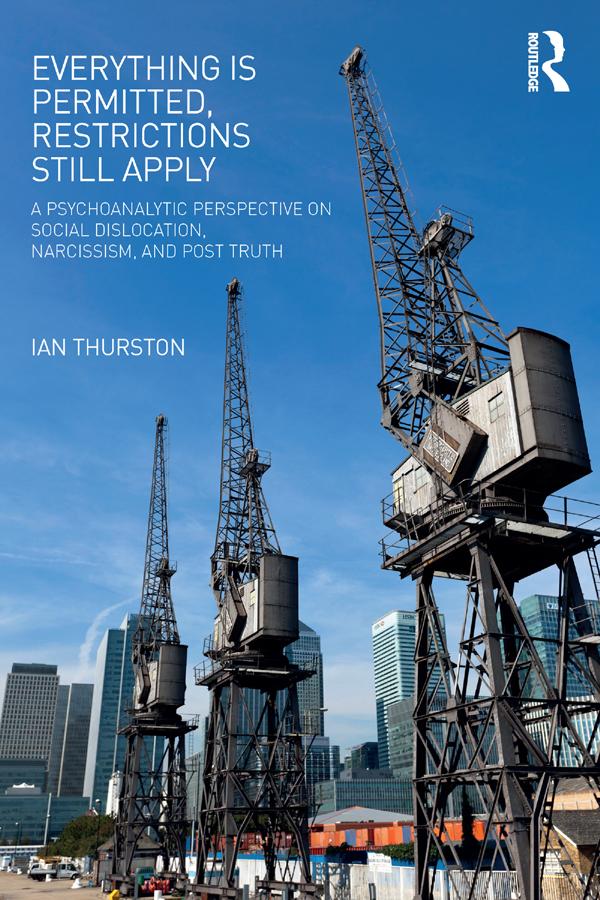
This book applies historicised psychoanalytic thinking in a non-reductive way to better understand the dominant emotional trends in contemporary cultural and socio-political life, with a specific focus on the relationship between social dislocation, narcissism, and "post truth".
Rapid social dislocation and change are ubiquitous in late capitalist societies, though these processes may be felt unequally. Following the work of the late Christopher Lasch, Everything is Permitted, Restrictions Still Apply suggests there are powerful narcissistic trends in contemporary life mitigating against the capacity to acknowledge and face these changes; in other words, against the capacity to face reality and to mourn. There is a tendency to assert the primacy of a compelling emotional narrative over the claims of evidence and expertise, and to relate to others, past and present, as alternately idealised and/or denigrated aspects of the self. These trends permeate across socio-cultural divides and the political spectrum – underpinning phenomena as apparently divergent as free-market fundamentalism, certain forms of anti-capitalism, and contemporary identity and victim politics of both nominal right and left: movements that have more emotional and intellectual underpinnings in common than their proponents may care to admit. The contrast between liberal progressiveness and post-truth populism ignores the inter-relationship of these phenomena and begs the question of those powerful subjectivist and relativistic trends amongst sections of radical and "progressive" opinion that have long sought to problematise the very notion of truth. This book links these phenomena to contemporary social defences against facing limitation, loss, and internal conflict. More specifically it argues that in a pseudo-therapeutic culture preoccupied with narratives of victimhood, the losses associated with "traditional" manufacturing and its attendant associational cultures have neither been acknowledged nor mourned.
Everything is Permitted, Restrictions Still Apply will appeal to all readers interested in history, politics, and socio-cultural analysis, and in new ways of thinking about contemporary issues. It will be of particular interest to researchers applying a psycho-social perspective on contemporary conflict and to a psychoanalytically informed readership.
Zahle einfach mit Karte, Klarna, Apple Pay oder Google Pay. Nicht zufrieden? Du hast immer ein 14-tägiges Widerrufsrecht. Lies mehr in unseren AGB. Hast du Fragen, schreib uns eine E-Mail an hello@memmo.org.
Memmo macht das Lernen einfacher – wo auch immer du bist. Bei uns findest du deine Kursbücher und smarte Lerntools an einem Ort: Zusammenfassungen, Quizzes, Podcasts und Lernkarten. Und Ted, dein Lernbuddy, beantwortet alles, was du wissen möchtest. Über 50.000 Studierende lernen bereits hier – gemacht, damit du schneller lernst und weniger Stress hast.