
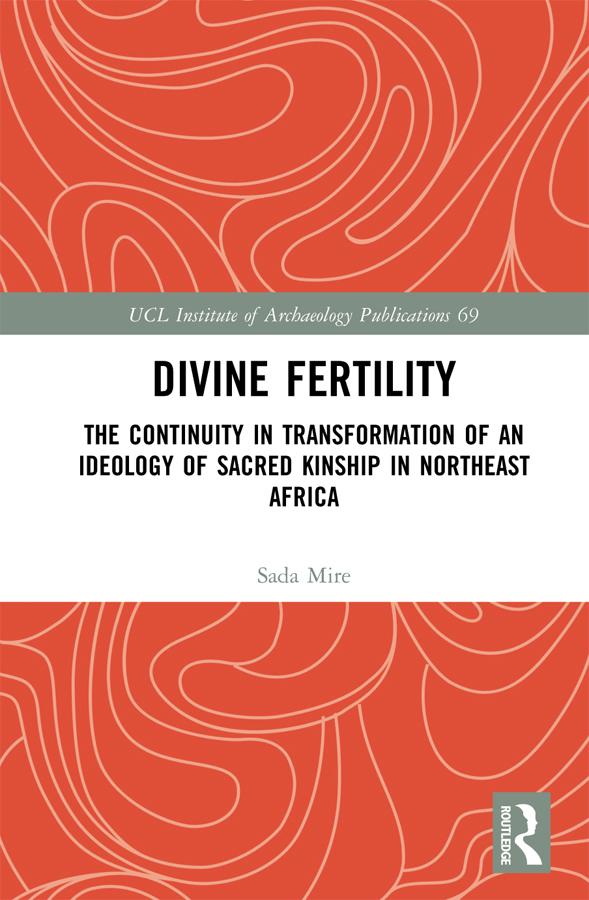
This book uniquely explores the impact of indigenous ideology and thought on everyday life in Northeast Africa. Furthermore, in highlighting the diversity in pre-Christian, pre-Islamic regional beliefs and practices that extend beyond the simplistic political arguments of the current dominant narratives, the study shows that for millennia complex indigenous institutions have bound people together beyond the labels of Christianity and Islam; they have sustained peace through cultural exchange and tolerance (if not always complete acceptance).
Through recent archaeological and ethnographic research, the concepts, landscapes, materials and rituals believed to be associated with the indigenous and shared culture of the Sky-God belief are examined. The author makes sense, for the first time, of the relationship between the notion of sacred fertility and a number of regional archaeological features and on-going ancient practices including FGM, spirit possessions, and other physically invasive practices and the ritual hunt. The book explores one of the most important pilgrimage centres in Somaliland and Somalia, the sacred landscape of Saint Aw-Barkhadle, founded ca. 12th century AD. It is believed to be the burial place of the rulers of the first Muslim Ifat and Awdal dynasties in this region, and potentially the lost first capital of Awdal kingdom before Harar. This ritual centre is seen as a ‘microcosm’ of the ancient Horn of Africa with its exceptional multi-religious heritage, through which the author lays out a locally appropriate archaeological interpretational framework, the "Ritual Set," also applied here to the Ethiopian sites of Tiya, Sheikh Hussein Bale, Aksum and Lalibela, setting these places against a wider historical background of indigenous Sky-God belief.
This archaeological study of sacred landscapes, stelae traditions, ancient Christian and medieval Muslim centres of Northeast Africa is the first to put forward a theoretical and analytical framework for the interpretation of the shared regional heritage and the indigenous archaeology of the region. It will be invaluable to archaeologists, anthropologists, historians and policymakers interested in Africa and beyond.
Zahle einfach mit Karte, Klarna, Apple Pay oder Google Pay. Nicht zufrieden? Du hast immer ein 14-tägiges Widerrufsrecht. Lies mehr in unseren AGB. Hast du Fragen, schreib uns eine E-Mail an hello@memmo.org.
Memmo macht das Lernen einfacher – wo auch immer du bist. Bei uns findest du deine Kursbücher und smarte Lerntools an einem Ort: Zusammenfassungen, Quizzes, Podcasts und Lernkarten. Und Ted, dein Lernbuddy, beantwortet alles, was du wissen möchtest. Über 50.000 Studierende lernen bereits hier – gemacht, damit du schneller lernst und weniger Stress hast.