
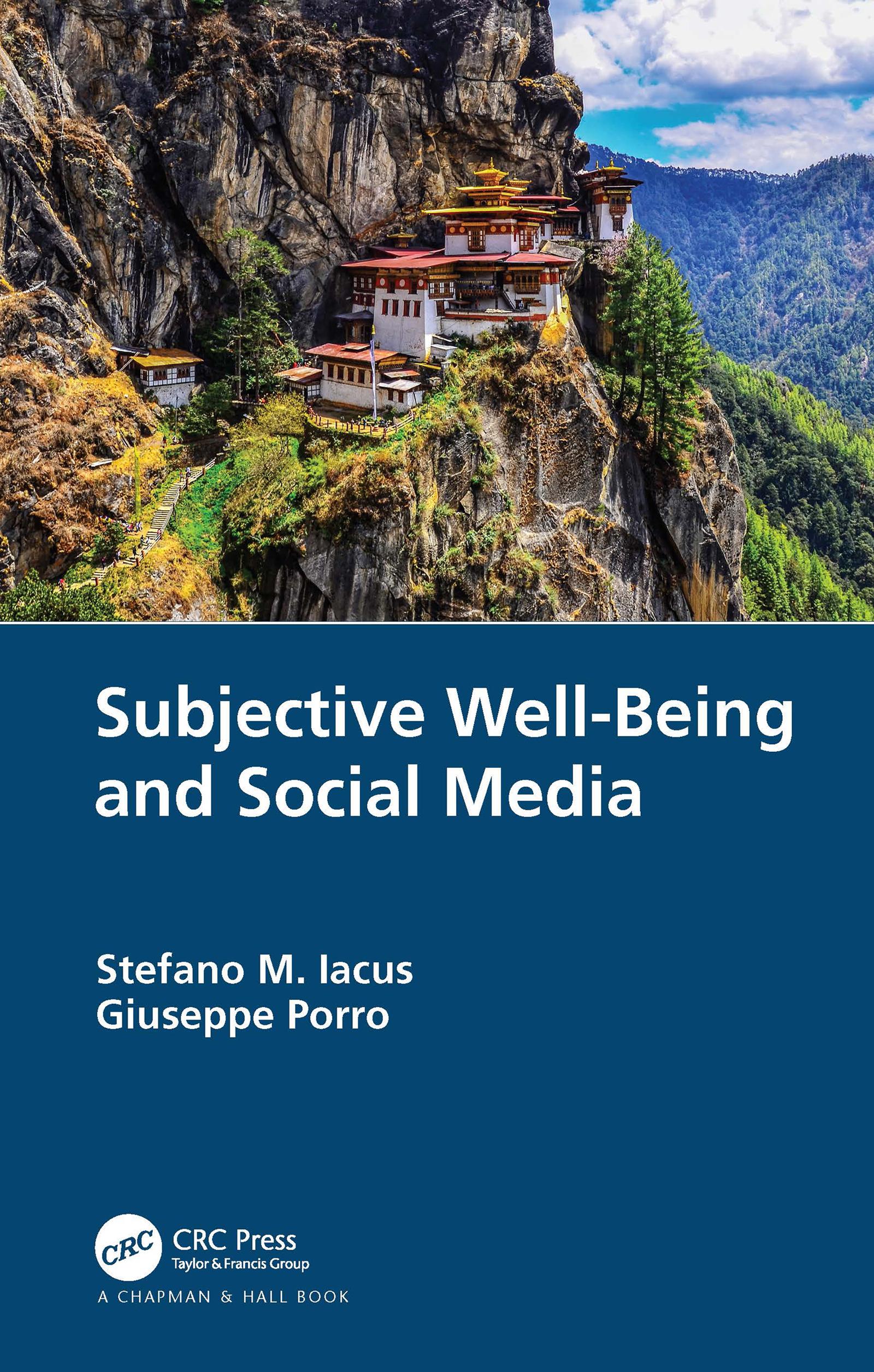
Subjective Well-Being and Social Media shows how, by exploiting the unprecedented amount of information provided by the social networking sites, it is possible to build new composite indicators of subjective well-being. These new social media indicators are complementary to official statistics and surveys, whose data are collected at very low temporary and geographical resolution.
The book also explains in full details how to solve the problem of selection bias coming from social media data. Mixing textual analysis, machine learning and time series analysis, the book also shows how to extract both the structural and the temporary components of subjective well-being.
Cross-country analysis confirms that well-being is a complex phenomenon that is governed by macroeconomic and health factors, ageing, temporary shocks and cultural and psychological aspects. As an example, the last part of the book focuses on the impact of the prolonged stress due to the COVID-19 pandemic on subjective well-being in both Japan and Italy. Through a data science approach, the results show that a consistent and persistent drop occurred throughout 2020 in the overall level of well-being in both countries.
The methodology presented in this book:
- enables social scientists and policy makers to know what people think about the quality of their own life, minimizing the bias induced by the interaction between the researcher and the observed individuals;
- being language-free, it allows for comparing the well-being perceived in different linguistic and socio-cultural contexts, disentangling differences due to objective events and life conditions from dissimilarities related to social norms or language specificities;
- provides a solution to the problem of selection bias in social media data through a systematic approach based on time-space small area estimation models.
The book comes also with replication R scripts and data.
Zahle einfach mit Karte, Klarna, Apple Pay oder Google Pay. Nicht zufrieden? Du hast immer ein 14-tägiges Widerrufsrecht. Lies mehr in unseren AGB. Hast du Fragen, schreib uns eine E-Mail an hello@memmo.org.
Memmo macht das Lernen einfacher – wo auch immer du bist. Bei uns findest du deine Kursbücher und smarte Lerntools an einem Ort: Zusammenfassungen, Quizzes, Podcasts und Lernkarten. Und Ted, dein Lernbuddy, beantwortet alles, was du wissen möchtest. Über 50.000 Studierende lernen bereits hier – gemacht, damit du schneller lernst und weniger Stress hast.