
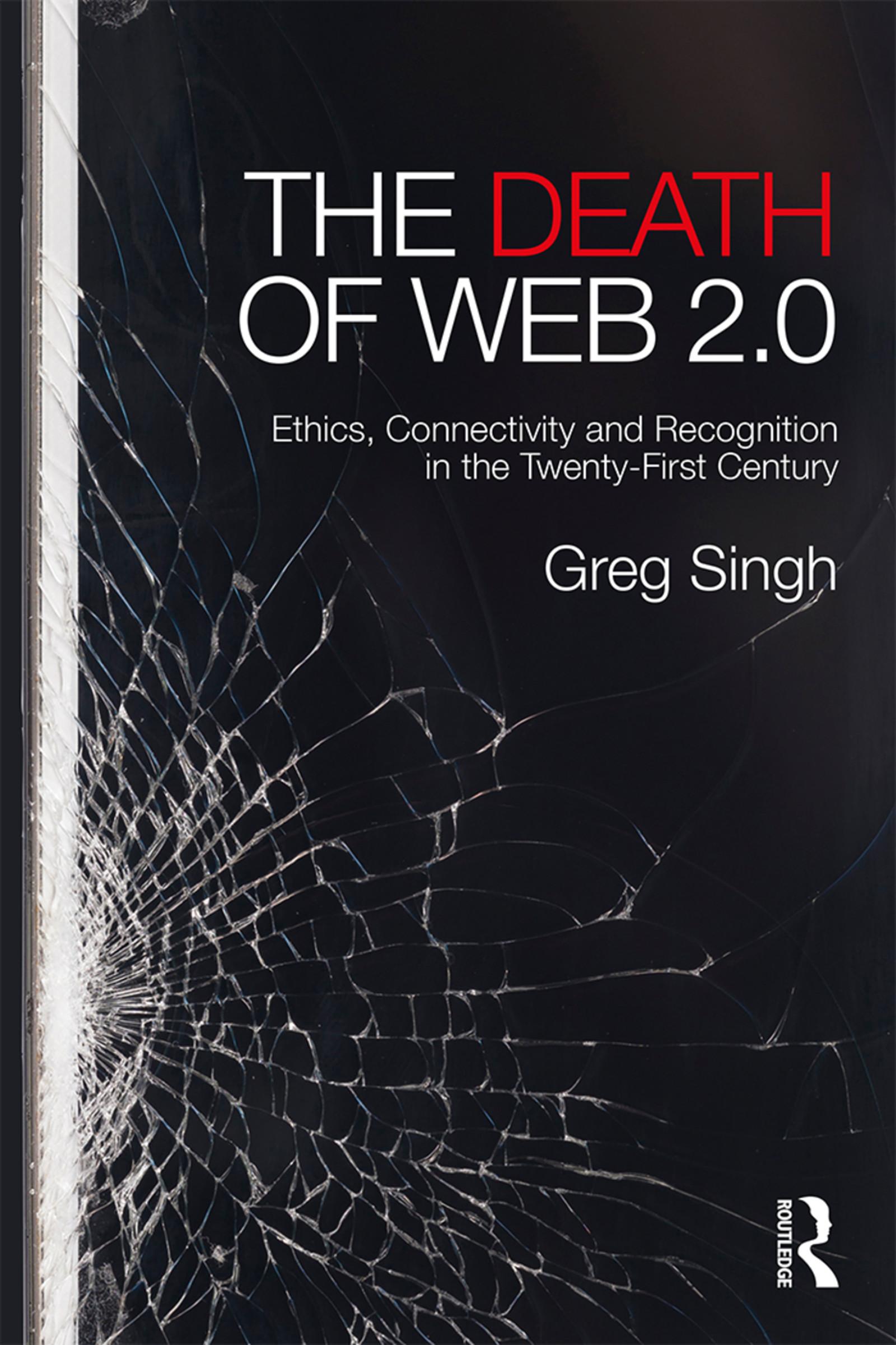
With all our contemporary connectivity, are we really connected? What does the nature of connectivity tell us about interpersonal and community relationships? What ethical concerns are raised through an always-on culture?
Communication in today’s world is characterised by a condition of persistent, semi-permanent connectivity, which seems to bring us closer together, but which can also be profoundly alienating. The Death of Web 2.0 takes a retrospective look at a moment in recent media history that has had, and will continue to have, a lasting impact upon the predominant attitude towards cultures of connectivity. Greg Singh draws from a range of approaches, intellectual traditions and scholarly disciplines to engage key questions underpinning the contemporary communications media ecosystem.
Bringing together influences from communitarian ethics, recognition theory and relational and depth psychology, Singh synthesises key approaches to produce a critical inquiry that projects the tensions at the heart of connectivity as a principle of Web 2.0. He argues that Web 2.0 is a cultural moment that is truly over, and that what is popularly described as 'Web 2.0' is an altogether different set of principles and practices. The Death of Web 2.0 recognises the consequences of our 'always-on' culture, where judgments are made quickly and where impacts can be far-reaching, affecting our relationships, wellbeing, mental health and the health of our communities, and it concludes by asking what an ethics of connectivity would look like.
This unique interdisciplinary work will be essential reading for academics and students of Jungian and post-Jungian studies, media and cultural studies and psychosocial studies as well as anyone interested in the social implications of new media.
Zahle einfach mit Karte, Klarna, Apple Pay oder Google Pay. Nicht zufrieden? Du hast immer ein 14-tägiges Widerrufsrecht. Lies mehr in unseren AGB. Hast du Fragen, schreib uns eine E-Mail an hello@memmo.org.
Memmo macht das Lernen einfacher – wo auch immer du bist. Bei uns findest du deine Kursbücher und smarte Lerntools an einem Ort: Zusammenfassungen, Quizzes, Podcasts und Lernkarten. Und Ted, dein Lernbuddy, beantwortet alles, was du wissen möchtest. Über 50.000 Studierende lernen bereits hier – gemacht, damit du schneller lernst und weniger Stress hast.