
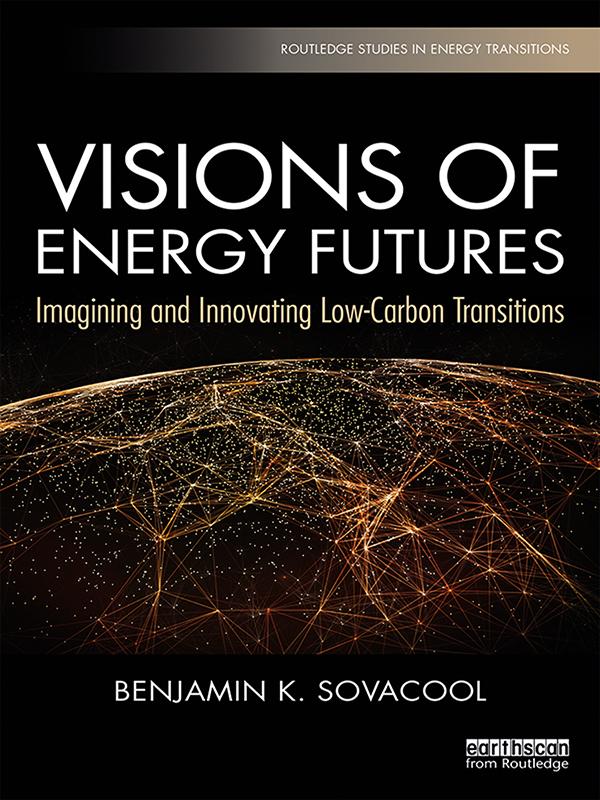
This book examines the visions, fantasies, frames, discourses, imaginaries, and expectations associated with six state-of-the-art energy systems—nuclear power, hydrogen fuel cells, shale gas, clean coal, smart meters, and electric vehicles—playing a key role in current deliberations about low-carbon energy supply and use.
Visions of Energy Futures: Imagining and Innovating Low-Carbon Transitions unveils what the future of energy systems could look like, and how their meanings are produced, often alongside moments of contestation. Theoretically, it analyzes these technological case studies with emerging concepts from various disciplines: utopianism (history of technology), symbolic convergence (communication studies), technological frames (social construction of technology), discursive coalitions (discourse analysis and linguistics), sociotechnical imaginaries (science and technology studies), and the sociology of expectations (innovation studies, future studies). It draws from these cases to create a synthetic set of dichotomies and frameworks for energy futures based on original data collected across two global epistemic communities— nuclear physicists and hydrogen engineers—and experts in Eastern Europe and the Nordic region, stakeholders in South Africa, and newspapers in the United Kingdom. This book is motivated by the premise that tackling climate change via low-carbon energy systems and practices is one of the most significant challenges of the twenty-first century, and that success will require not only new energy technologies, but also new ways of understanding language, visions, and discursive politics. The discursive creation of the energy systems of tomorrow are propagated in polity, hoping to be realized as the material fact of the future, but processed in conflicting ways with underlying tensions as to how contemporary societies ought to be ordered.
This book will be essential reading for students and scholars of energy policy, energy and environment, and technology assessment.
Zahle einfach mit Karte, Klarna, Apple Pay oder Google Pay. Nicht zufrieden? Du hast immer ein 14-tägiges Widerrufsrecht. Lies mehr in unseren AGB. Hast du Fragen, schreib uns eine E-Mail an hello@memmo.org.
Memmo macht das Lernen einfacher – wo auch immer du bist. Bei uns findest du deine Kursbücher und smarte Lerntools an einem Ort: Zusammenfassungen, Quizzes, Podcasts und Lernkarten. Und Ted, dein Lernbuddy, beantwortet alles, was du wissen möchtest. Über 50.000 Studierende lernen bereits hier – gemacht, damit du schneller lernst und weniger Stress hast.