
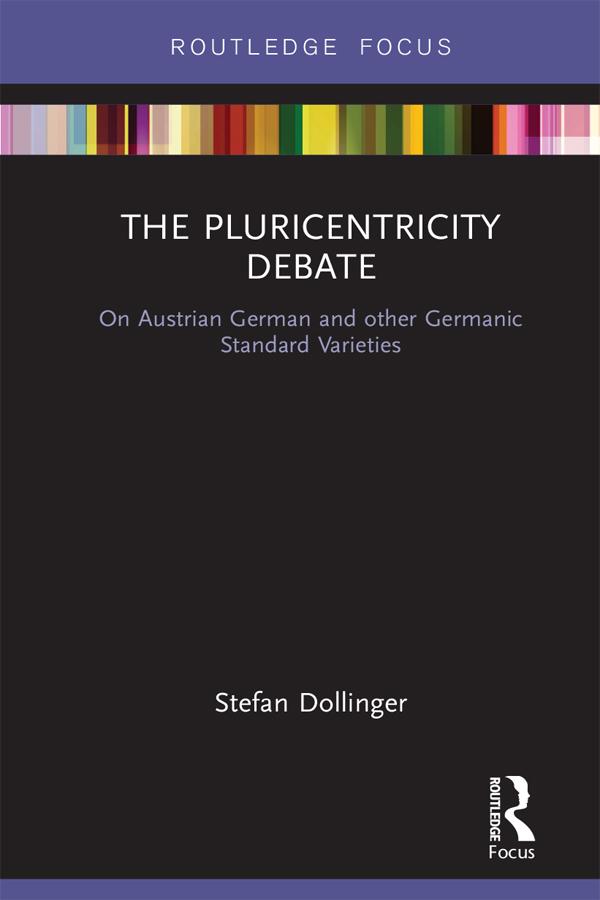
This book unpacks a 30-year debate about the pluricentricity of German. It examines the concept of pluricentricity, an idea implicit to the study of World Englishes, which expressly allows for national standard varieties, and the notion of "pluri-areality," which seeks to challenge the former. Looking at the debate from three angles – methodological, theoretical, and epistemological – the volume draws on data from German and English, with additional perspectives from Dutch, Luxembourgish, Swedish, Danish and Norwegian, to establish if and to what degree "pluri-areality" and pluricentricity model various sociolinguistic situations adequately. Dollinger argues that "pluri-areality" is synonymous with "geographical variation" and, as such, no match for pluricentricity. Instead, "pluri-areality" presupposes an atheoretical, supposedly "neutral", data-driven linguistics that violates basic science-theoretical principles. Three fail-safes are suggested – the uniformitarian hypothesis, Popper’s theory of falsification and speaker attitudes – to avoid philological incompatibilities and terminological clutter. This book is of particular interest to scholars in sociolinguistics, World Englishes, Germanic languages and linguists more generally.
Zahle einfach mit Karte, Klarna, Apple Pay oder Google Pay. Nicht zufrieden? Du hast immer ein 14-tägiges Widerrufsrecht. Lies mehr in unseren AGB. Hast du Fragen, schreib uns eine E-Mail an hello@memmo.org.
Memmo macht das Lernen einfacher – wo auch immer du bist. Bei uns findest du deine Kursbücher und smarte Lerntools an einem Ort: Zusammenfassungen, Quizzes, Podcasts und Lernkarten. Und Ted, dein Lernbuddy, beantwortet alles, was du wissen möchtest. Über 50.000 Studierende lernen bereits hier – gemacht, damit du schneller lernst und weniger Stress hast.