
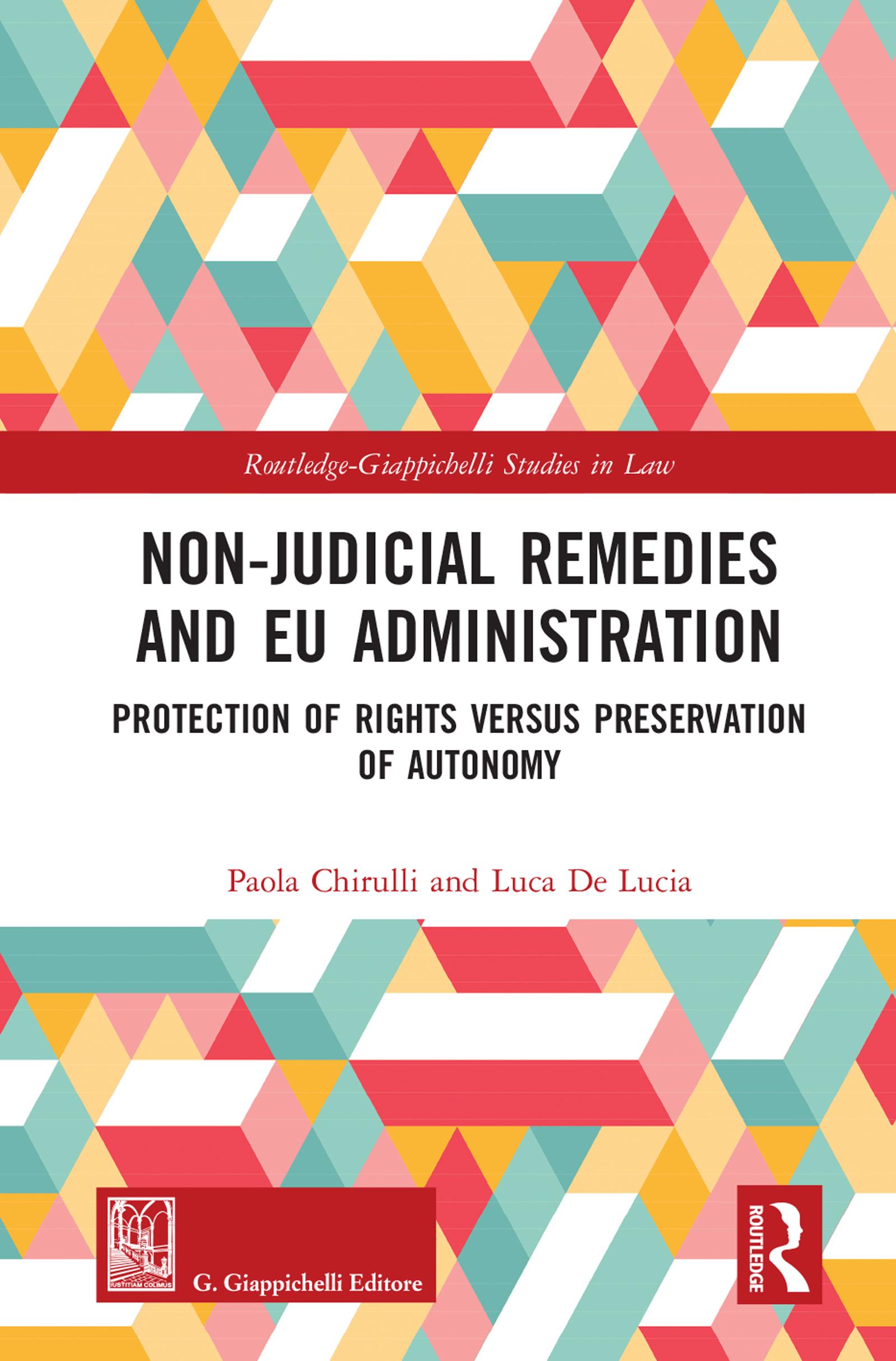
The increasing number of executive tasks assigned to EU institutions and agencies has resulted in a greater demand for justice that can no longer be satisfied by the courts alone. This has led to the development of a wide range of administrative remedies that have become a central part of the EU administrative justice system. This book examines the important theoretical and practical issues raised by this phenomenon.
The work focuses on five administrative remedies: internal review; administrative appeals to the Commission against decisions of executive and decentralised agencies; independent administrative review of decisions of decentralised agencies; complaints to the EU Ombudsman; and complaints to the EU Data Protection Supervisor. The research rests on the idea that there is a complex, and at times ambivalent, relationship between administrative remedies and the varying degrees of autonomy of EU institutions and bodies, offices and agencies. The work draws on legislation, internal rules of executive bodies, administrative practices and specific case law, data and statistics. This empirical approach helps to unveil the true dynamics present within these procedures and demonstrates that whilst administrative remedies may improve the relationship between individuals and the EU administration, their interplay with administrative autonomy might lead to a risk of fragmentation and incoherence in the EU administrative justice system.
Zahle einfach mit Karte, Klarna, Apple Pay oder Google Pay. Nicht zufrieden? Du hast immer ein 14-tägiges Widerrufsrecht. Lies mehr in unseren AGB. Hast du Fragen, schreib uns eine E-Mail an hello@memmo.org.
Memmo macht das Lernen einfacher – wo auch immer du bist. Bei uns findest du deine Kursbücher und smarte Lerntools an einem Ort: Zusammenfassungen, Quizzes, Podcasts und Lernkarten. Und Ted, dein Lernbuddy, beantwortet alles, was du wissen möchtest. Über 50.000 Studierende lernen bereits hier – gemacht, damit du schneller lernst und weniger Stress hast.