
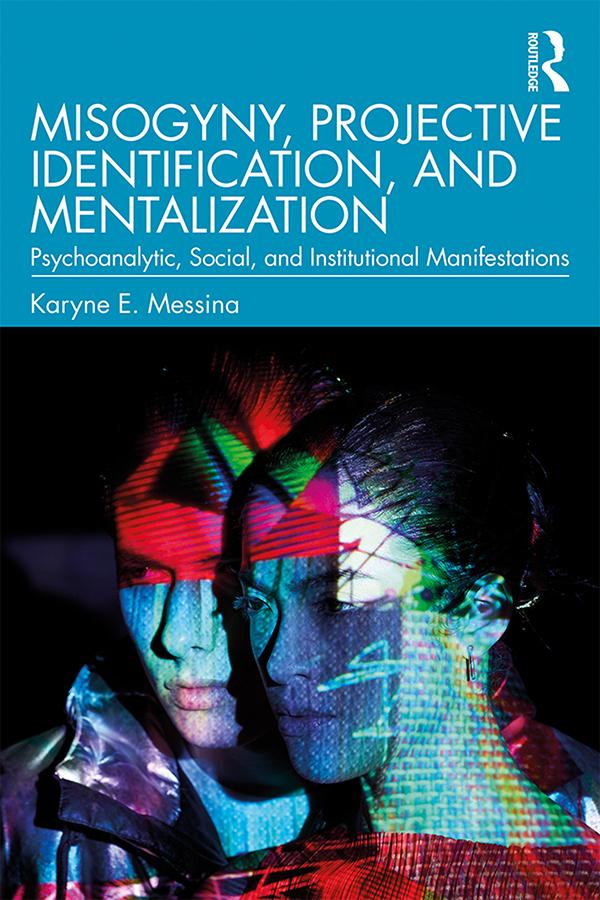
Misogyny, Projective Identification, and Mentalization looks at how the psychoanalytic concepts of projective identification and mentalization may explain the construction of society and how they have enabled misogyny to be expressed in social, political, and institutional settings. Karyne E. Messina explores how misogyny has affected the perception and treatment of women through analysis of a range of examples of individual women and groups.
The first part explores projective identification as a mechanism for the suppression of women, looking at the origins of the concept in psychoanalysis and its expansion. The author examines the story of Clara Thompson as an example, arguing that her virtual disappearance from the history of psychiatry and psychoanalysis itself is a telling example of this process at work. The second part of the book uses four examples of individuals, including the recent election loss by Hillary Clinton in 2016, to show that projective identification can (particularly in political and cultural settings) overtake and motivate groups as well as individuals, and lead to violence, atrocity, humiliation, and dismissal of and against women. Part three then features case studies of four groups of women from the 20th century, including victims of the 1994 Rwandan genocide, showing how projective identification against groups has occurred.
With specific reference to the erasure of women’s contributions in society, both individually and collectively, and the trauma that arises from the many effects of regarding women as a group as "less" or "other", this is a book which sets a new agenda for understanding how misogyny is expressed socially. Misogyny, Projective Identification, and Mentalization will be of interest to psychoanalysts and psychoanalytic psychotherapists as well as scholars of politics, gender, and cultural studies.
Zahle einfach mit Karte, Klarna, Apple Pay oder Google Pay. Nicht zufrieden? Du hast immer ein 14-tägiges Widerrufsrecht. Lies mehr in unseren AGB. Hast du Fragen, schreib uns eine E-Mail an hello@memmo.org.
Memmo macht das Lernen einfacher – wo auch immer du bist. Bei uns findest du deine Kursbücher und smarte Lerntools an einem Ort: Zusammenfassungen, Quizzes, Podcasts und Lernkarten. Und Ted, dein Lernbuddy, beantwortet alles, was du wissen möchtest. Über 50.000 Studierende lernen bereits hier – gemacht, damit du schneller lernst und weniger Stress hast.