
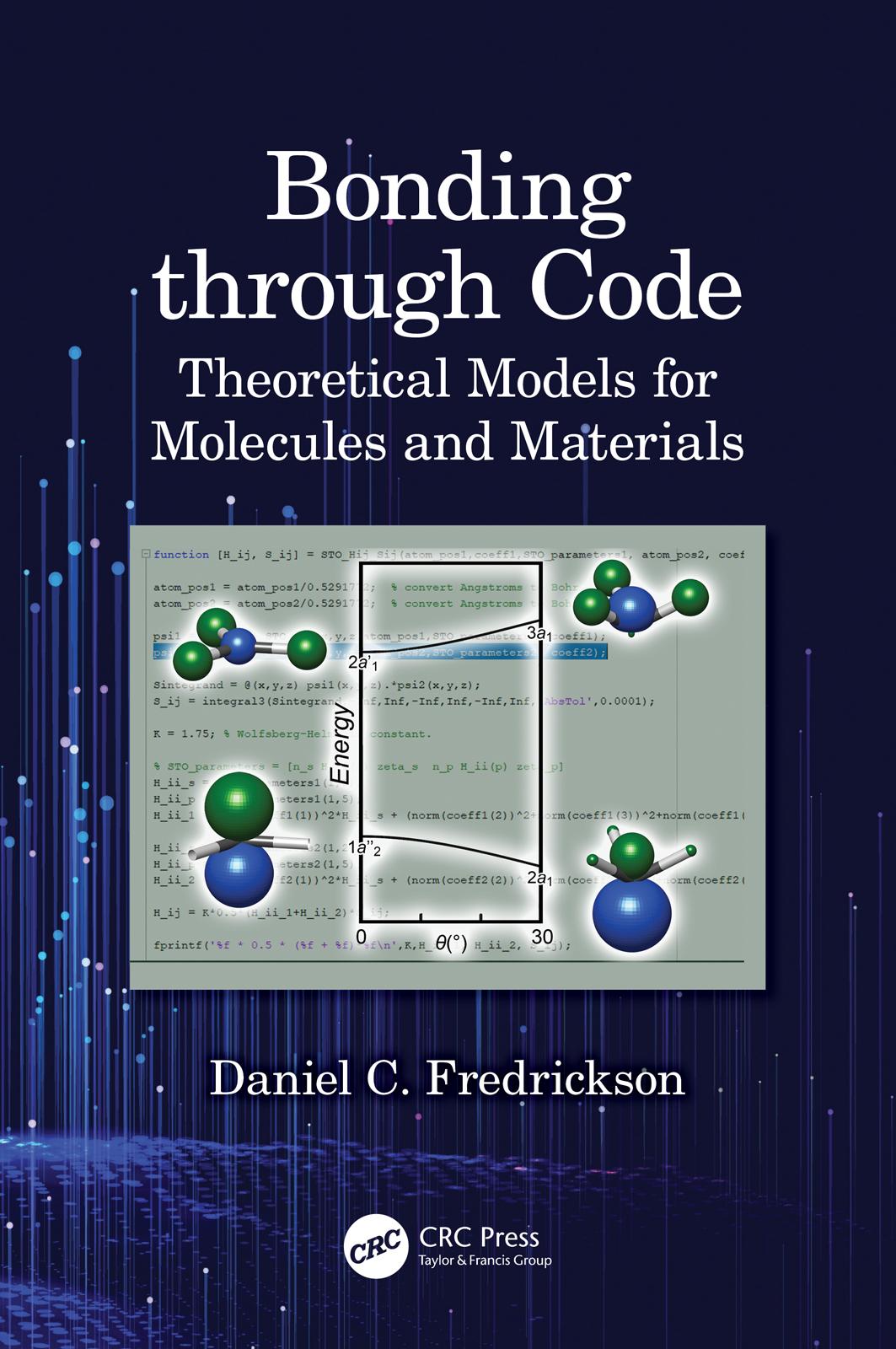
This timely and unique publication is designed for graduate students and researchers in inorganic and materials chemistry and covers bonding models and applications of symmetry concepts to chemical systems. The book discusses the quantum mechanical basis for molecular orbital concepts, the connections between molecular orbitals and localized views of bonding, group theory, bonding models for a variety of compounds, and the extension of these ideas to solid state materials in band theory. Unlike other books, the concepts are made tangible to the readers by guiding them through their implementation in MATLAB functions. No background in MATLAB or computer programming is needed; the book will provide the necessary skills.
Key Features
- Visualization of the Postulates of Quantum Mechanics to build conceptual understanding
- MATLAB functions for rendering molecular geometries and orbitals
- Do-it-yourself approach to building a molecular orbital and band theory program
- Introduction to Group Theory harnessing the 3D graphing capabilities of MATLAB
- Online access to a growing collection of applications of the core material and other appendices
Bonding through Code is ideal for first-year graduate students and advanced undergraduates in chemistry, materials science, and physics. Researchers wishing to gain new tools for theoretical analysis or deepen their understanding of bonding phenomena can also benefit from this text.
About the Author
Daniel Fredrickson is a Professor in the Department of Chemistry at the University of Wisconsin–Madison, where his research group focuses on understanding and harnessing the structural chemistry of intermetallic phases using a combination of theory and experiment. His interests in crystals, structure, and bonding can be traced to his undergraduate research at the University of Washington (B.S. in Biochemistry, 2000) with Prof. Bart Kahr, his Ph.D. studies at Cornell University (2000–2005) with Profs. Stephen Lee and Roald Hoffmann, and his post-doctoral work with Prof. Sven Lidin at Stockholm University (2005–2008). As part of his teaching at UW–Madison since 2009, he has worked to enhance his department’s graduate course, Physical Inorganic Chemistry I: Symmetry and Bonding, through the incorporation of new material and the development of computer-based exercises.
Zahle einfach mit Karte, Klarna, Apple Pay oder Google Pay. Nicht zufrieden? Du hast immer ein 14-tägiges Widerrufsrecht. Lies mehr in unseren AGB. Hast du Fragen, schreib uns eine E-Mail an hello@memmo.org.
Memmo macht das Lernen einfacher – wo auch immer du bist. Bei uns findest du deine Kursbücher und smarte Lerntools an einem Ort: Zusammenfassungen, Quizzes, Podcasts und Lernkarten. Und Ted, dein Lernbuddy, beantwortet alles, was du wissen möchtest. Über 50.000 Studierende lernen bereits hier – gemacht, damit du schneller lernst und weniger Stress hast.