
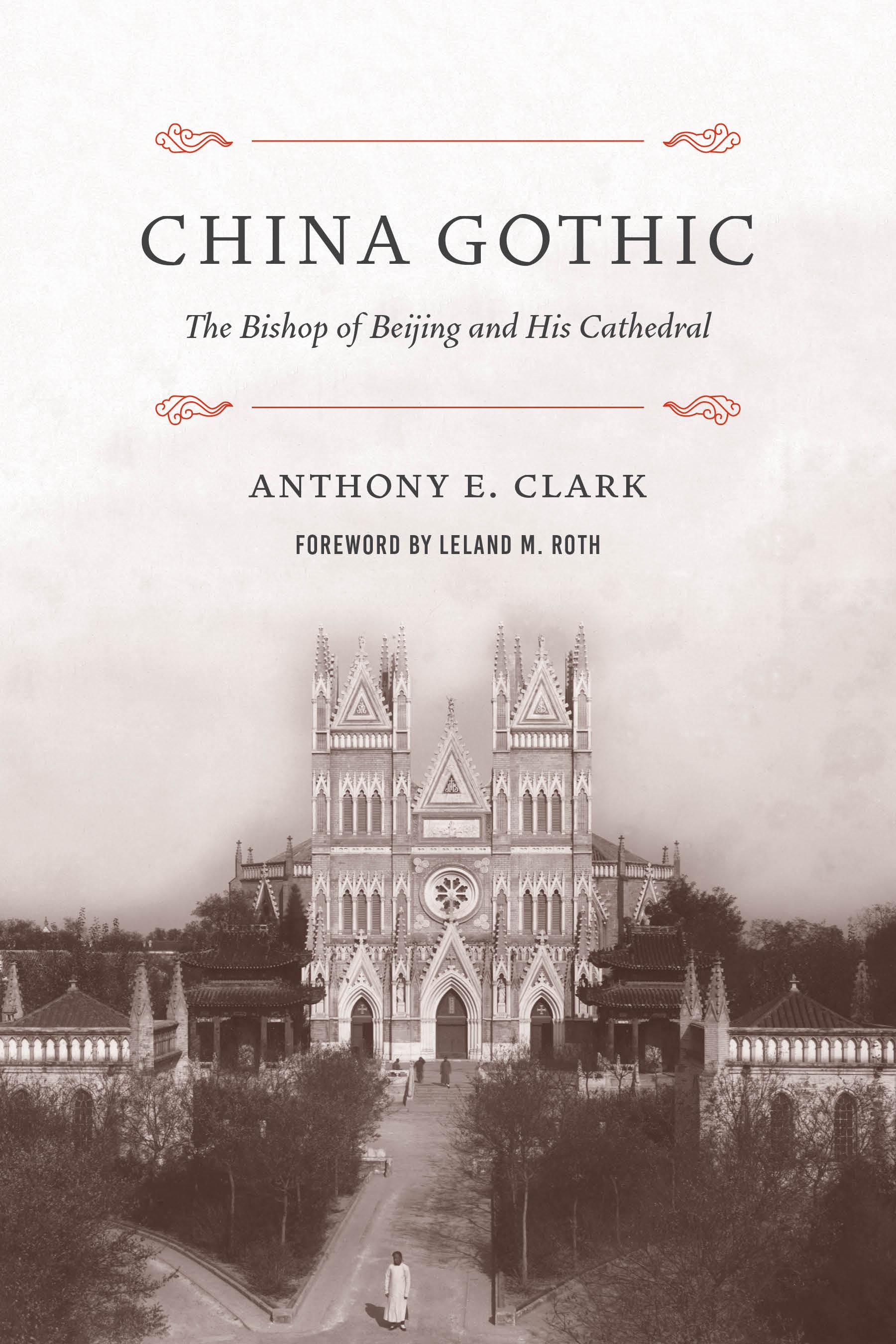
As China struggled to redefine itself at the turn of the twentieth century, nationalism, religion, and material culture intertwined in revealing ways. This phenomenon is evident in the twin biographies of North China’s leading Catholic bishop of the time, Alphonse Favier (1837–1905), and the Beitang cathedral, epicenter of the Roman Catholic mission in China through incarnations that began in 1701. After its relocation and reconstruction under Favier’s supervision, the cathedral—and Favier—miraculously survived a two-month siege in 1900 during the Boxer Rebellion. Featuring a French Gothic Revival design augmented by Chinese dragon–shaped gargoyles, marble balustrades in the style of Daoist and Buddhist temples, and other Chinese aesthetic flourishes, Beitang remains an icon of Sino-Western interaction.
Anthony Clark draws on archival materials from the Vatican and collections in France, Italy, China, Poland, and the United States to trace the prominent role of French architecture in introducing Western culture and Catholicism to China. A principal device was the aesthetic imagined by the Gothic Revival movement of the eighteenth and nineteenth centuries, the premier example of this in China being the Beitang cathedral. Bishop Favier’s biography is a lens through which to examine Western missionaries’ role in colonial endeavors and their complex relationship with the Chinese communities in which they lived and worked.
Zahle einfach mit Karte, Klarna, Apple Pay oder Google Pay. Nicht zufrieden? Du hast immer ein 14-tägiges Widerrufsrecht. Lies mehr in unseren AGB. Hast du Fragen, schreib uns eine E-Mail an hello@memmo.org.
Memmo macht das Lernen einfacher – wo auch immer du bist. Bei uns findest du deine Kursbücher und smarte Lerntools an einem Ort: Zusammenfassungen, Quizzes, Podcasts und Lernkarten. Und Ted, dein Lernbuddy, beantwortet alles, was du wissen möchtest. Über 50.000 Studierende lernen bereits hier – gemacht, damit du schneller lernst und weniger Stress hast.