
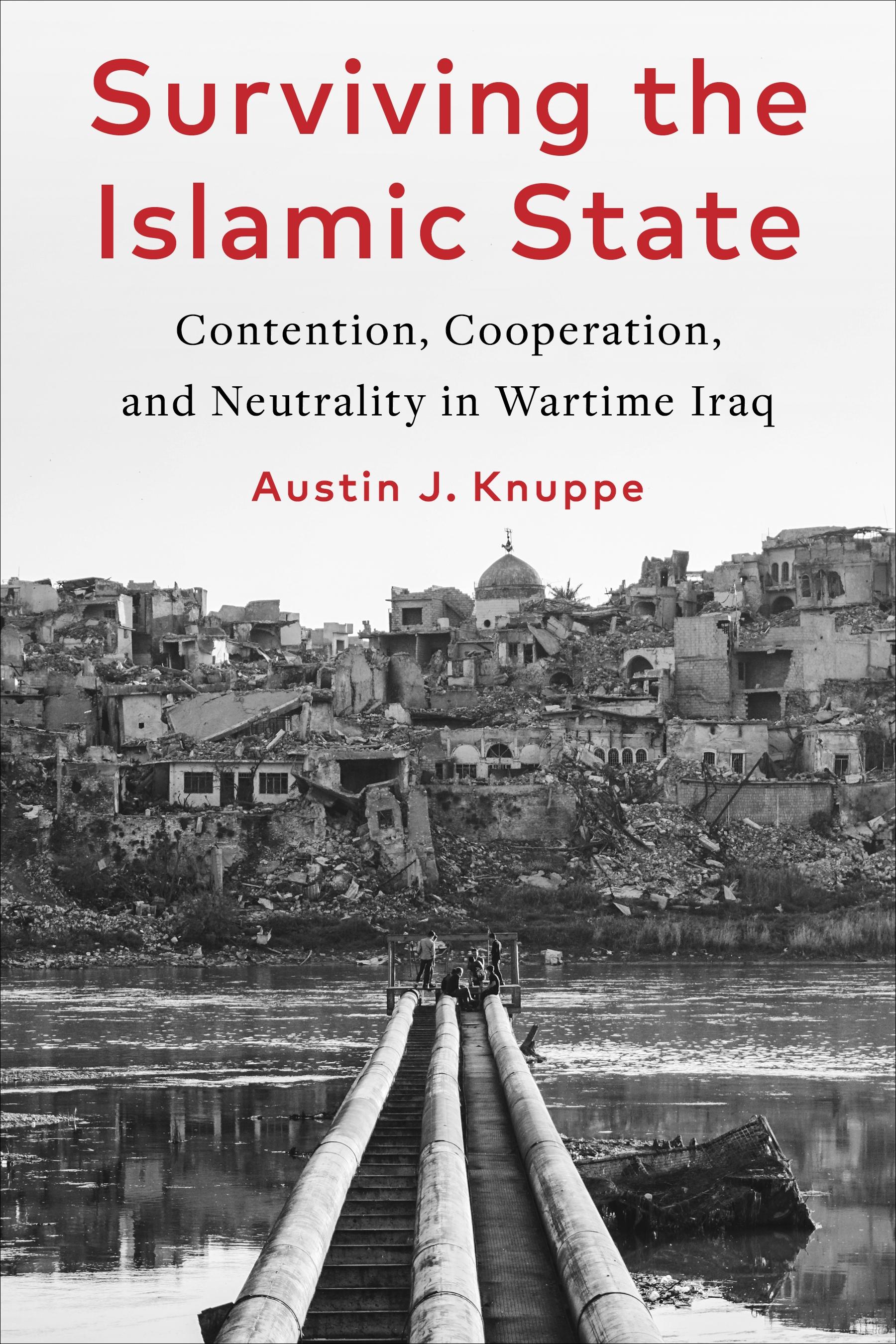
How did ordinary Iraqis survive the occupation of their communities by the Islamic State? How did they decide whether to stay or flee, to cooperate or resist? Based on an original survey from Baghdad alongside key interviews in the field, this book offers an insightful account of how Iraqis in different areas of the country responded to the rise and fall of the Islamic State.
Austin J. Knuppe argues that people adopt survival repertoires—a variety of social practices, tools, organized routines, symbols, and rhetorical strategies—to navigate wartime violence and detect threats. He traces how repertoires varied among different communities over the course of the conflict. In areas insulated from insurgent control, such as cosmopolitan Baghdad, local residents had the flexibility to support coalition forces while also voicing opposition to government policies. For Iraqis in rural communities confronting insurgent control, collaboration and resistance entailed significant risks. In Sunni-majority communities in the western desert, passive acquiescence and active cooperation temporarily insulated Iraqis from insurgent victimization. For ethnic and religious minorities in the north, however, flight or resistance proved the only viable options. In many communities, local residents mobilized neighborhood self-defense groups and militias loosely aligned with coalition forces once the tides turned against the Islamic State.
Beyond contributing to academic and policy debates about civilian protection during wartime, Surviving the Islamic State foregrounds everyday people’s experiences while modeling an ethical approach for conducting field research in conflict-affected communities.
Zahle einfach mit Karte, Klarna, Apple Pay oder Google Pay. Nicht zufrieden? Du hast immer ein 14-tägiges Widerrufsrecht. Lies mehr in unseren AGB. Hast du Fragen, schreib uns eine E-Mail an hello@memmo.org.
Memmo macht das Lernen einfacher – wo auch immer du bist. Bei uns findest du deine Kursbücher und smarte Lerntools an einem Ort: Zusammenfassungen, Quizzes, Podcasts und Lernkarten. Und Ted, dein Lernbuddy, beantwortet alles, was du wissen möchtest. Über 50.000 Studierende lernen bereits hier – gemacht, damit du schneller lernst und weniger Stress hast.