
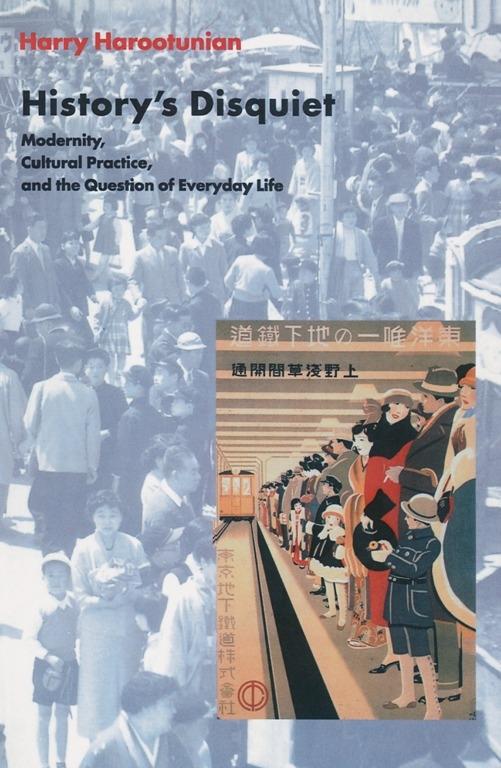
Acclaimed historian Harry Harootunian calls attention to the boundaries, real and theoretical, that compartmentalize the world around us. In one of the first works to explore on equal footing European and Japanese conceptions of modernity—as imagined in the writings of Georg Simmel and Walter Benjamin, as well as ethnologist Yanagita Kunio and Marxist philosopher Tosaka Jun—Harootunian seeks to expose the problematic nature of scholarly categories. In doing so, History's Disquiet presents intellectual genealogies of such orthodox notions as "field" and "modernity" and other concepts intellectuals in the East and West have used to understand the changing world around them. Contrasting reflections on everyday life in Japan and Europe, Harootunian shows how responses to capitalist society were expressed in similar ways: social critics in both regions alleged a broad sense of alienation, particularly among the middle class. However, he also points out that Japanese critics viewed modernity as a condition in which Japan—without the lengthy period of capitalist modernization that characterized Europe and America—was either "catching up" with those regions or "copying" them.
As elegantly written as it is controversial, this book is both an invitation for rethinking intellectual boundaries and an invigorating affirmation that such boundaries can indeed be broken down.
Zahle einfach mit Karte, Klarna, Apple Pay oder Google Pay. Nicht zufrieden? Du hast immer ein 14-tägiges Widerrufsrecht. Lies mehr in unseren AGB. Hast du Fragen, schreib uns eine E-Mail an hello@memmo.org.
Memmo macht das Lernen einfacher – wo auch immer du bist. Bei uns findest du deine Kursbücher und smarte Lerntools an einem Ort: Zusammenfassungen, Quizzes, Podcasts und Lernkarten. Und Ted, dein Lernbuddy, beantwortet alles, was du wissen möchtest. Über 50.000 Studierende lernen bereits hier – gemacht, damit du schneller lernst und weniger Stress hast.