
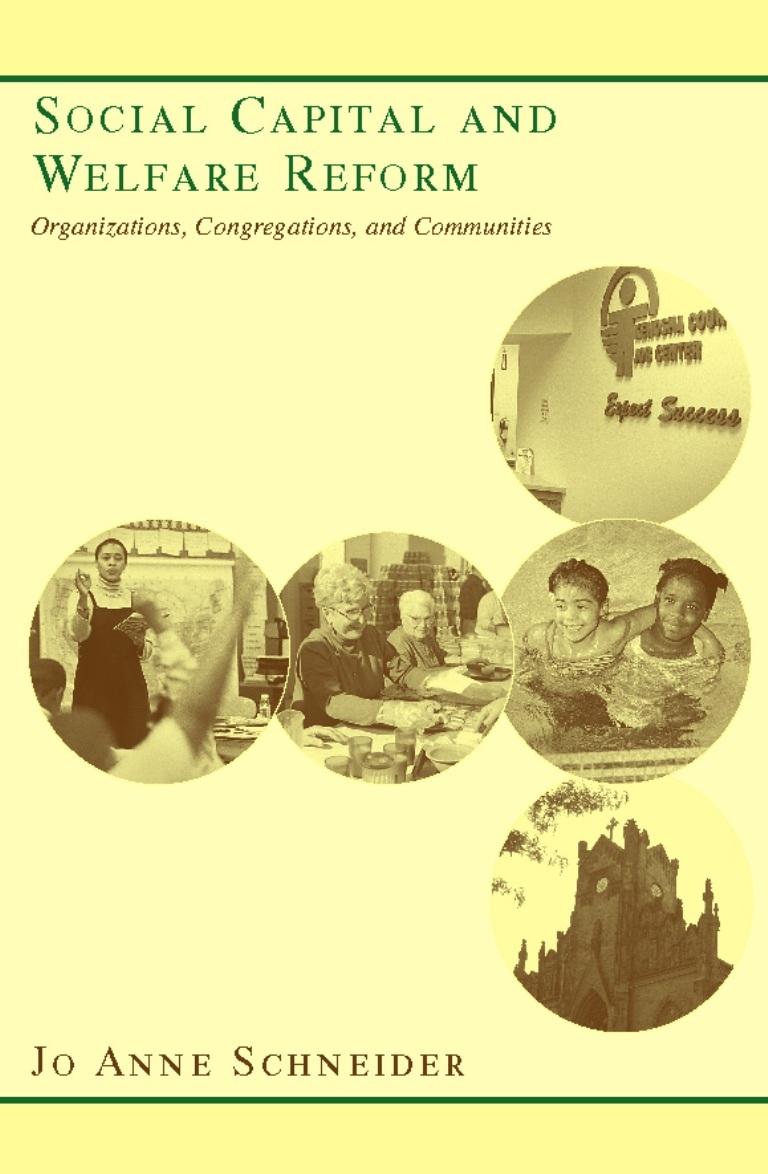
In this groundbreaking study, Jo Anne Schneider considers the reasons behind the limited success of most welfare reform initiatives and offers evidence-based recommendations for enhancing the effectiveness of welfare policy.
Schneider draws on her rich and nuanced ethnographic studies of Philadelphia, Milwaukee, and Kenosha, Wisconsin to clarify the role of social capital for both individuals and institutions. She shows that the social relationships and patterns of trust that enable people to gain access to resources like government services, organization funding, and jobs are crucial in helping families achieve their goals. Schneider examines the complex ways in which social capital functions in conjunction with economic, human, and cultural capital, and explores social capital dynamics among government, nonprofits, and congregations that together provide the welfare support system.
Social Capital and Welfare Reform is compulsory reading for researchers and students in social work, sociology, anthropology, public policy, education, community psychology, social psychiatry, and non-profit and public administration as well as policy makers interested in welfare reform, poverty, and nonprofits.
Zahle einfach mit Karte, Klarna, Apple Pay oder Google Pay. Nicht zufrieden? Du hast immer ein 14-tägiges Widerrufsrecht. Lies mehr in unseren AGB. Hast du Fragen, schreib uns eine E-Mail an hello@memmo.org.
Memmo macht das Lernen einfacher – wo auch immer du bist. Bei uns findest du deine Kursbücher und smarte Lerntools an einem Ort: Zusammenfassungen, Quizzes, Podcasts und Lernkarten. Und Ted, dein Lernbuddy, beantwortet alles, was du wissen möchtest. Über 50.000 Studierende lernen bereits hier – gemacht, damit du schneller lernst und weniger Stress hast.