
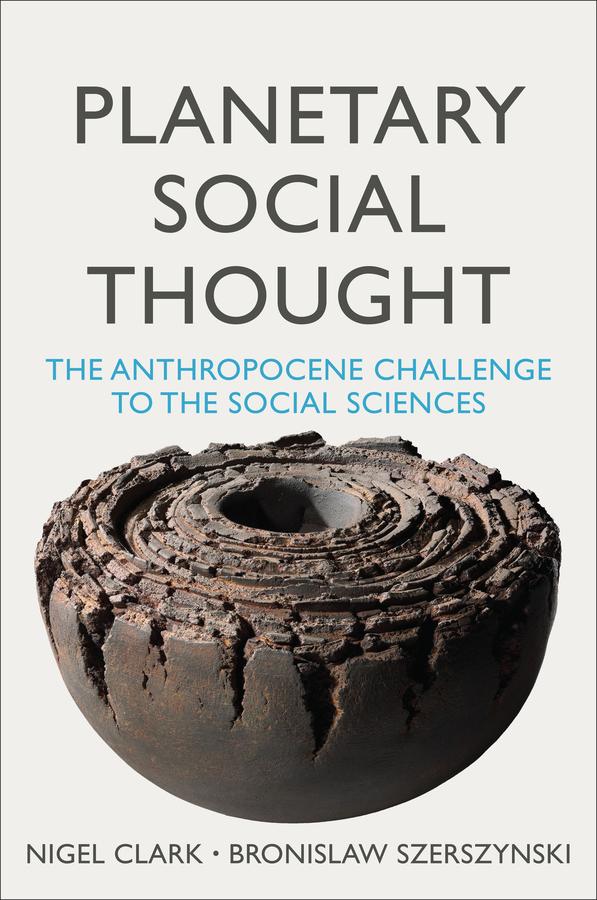
The Anthropocene has emerged as perhaps the scientific concept of the new millennium. Going further than earlier conceptions of the human–environment relationship, Anthropocene science proposes that human activity is tipping the whole Earth system into a new state, with unpredictable consequences. Social life has become a central ingredient in the dynamics of the planet itself.
How should the social sciences respond to the opportunities and challenges posed by this development? In this innovative book, Clark and Szerszynski argue that social thinkers need to revise their own presuppositions about the social: to understand it as the product of a dynamic planet, self-organizing over deep time. They outline ‘planetary social thought’: a transdisciplinary way of thinking social life with and through the Earth. Using a range of case studies, they show how familiar social processes can be radically recast when looked at through a planetary lens, revealing how the world-transforming powers of human social life have always depended on the forging of relations with the inhuman potentialities of our home planet.
Presenting a social theory of the planetary, this book will be essential reading for students and scholars interested in humanity’s relation to the changing Earth.
Betal nemt med kort, Klarna, Apple Pay eller Google Pay. Ikke tilfreds? Du har altid 14 dages fortrydelsesret. Læs mere i vores vilkår. Har du spørgsmål, så send os en mail på hello@memmo.org.
Memmo gør det nemmere at studere – uanset hvor du er i verden. Hos os samler du dine kursusbøger og smarte studieværktøjer ét sted: resuméer, quizzer, podcasts og flashcards. Og så er der Ted, din studieven, der svarer på alt, du undrer dig over. Over 50 000 studerende studerer allerede her – bygget til at hjælpe dig med at lære hurtigere og stresse mindre.