
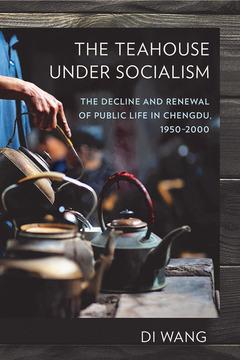
To understand a city fully, writes Di Wang, we must observe its most basic units of social life. In The Teahouse under Socialism, Wang does just that, arguing that the teahouses of Chengdu, the capital of Sichuan Province, are some of the most important public spaces—perfect sites for examining the social and economic activities of everyday Chinese.
Wang looks at the transformation of these teahouses from private businesses to collective ownership and how state policy and the proprietors' response to it changed the overall economic and social structure of the city. He uses this transformation to illuminate broader trends in China's urban public life from 1950 through the end of the Cultural Revolution and into the post-Mao reform era. In doing so, The Teahouse under Socialism charts the fluctuations in fortune of this ancient cultural institution and analyzes how it survived, and even thrived, under bleak conditions.
Throughout, Wang asks such questions as: Why and how did state power intervene in the operation of small businesses? How was "socialist entertainment" established in a local society? How did the well-known waves of political contestation and struggle in China change Chengdu's teahouses and public life? In the end, Wang argues, the answers to such questions enhance our understanding of public life and political culture in the Communist state.
Betal nemt med kort, Klarna, Apple Pay eller Google Pay. Ikke tilfreds? Du har altid 14 dages fortrydelsesret. Læs mere i vores vilkår. Har du spørgsmål, så send os en mail på hello@memmo.org.
Memmo gør det nemmere at studere – uanset hvor du er i verden. Hos os samler du dine kursusbøger og smarte studieværktøjer ét sted: resuméer, quizzer, podcasts og flashcards. Og så er der Ted, din studieven, der svarer på alt, du undrer dig over. Over 50 000 studerende studerer allerede her – bygget til at hjælpe dig med at lære hurtigere og stresse mindre.